
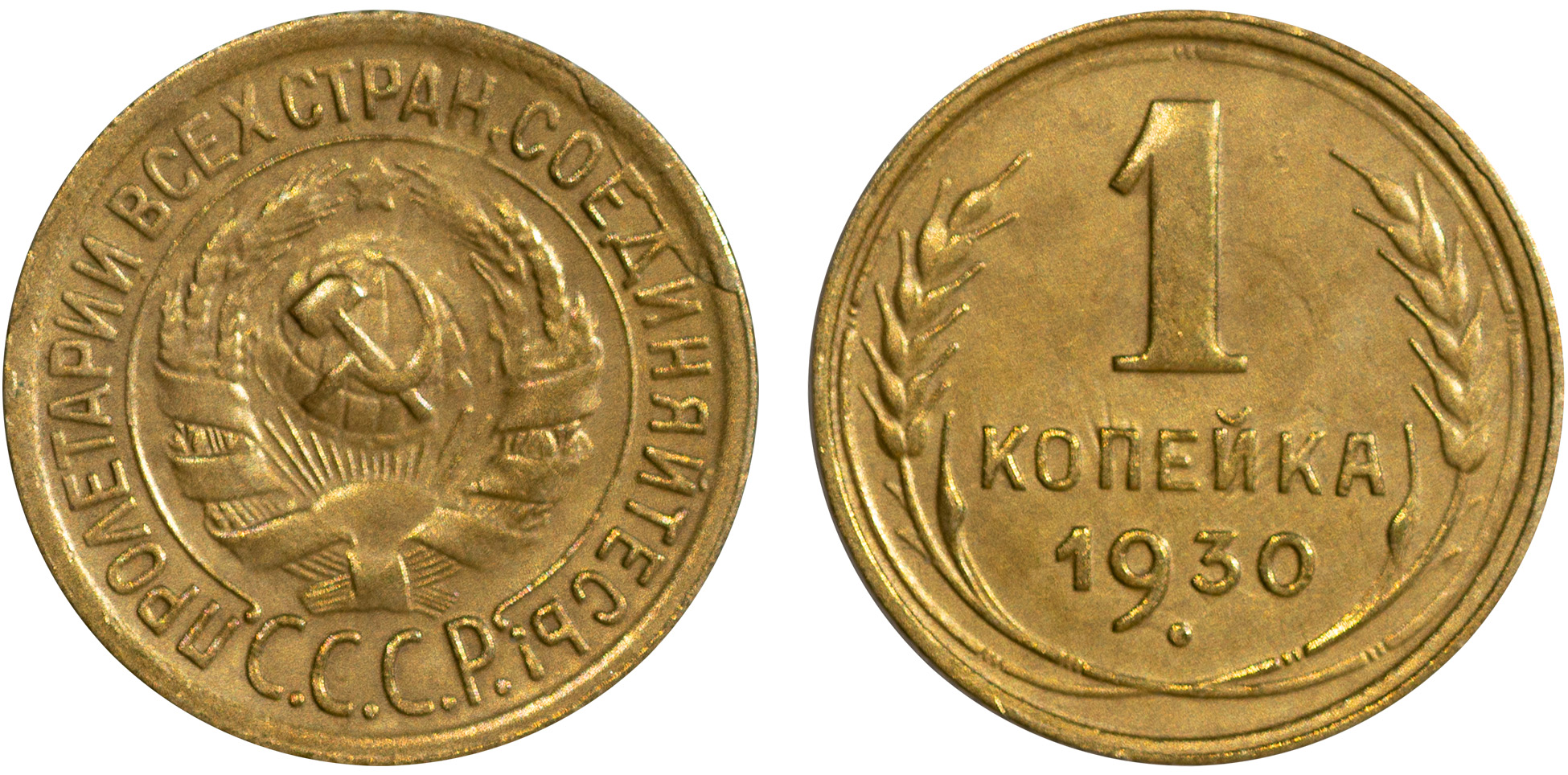
On March 2, 1930, the newspaper Pravda published Stalin’s article “Dizzy with Success,” about the “excesses at the local level” committed during collectivization.
In it, Stalin condemned numerous violations of the principle of voluntariness in organizing collective farms.
He criticized excessive “overzealousness” in the campaign of dekulakization, whose victims included many middle peasants. All responsibility for the mistakes made was placed on the local leadership. It must be said that the task of collectivization was carried out through the dekulakization not only of kulaks but also of middle peasants. Violence was the main method of forcing people into collective farms. The peasantry responded with mass dissatisfaction and open protests. Faced with what was in effect an unfolding civil war, the Stalinist leadership decided to maneuver. The so-called “excesses” were condemned; it was proposed to revise the attitude toward the middle peasant; and in certain regions, as a temporary measure, the resettlement of kulaks was allowed to be halted for the duration of the sowing season. The expression “dizzy with success” became a set phrase in the Russian language. It should be noted that only two years after the publication of this article, the famous “Law of the Spikelets” was adopted, which for theft of collective-farm and cooperative property provided for execution with confiscation of property, and under mitigating circumstances could be replaced by imprisonment for a term of no less than 10 years with confiscation of property.
As a “measure of judicial repression in cases concerning the protection of collective farms and collective farmers from violence and threats by kulak elements,” imprisonment for a term of 5 to 10 years with confinement in the GULAG was предусмотрено. Those convicted under this law were not subject to amnesty. The law was often applied in cases that posed no social danger at all. It received the name “Law of the Spikelets” because peasants were convicted under it for, due to hunger, cutting unripe ears of grain from a collective-farm or state-farm field.
On February 18, 1930, after nearly a year of work, Clyde Tombaugh discovered a possibly moving object on photographs from January 23 and 29. On March 13, 1930, after the observatory received other confirming photographs, news of the discovery was telegraphed to the Harvard College Observatory. Its existence had been theoretically predicted by the American astronomer Percival Lowell in 1915. The right to name the new celestial body belonged to the Lowell Observatory. Name suggestions began arriving from all over the world. The name “Pluto” was first proposed by Venetia Burney, an eleven-year-old schoolgirl from Oxford.
She was interested not only in astronomy but also in classical mythology, and decided that this name—the ancient Roman version of the name of the Greek god of the underworld—suited such a presumably dark and cold world. The object officially received its name on March 24, 1930. And 76 years later, on August 24, 2006, at the assembly of the International Astronomical Union held in Prague, Pluto was stripped of its status as a planet of the Solar System.
It is now only a “dwarf planet.” After a week of discussions, 2,500 astronomers representing 75 countries approved by vote the criteria a celestial body must meet to obtain planet status. According to the new definition, planet status is assigned to a “celestial body that moves in an orbit around the Sun that is exclusive to that celestial body, and has sufficient mass to form a gravitational field, as a result of which the celestial body assumes a spherical shape.” After Pluto’s exclusion from the list of planets, the name is reserved for only 8 celestial bodies: Mercury, Venus, Earth, Mars, Jupiter, Saturn, Uranus, and Neptune. According to the new classification, Pluto now belongs to the category of minor planets, or planetoids.
On May 27, 1930, Richard Drew patented his invention: transparent adhesive tape. In 1923, Richard Drew took a job at Minnesota Mining and Manufacturing (the company now known as 3M), which produced sandpaper, conducted research on waterproof surfaces, and experimented with cellophane. In 1925, the company tested its new “Wetordry” sandpaper in stores and auto repair shops, and Richard was assigned to oversee the process. One day in an auto shop he noticed that when car bodies were painted in areas where the surface needed to be painted in two or more colors, the dividing lines came out messy. The painters did not like it, and Drew promised to come up with something. After some time, Richard did indeed bring the painter an adhesive tape 2 inches (5 cm) wide, with adhesive only along each edge. During testing, the tape wrinkled due to some design shortcomings.
The improvement process took about 5 years—only in 1930 did the first roll of “Scotch” cellophane tape successfully pass tests.
The world’s first Scotch tape was made from rubber, oils, and resins on a cellophane backing. It was waterproof and withstood a wide range of temperatures. It was initially used for sealing food packaging. However, during the Great Depression people themselves came up with many other ways to use tape at work and at home: from sealing bags of clothing to holding broken eggs.
In 1932, John Borden improved Scotch tape by adding a built-in cutting blade, which significantly made the tape easier to use.
In subsequent years there were some other improvements as well, along with an expansion of the tape product range.
Today, the 3M family of Scotch tapes includes more than 900 product names.