
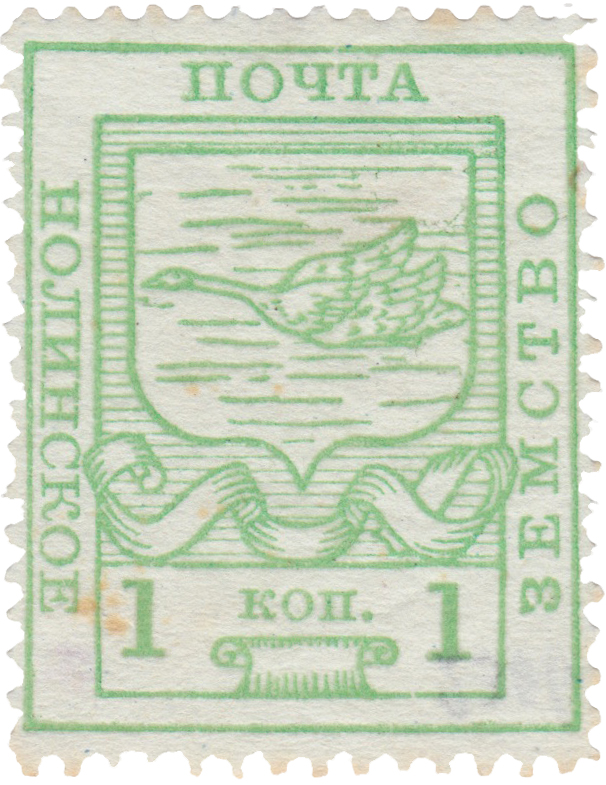
In Nolinsk Uyezd, which included the village of Bogorodskoye, the zemstvo post was established by a decision of the zemstvo assembly at its first session in 1867. It began regular operation in 1868. Mail in the volost of what is now the Bogorodsky District was carried along the uyezd Glazov commercial route.
To deliver zemstvo mail, the uyezd maintained 27 zemstvo stations, one of which was in the village of Bogorodskoye and had 5 horses. A fee was charged for each horse per verst.
By a resolution of the assembly in 1880, the fee for forwarding ordinary private correspondence was abolished. The abolition of the fee led to an increase in the number of letters sent from the uyezd. If in 1878 there were 94, then in 1880 the number rose to 984, and in 1894 to 7,158. By 1906, 49,000 private letters were being sent from the uyezd.
The fee was collected again in 1910–17. Stamps were issued in 1, 2, 3, 5, and 6 kopecks. They were printed in the uyezd printing house and in a private printing house in Saint Petersburg. On the 1-, 3-, and 5-kopeck stamps of 1915 there is an image of a flying swan. They were printed on both sides of the sheet. The stamps were canceled with ink (by crossing out) and with circular and oval handstamps. Presumably in the first half of 1918, in connection with changes to zemstvo postal tariffs, the 1-, 2-, 3-, and 5-kopeck stamps received hand-applied overprints in black or violet with new denominations of 10, 15, 25, 30, and 50 kopecks. In early September 1918, the post was closed.