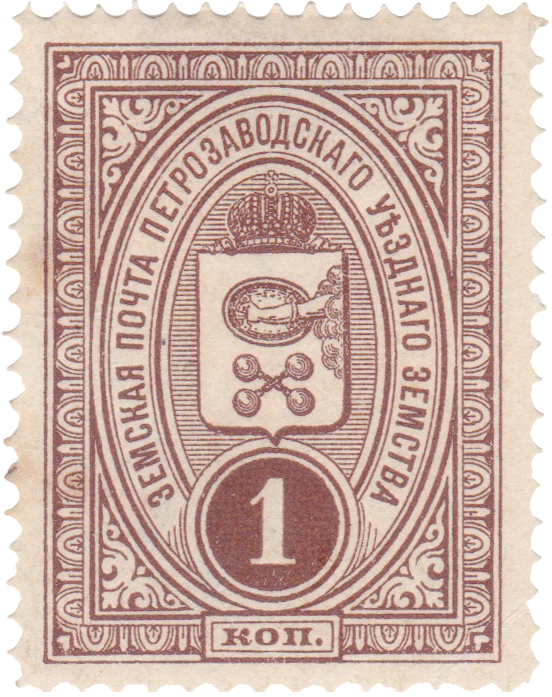
On January 1, 1896, the zemstvo post of the Petrozavodsk Uyezd (Olonets Governorate) was opened. Mail from the uyezd center of Petrozavodsk was sent twice a week to seven volost administrations.
In 1901, a fee was established for the delivery of private correspondence and zemstvo postage stamps were introduced, printed at the EZGB. They bore the image of the governorate coat of arms. Ordinary letters were paid with a 3-kopeck stamp, money letters with a 5-kopeck stamp, registered letters and wrappers with a 10-kopeck stamp, and parcels with a 20-kopeck stamp. Stamps of 1, 2, and 15 kopecks were also issued. The last issue of stamps was in 1916. They were canceled with round and oval postmarks.
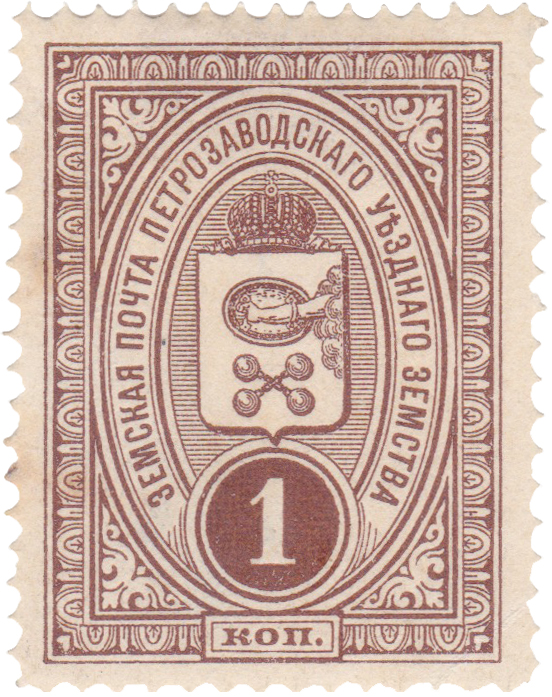
A sheet from the collection of Siegfried Rudolfovich Lindenmayer. An outstanding Russian and Soviet philatelist-researcher, one of the largest collectors of stamps of the Russian Empire. He was a “titan” of pre-revolutionary Russian philately. His name was placed alongside such legends as Agathon Faberge or Alexander Lyapin.
An engineer by profession. He became seriously involved in philately after the Great Patriotic War. His approach was systematic, scholarly, and pedantic, which was reflected in the quality of his collection.
He was not merely a collector but a profound researcher. He served on the editorial board of the journal “Philately of the USSR,” published articles, and his expert opinions were trusted without reservation.
He was known for incredible meticulousness, strict principles, and even asceticism in collecting. Legends say he could spend years searching for one specific stamp he needed in perfect condition, refusing more readily available options.
His collection of Russian stamps from 1857–1917 was considered by experts to be the best in the world among those in private hands.
After Siegfried Rudolfovich’s death in 1990, his heirs decided to sell the collection.
The main part was sold at two legendary auctions:
David Feldman S.A. (Geneva, Switzerland) in 1992–1993. The sale of the Lindenmayer collection became the central event of the year for world philately. The catalogs of these auctions are still used as reference works.
The auction house “Gelos” (Moscow) in 1994–1995. The dispersal of the remaining part in Moscow became the first opportunity for Russian collectors to acquire legendary rarities that for decades had been “kept under seven seals.”
The auctions caused a sensation. Prices were record-breaking. For example, a block of four stamps “Russian Post in China” sold for $130,000 (an enormous sum for that time). The collection was dispersed worldwide, enriching the holdings of new owners and museums.
1 Kopeck 1901.
Petrozavodsk. Zemstvo Post of the Petrozavodsk Uyezd Zemstvo.