
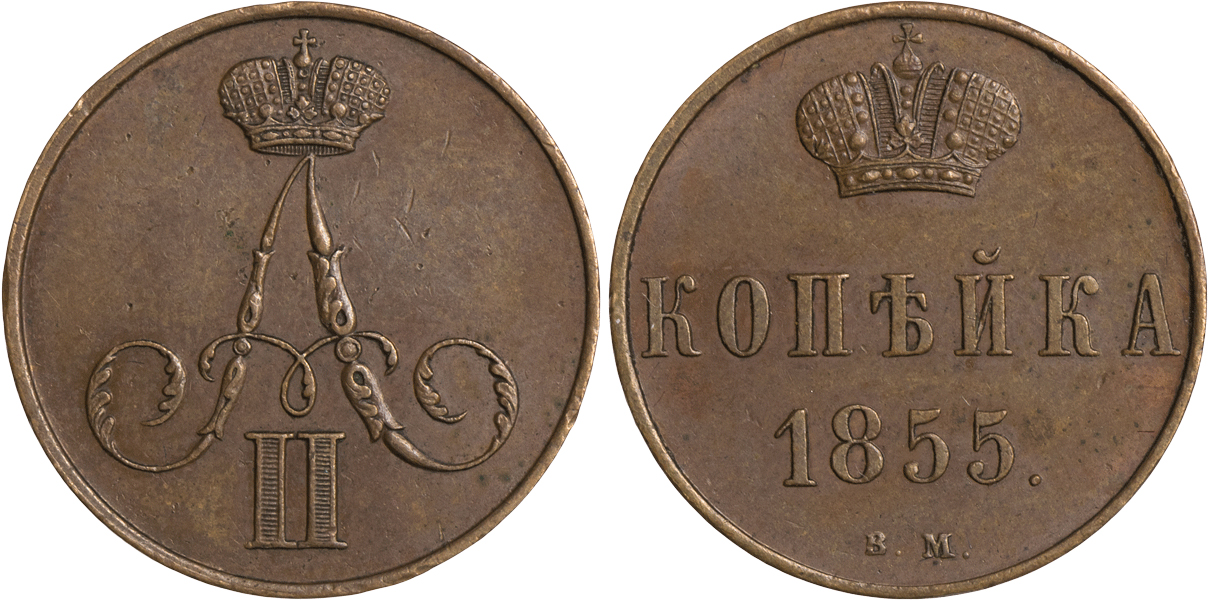
More than once toward the end of his life Nicholas I fell into doubt, but… “My successor will do as he pleases; I cannot change.” In February, suffering from influenza, he went out for a walk without a fur coat in a severe frost and died on February 19. When news of his death reached Europe, Russian government interest-bearing securities rose in price on all exchanges. Alexander II ascended the throne.
In August the siege of Sevastopol ended. Eight hundred guns ceaselessly pounded the city. A general assault began. On August 27, at the cost of enormous losses, the allies managed to seize the Malakhov Kurgan—the height dominating the city. After that, the defenders of the fortress crossed to the Northern Side by a bridge built in advance across the bay and abandoned the southern part of the city. The allies entered the city on August 29.
The Amur expedition of G. I. NEVELSKOY, begun in 1849, was completed; it established the insular nature of Sakhalin and the accessibility of the Amur for seagoing vessels.
On May 19 an Anglo-French fleet, even stronger than the previous year’s, appeared off Petropavlovsk. But by that time Petropavlovsk was already empty. On April 5 the Russian squadron, with the garrison and supplies, departed for the Tatar Strait and from there to the Amur. The enemy squadron rushed in pursuit, but did not find the Russian one.
English newspapers would analyze the failure of the Anglo-French fleet for a long time; however, the truth would be discovered only much later. England and France used the maps of La Pérouse and Broughton, according to which the disappearance of the Russian ships was inexplicable. The strait between Sakhalin and the mainland discovered by Nevelskoy saved the Russian ships from inevitable destruction.
The residents of Chita decided to build a fire watchtower and raised money for it. The estimate had to be sent to St. Petersburg. The estimate approved by the Minister of Internal Affairs would return to Chita two years later; during that time the prices of timber and labor would rise significantly. A new estimate was drawn up and sent to St. Petersburg. The story would continue for about twenty-five years, until the people of Chita put double figures into the estimate, so that after approval they would be able to stay within it.
In the case of petty theft, the culprit caught at the scene is not dragged to the precinct. Any watchman is authorized to draw, with a piece of chalk, a cross in a circle on the thief’s back—even if he is dressed smartly—and to make him sweep the pavement at the place where the crime was committed. At dusk the thieves’ hands are tied together with a rope and they are taken to the station. They spend the night in holding cells. In the morning they are given brooms again, and they sweep the pavement near the government offices of that station. When this work is finished, they are entered on the lists of thieves and sent home.
MENDELEEV, D. I., graduated from the Department of Natural Sciences and Mathematics of the Main Pedagogical Institute in St. Petersburg, defending his candidate’s dissertation, “Isomorphism in Connection with Other Relations of Crystalline Form to Composition.” For a year he would work as a teacher at the Simferopol Gymnasium and then at the First Odessa Gymnasium.
TOLSTOY, L. N., left for St. Petersburg in November. Back in 1852 he published the story “Childhood,” which at once brought him to prominence in literary circles. The stories written in the Caucasus and in Sevastopol, especially his “Sevastopol Sketches,” brought Tolstoy exceptional fame—and when he arrived in St. Petersburg in November 1855, he immediately found himself in an atmosphere of such attention and admiration that his head spun. Later Tolstoy would relate in “A Confession” that he felt alien to the literary milieu with all its artificiality and self-admiration. Relations between Tolstoy and Turgenev began to develop especially painfully… On August 4, regarding the defeat of Russian troops at the Chyornaya River, Leo Tolstoy wrote a song: “On the fourth day, ill fate drove us to take the heights… It’s neatly written into the papers, but they forgot the ravines—and how to walk through them… To the Fedyukhin Heights only three companies went, but regiments set out!..”
VALENTIN ALEKSANDROVICH SEROV was born, a future painter.
PAVEL YEGOROVICH CHEKHOV, having been freed from serf dependence, went to work as a clerk, then a small trader. To give his children the opportunity to get an education, he would also obtain merchant documents of the 3rd, and later the 2nd, guild of Taganrog.