
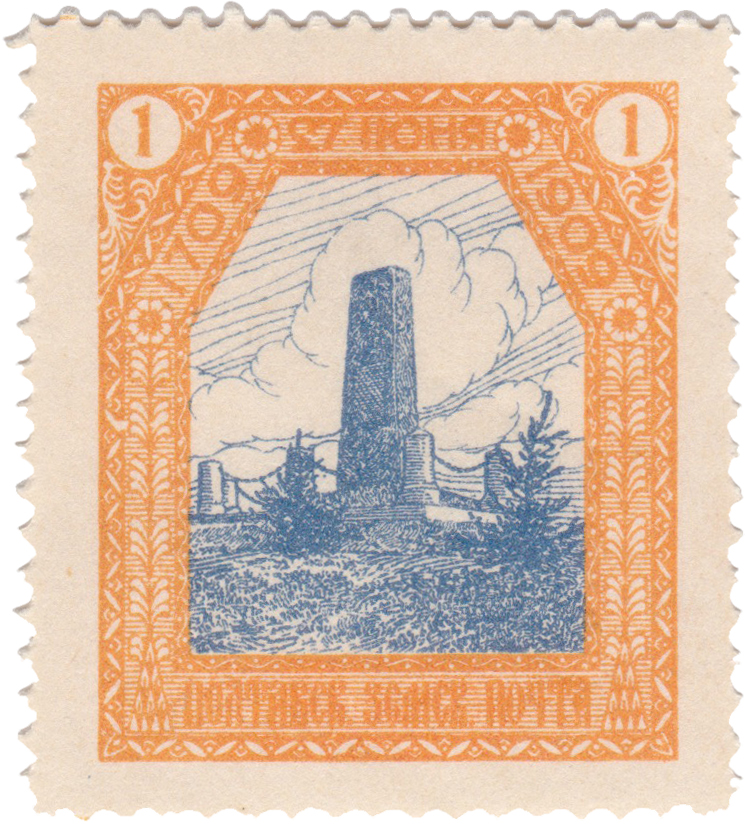
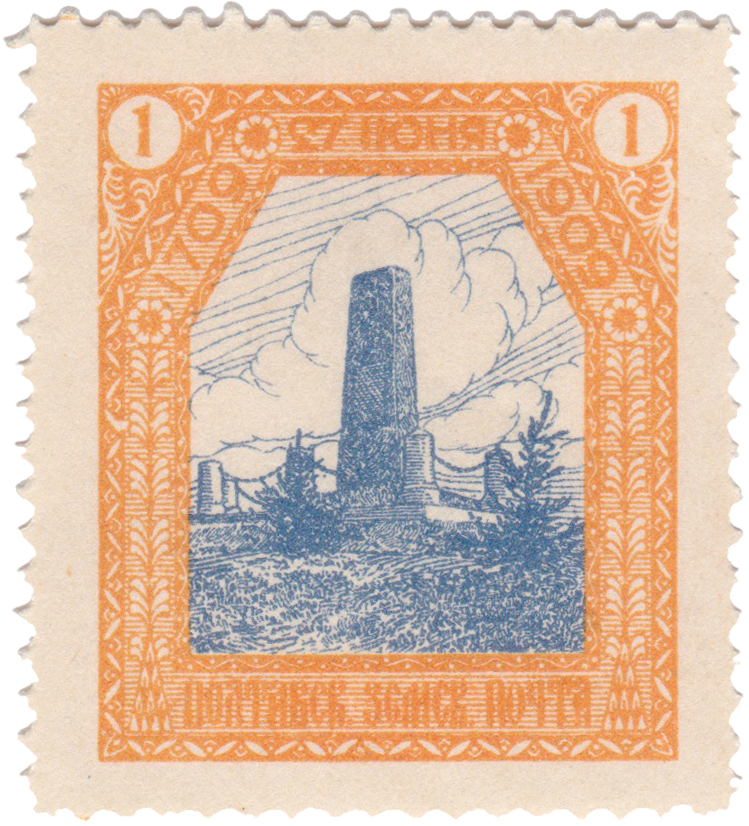
Monuments series. The first commemorative issue of zemstvo stamps was released in Poltava Uyezd in 1909. It was dedicated to the 200th anniversary of the defeat of the Swedes at Poltava and consisted of 7 stamps.
The stamps were printed at one of the best printing houses of the time, Golike & Vilborg in St. Petersburg, and enjoyed great success. Their shape, the theme of the design, and the artwork itself were unusual for that era.
Five of them, set in picturesque frames, depict several monuments erected in honor of the 200th anniversary of the Battle of Poltava. The 1- and 2-kopeck stamps show monuments installed on the battlefield in 1909. The third stamp (3 kopecks) features an image of the “Monument of Glory” located in Poltava; the fourth (5 kopecks) reproduces a monument honoring the commandant of the Poltava garrison. The 6-kopeck stamp shows a monument erected in 1849 on the spot where Peter I rested after the battle. The 10-kopeck stamp depicts the burial site of Russian soldiers who died in the Battle of Poltava. The last stamp in the series (15 kopecks) bears a portrait of Peter I.
March 1, 1903 — the zemstvo post of Poltava Uyezd (Poltava Governorate) was opened. Mail was dispatched twice a week from the uyezd center, the city of Poltava, to 17 volosts of the uyezd. Zemstvo postage stamps were used to pay for private correspondence: ordinary letters were paid with 3-kopeck stamps, and registered letters with 6-kopeck stamps. They are very diverse in printing method and purpose (official, for ordinary and registered wrappers, money correspondence, etc.).
Many issues depict the uyezd coat of arms. The stamps were printed at private printing houses; from 1905, at EZGB.
Imperforate stamps were of unofficial origin and were intended for collectors. The stamps were canceled with circular, oval, and rectangular handstamps.