
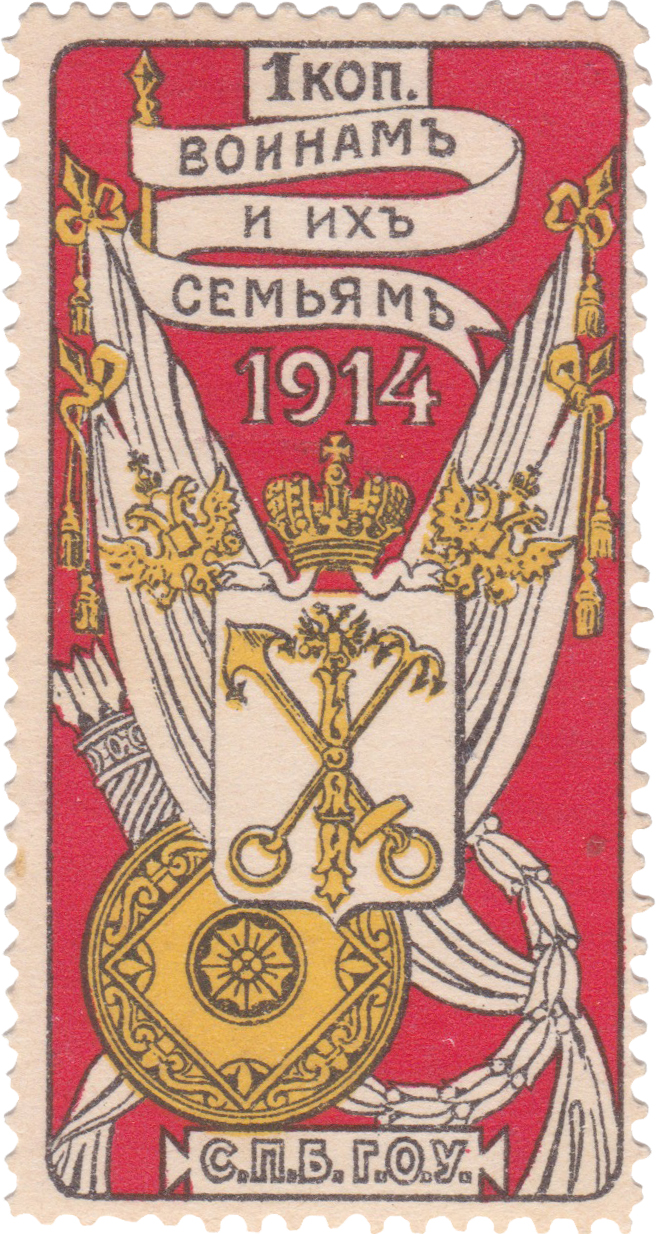
At the beginning of World War I, many semi-postal charity stamps were issued, with proceeds allocated to funds aiding the wounded and the families of fallen soldiers.
The municipal public administration was, in pre-revolutionary Russia, the city executive body subordinate to the governor and composed of representatives of the city’s wealthiest estates. Among other duties, this body oversaw collections and donations from citizens, and it can be assumed that organizing aid for the soldiers of the newly erupted world war was seen as a display of patriotism and was considered at the highest level.
Helping one’s neighbor in Russia had always been quite popular: before the start of the 20th century, the Empire had about 7,500 charitable organizations, and by 1902 as many as 11,040 were registered. So all kinds of charity drives, concerts, and “cup” collections in Russian cities of that time were not a rare occurrence. People chipped in for everything—relief for the starving, outfitting public almshouses, supporting war invalids and their family members, and so on.
But with the outbreak first of the Russo-Japanese War and then World War I, charity ceased to be a purely personal matter and became a “civic duty.” Avoiding it was considered a dreadful faux pas, while demonstrating one’s participation, on the contrary, took on the character of a kind of competition. This gave rise to numerous charity badges, postcards, and other distinguishing marks. Initially, they were needed so that collectors would not ask the same townspeople for a contribution twice. However, later they began to play a special, important role: highlighting the high level of civic engagement of their owner. People wanted not only to wear these signs, but also to be able to show them to their correspondents. That is how non-postal charity stamps came into being: now the recipient of a letter, seeing them on the back of the envelope, could be assured of the sender’s strong civic responsibility and patriotism.