
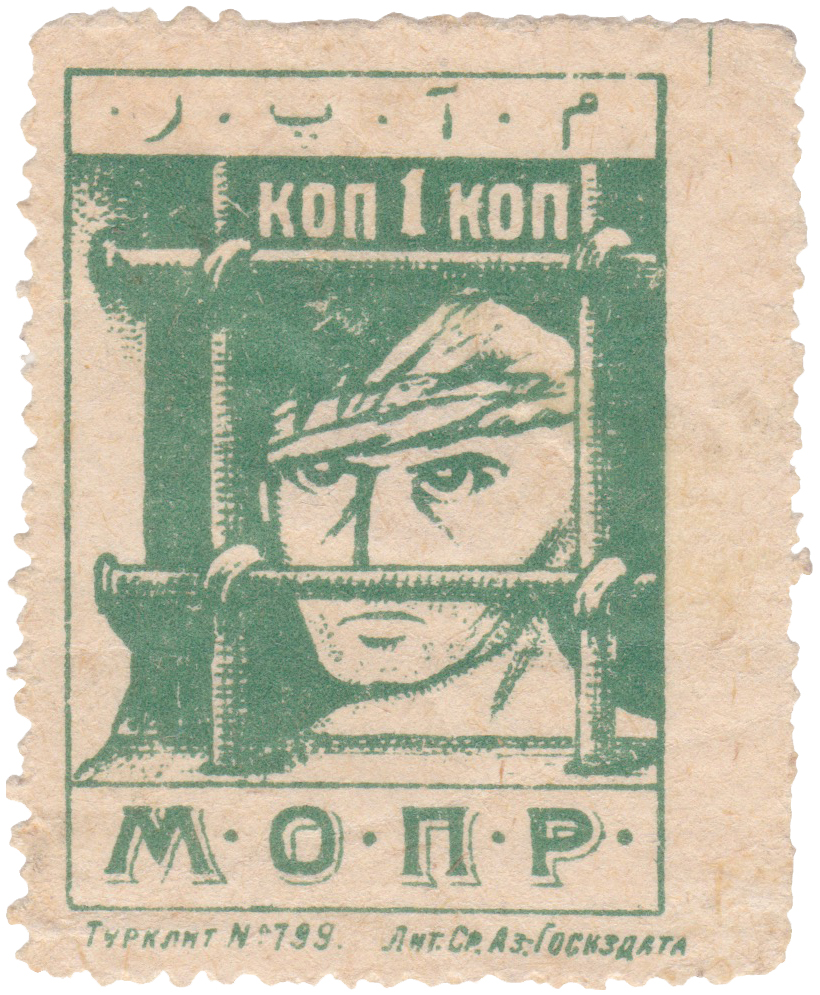
The International Organization for Aid to the Fighters of the Revolution (MOPR) was a charitable organization created in 1922 by a decision of the 4th Congress of the Comintern as an analogue to the Red Cross. MOPR was a non-partisan organization and set as its task legal, moral, and material assistance to imprisoned fighters of the revolution, their families and children, as well as the families of fallen comrades. MOPR brought together broad masses of workers, peasants, and lower-level employees regardless of their party affiliation.
In reality, MOPR was a tool for promoting communist ideology worldwide and also served as cover for the activities of Soviet special services. From a propaganda standpoint, however, the idea of creating MOPR was very successful. The theme of rescuing unjustly accused workers from imprisonment appeared extremely noble to the global public, so the number of MOPR members around the world began to grow rapidly from the very first days of the organization’s existence. It is obvious that the “creator” of MOPR—the Soviet Union—had to remain an example for all fraternal communist parties in this matter. Therefore, membership that was voluntary at first quickly became “voluntary-compulsory.” Others also had to follow the example of the “most class-conscious” workers who had joined the organization—not out of solidarity or compassion, but in order not to attract criticism.
In March 1923, the Central Committee of MOPR declared Paris Commune Day (18 March) its holiday. By 1924, the organization had sections in 19 countries. By 1932, MOPR united 70 national sections comprising about 14 million people (9.7 million of them were in MOPR of the USSR, whose contributions to the fund were the most substantial). Until 1936, MOPR, like the NKVD, had the right to issue entry permits to the USSR.
The issue was not so much “terror” against revolutionaries as a fact that had become obvious by the 1920s: the idea of world revolution was still extremely far from realization. In order not to finally undermine the trust of the masses in the coming victory of the world proletariat, it was necessary, on the one hand, to develop in every way the thesis of the constant “persecution” of revolutionaries abroad, and on the other hand, to form a mechanism of material support for Western communist and other “left” organizations whose activities were aimed at “fanning” the global revolutionary fire.
It is believed that the name for MOPR was coined by the head of the Polish section of Comintern communists, Julian Marchlewski. A loyal associate of Rosa Luxemburg and Jan Tyszka, one of the founders of the German Spartacus League (read more about the German Spartacus League in the story “From Trumpeter to Drummer”), and head of the Revolutionary Committee of Poland, he became the first chairman of the Central Committee of the International Organization for Aid to the Fighters of the Revolution. The Executive Committee of MOPR was headed at the same time by Clara Zetkin, one of the founders of the Communist Party of Germany, who, after Marchlewski’s death in 1925, became the leader of the organization. Her deputy was appointed a Russian, the prominent scholar Panteleimon Lepeshinsky.
Of course, the USSR transferred the largest sums of donations “for the prisoners of capital,” the main source of which was voluntary—sometimes forced, and at times outright violent—collections of money from the population. And if foreign MOPR sections collected funds to help their own communists and political prisoners, in the USSR people were urged to “give up their last shirt” to help numerous foreign “brothers.” It can be stated with confidence that MOPR laid the foundation for the grim Soviet tradition of assisting fraternal communist parties, and later entire peoples, at the expense of its own citizens.
Over time, MOPR de facto turned from an international aid organization into a mechanism for distributing funds collected in the USSR to support fraternal communist parties.
Over time, MOPR turned into a gigantic “state within a state.” By 1940, i.e., over 18 years of work, about 180 million rubles had been collected “for the prisoners of capital”—a simply fabulous sum. But while in the first years of MOPR’s existence absolutely all collected money went to support prisoners, from the second half of the 1920s about a third of the funds began to be kept for the needs of the organization itself, which had grown to incredible масштабы. And although assistance to fighters of the revolution in capitalist countries formally remained MOPR’s main goal, in reality the organization engaged not only in this but also in attempts to create communist cells in those countries where the communist movement was known only from newspapers.
Soviet MOPR members came up with ever new ways to collect as much money as possible from the population for foreign “prisoners of capital.” For these purposes, MOPR of the USSR issued lottery tickets, postage stamps, postcards, held auctions, organized voluntary Saturday workdays, and sold charitable magazines of foreign sections. By the way, it was a bundle of precisely such magazines that Comrade Vyazemskaya, head of the cultural department of the building, persistently urged Professor Preobrazhensky to buy in Mikhail Bulgakov’s famous novel “Heart of a Dog.”
On an international scale, it operated until World War II. On 12 April 1948, the Central Committee of the International Organization for Aid to the Fighters of the Revolution of the USSR resolved to dissolve the Soviet section. All property and valuables of MOPR were transferred to the Union of Societies of the Red Cross and Red Crescent. However, the reason for the liquidation of the organization was not only waning enthusiasm. The dissolution of MOPR was caused by the need to unite all anti-fascist forces. And national and class approaches to friendship, as World War II showed, were deadly dangerous. MOPR dissolved completely painlessly, without emphasizing at all that the world proletarian revolution for which it had been created never took place.