Varieties:
Row 1 — Type III,
Row 2 — Type III Ka ("foreign"),
Row 3 — Type II,
Row 4 — Type I Ks (the second "S" is broken),
Row 5 — Type I Kd (ornament underprinted)
Collection-fee stamps from philatelic parcels, or control-fee stamps for foreign exchange, are a type of fiscal stamp used to pay a mandatory fee for sending philatelic collectible material or banknotes abroad inside postal items. They were affixed to postal items containing such materials and were cancelled with special control handstamps after verification that the contents corresponded to the amount of the control fee. They were issued in the USSR from 1922 to 1933.
From 1 December 1923, new tariffs in gold currency were established for the foreign exchange of philatelic material and banknotes. Philatelic enclosures were subject to the following fee:
up to 500 francs — 3 kopeks in gold
from 500 to 1,000 francs — 6 kopeks in gold
from 1,000 to 2,000 francs — 12 kopeks in gold.
Mailings valued at more than 2,000 francs were not permitted. Prices for stamps were set according to the "Yvert" catalogue for the current year.
Banknote enclosures: up to 25 rubles in gold — 3 kopeks in gold; from 25 to 50 rubles in gold — 6 kopeks in gold; from 50 to 100 rubles in gold — 12 kopeks in gold. Enclosures over 100 rubles in gold were not permitted. Payment was made at the exchange rate of the Quotation Commission of the State Bank of the USSR on the day the fee was paid.
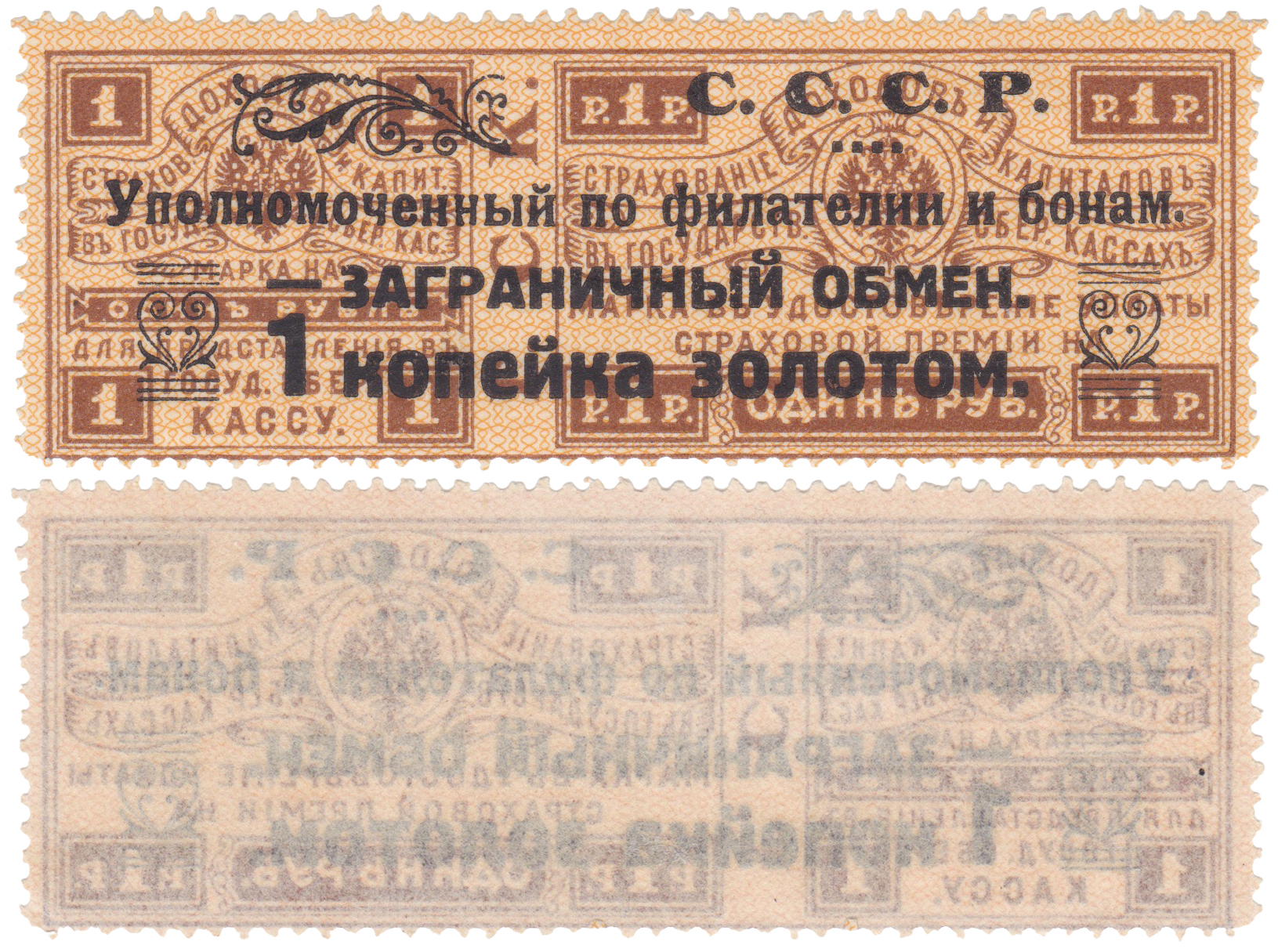
In this connection, on 1 December 1923 new control-fee stamps for foreign exchange were issued. On the insurance-fee stamps of the Russian Empire an overprint was applied: "USSR. Authorized Representative for Philately and Banknotes. Foreign Exchange" and the fee amount. The control-fee stamps that had been in circulation up to that time were cancelled. At the same time, a new cancellation handstamp for control-fee stamps was introduced.
Stamp of control fee for foreign exchange 1 Kopeck gold 1923.
Authorized Representative for Philately and Paper Money. USSR.