
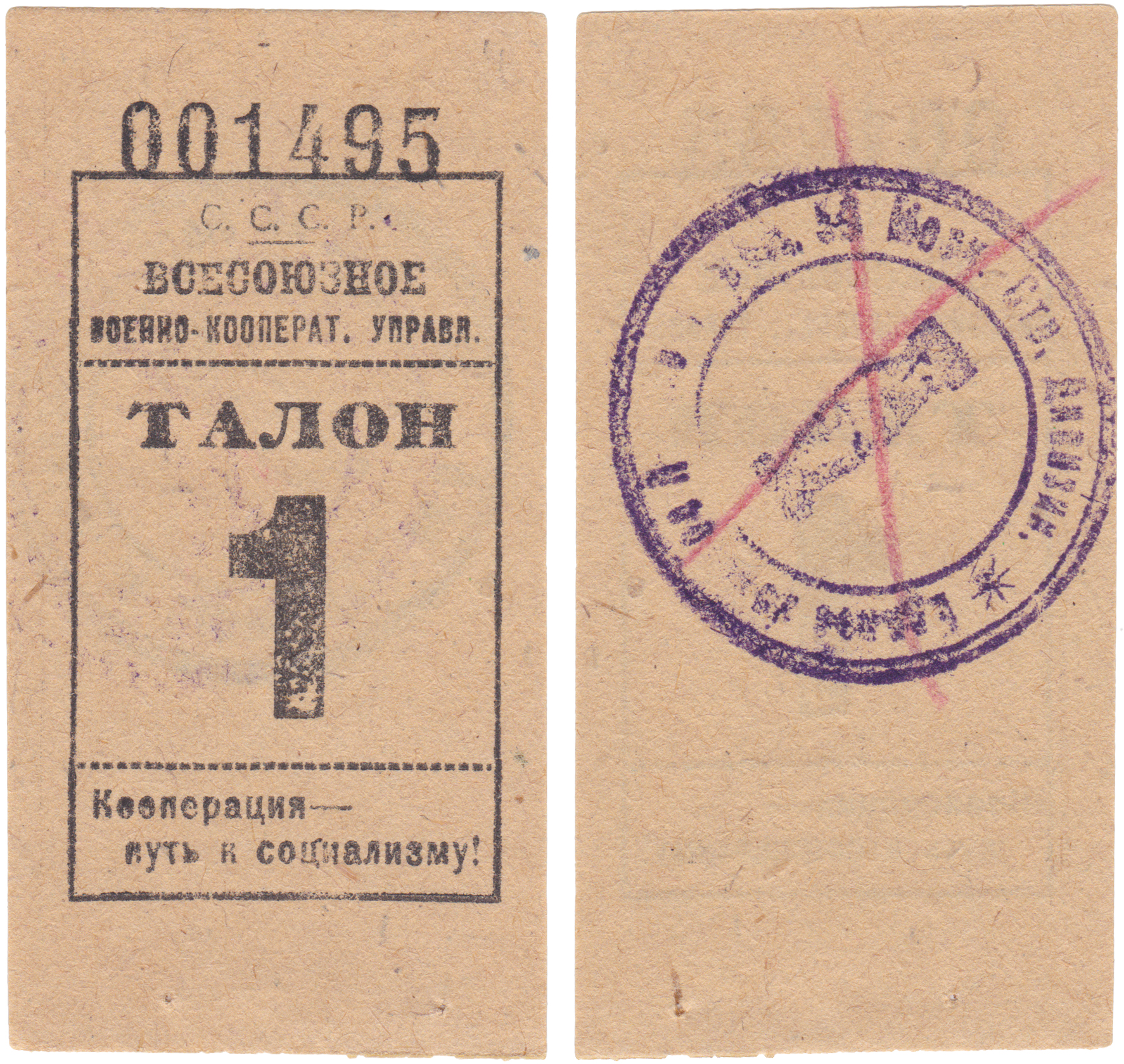
Military cooperation, an autonomous branch of consumer cooperation within the Tsentrosoyuz system, which included a network of military consumer societies.
The first cooperative societies of servicemen in Russia were created by officers. They followed the example of their English counterparts. In the 1890s, Russian Guards officers also began creating cooperative societies in military districts, garrisons, rifle brigades, and infantry regiments. These associations were usually called officers’ economic societies.
Though legally organized as consumer cooperatives under their charters, they provided retail services to their shareholders and to members of their families. Compared with workers’ and peasants’ cooperatives, officers’ consumer societies were distinguished by a relatively high share contribution and a refined assortment of goods in their shops.
By the end of the 19th century, Russia had more than 20 such consumer societies—from Warsaw to Chita and Vladivostok, from Saint Petersburg to Odessa and Tiflis. They also operated in Moscow. The Officers’ Economic Society of the Moscow Military District was founded in 1895. For a time its board was headed by N.P. Gibner, who later became a major cooperative figure in Russia.
This cooperative united 2,285 members and was one of the most prosperous consumer societies. Its address was also impressive: Moscow, the Kremlin, the Arsenal. The officer-cooperators published a newspaper, “Listok ob’yavleniy” (“Bulletin of Announcements”). The consumer society enjoyed trust, was commercially successful, and paid good dividends to its members.
During the Russo-Japanese War it was enlisted to supply troops in frontline and near-front conditions and further strengthened its financial position. This, among other things, enabled it to purchase as its own property the extensive holdings of Countess Ignatieva in Moscow on Vozdvizhenka, rebuild them, and fit out premises for a shop and a large warehouse.
The officers’ consumer society moved there in 1910. In Soviet times this was building No. 10 on Kalinin Avenue, where for many years the Central Military Department Store was located.
During the First World War, consumer cooperation and its military branch took part in directly supplying the active army. This concerned the organization of feeding points, soldiers’ shops, canteens, baths, as well as shop-wagons and other mobile retail outlets. In the summer–autumn of 1917 alone, on the Southwestern Front the network of troop cooperative shops increased from 95 units to 238; on the Western Front there were 185 such shops; on the Northern Front, 98. The number of shareholders grew rapidly, and rank-and-file soldiers were also admitted to cooperatives.
In 1918, officers’ consumer societies were merged with civilian cooperatives. But already at the beginning of the next year, the Deputy People’s Commissar for Naval Affairs, E.M. Sklyansky, approved the Charter of the Unified Military Cooperative Society (EVKO). The decree of the Council of People’s Commissars of the RSFSR of August 16, 1921 on military cooperation defined its future. From then on, the grassroots cells of cooperation in the Red Army were military cooperative associations (VKO), and their members could be all servicemen—from commanders to Red Army soldiers. An All-Russian Military Cooperative Administration was created. The VKO were tasked with organizing supplementary (above-ration) supply for their members on cooperative principles, carrying out procurement, purchasing, and trade for this purpose.
However, military cooperation in the first years of the NEP was unable to prove its commercial viability and its right to independent existence. First, the VKO were transformed into military consumer societies, and later the entire work of cooperative service for the military contingent was transferred to the civilian consumer cooperative system. Within the structure of the Tsentrosoyuz apparatus, the Central Military Cooperative Administration (TsVKU) operated. As a supervisory body under the Revolutionary Military Council of the USSR, a Central Military Cooperative Commission existed. From 1924 its chairman’s duties were performed by Semyon Mikhailovich Budyonny, a well-known military commander and, incidentally, the author of the booklet “For Defense—For Cooperation.”
In connection with the introduction in 1929 of the ration-card supply system, military consumer societies were transformed into closed military cooperatives (ZVK). In accordance with their Charter, they supplied the contingents of units, institutions, and administrations of the army, navy, militia, and the GPU.