Variety.
Bogorodsk emerged at the end of the 18th century, when, under a new redistribution of the uyezds of the Moscow Governorate, by decree of Empress Catherine II of October 5, 1781, it was ordered to create Bogorodsky Uyezd and to rename the yam settlement of Rogozha into the town of Bogorodsk. The basis for this name, according to a tradition of doubtful reliability, was the presence at the local church of a particularly venerated icon of the Mother of God.
The new town existed for about 15 years, until it was abolished by decree of Emperor Paul, but Paul’s son, Alexander I, on May 25, 1802, restored it to the rights of an uyezd town. In 1812 the town was subjected to the French invasion; the troops of Marshal Ney, one of Napoleon’s most brilliant commanders, were stationed there. On October 1 the French left Bogorodsk.
On February 28, 1917, the first response to the February Revolution in Bogorodsky Uyezd was that the Kupavinskaya factory stopped. The speech of M. P. Eremeev, who spoke first at the rally, began with the phrase: “At last the tsarist yoke has been lifted from us.”
On March 2, 1917, near the house of the district police chief Prince Vadbolsky (house No. 110 on Sovetskaya Street), a rally of the town’s residents took place, where a temporary town elder was elected—Alexander Petrovich Smirnov, a professional revolutionary, with a basic education; from 1923, People’s Commissar of Agriculture in the Bolshevik government, and at the same time head of the so-called “Peasant International.” Member of the All-Russian Central Executive Committee and the Central Committee of the AUCP(b). He replaced Panteleimon Sergeevich Kochetov, appointed in November 1916, and worked in Bogorodsk until leaving for the sessions of the Constituent Assembly, to which he had been elected as a deputy. Before his arrest in 1937, he headed the department of primary hemp-processing plants of the USSR Ministry of Light Industry. For “creating and participating in a counterrevolutionary terrorist organization,” he was shot on February 10, 1938, and rehabilitated in 1958.
On March 3, 1917, the Bogorodsk-Glukhovo organization of the RSDLP (Bolsheviks) was created.
On March 7, 1917, the Bogorodsk Soviet of Workers’ and Soldiers’ Deputies was formed.
On April 19, 1917, the Bogorodsk Soviet of Workers’ and Soldiers’ Deputies decided to introduce, “by direct implementation,” an 8-hour working day at all factories, equal pay for women and men, the arrest of the police and “all persons with reason to believe that they harm the new order.” At the same time, in April, a uyezd congress of peasant deputies was held, where the question of peasants’ use of land, forests, and hay meadows was decided.
On May 1, 1917, the first free May Day outing of Glukhovo workers was held. (The Worker’s Voice. Newspaper. 1927. Memoirs of P. P. Lavrov).
On May 13, 1917, the first uyezd congress of workers’ and soldiers’ deputies took place. An executive committee headed by N. V. Pogodin was elected. The congress declared itself “regional.” (Banner of Communism. Newspaper. No. 56. 1963).
On June 3, 1917, Orekhovo-Zuyevo received city status, uniting the village of Orekhovo and the settlement of Nikolskoye of Pokrovsky Uyezd of Vladimir Governorate, and the villages of Zuyevo and Dubrovka of Bogorodsky Uyezd of Moscow Governorate.
On August 29, 1917, a local branch of the trade union of “workers for processing textile-fibrous substances” was created in Bogorodsk—simply put, the textile workers’ union. The board included: Mokhov, Novozhilov, Savelov, Sorokin, Yaroslavtsev, Boytsov, Vorontsov, Bolshev, Frolov, Rumyantsev, Chesnokov, Babarykin, Koblov.
In September 1917, elections to the city Dumas were held. In Bogorodsk, out of 45 deputies: 19 were Bolsheviks, 6 were “Kadets,” and 20 were representatives of the “socialist bloc.” In Pavlovsky Posad, out of 22 deputies: 4 were Bolsheviks, 14 Mensheviks, and 4 “Kadets.” In Orekhovo-Zuyevo, out of 74 deputies: 56 were Bolsheviks, 11 SRs, 5 the Democratic Union, and only two Mensheviks. In the Bogorodsky Zemstvo, the Bolsheviks received 25 seats out of 56.
On October 25, 1917, in Bogorodsk, at a joint meeting of the Soviet of Workers’ Deputies, the city Duma, the Zemstvo board, the post-and-telegraph office, the garrison commander, and representatives of the railway, a Military-Revolutionary Committee was created.
In November 1917, due to the emerging danger of “squandering” factory property, including finished goods, the Bogorodsk branch of the textile workers’ union organized a control-and-management department to implement immediate workers’ control at factories.
On April 17, 1918, control commissions were created at factories, and commissars were appointed, whom the textile workers’ union instructed to “prepare the factories for their transfer into the hands of the workers.”
On May 12, 1918, an uprising occurred in Pavlovsky Posad. The Bogorodsk military commissar reported: “…a gathered crowd of kulaks from surrounding villages and merchants smashed and burned the local soviet; there are killed and wounded.” In Noginsk there is a monument to the Bolsheviks—victims of the uprising. Today in Pavlovsky Posad they are preparing to erect a monument to local residents—victims of the shooting of the crowd carried out by the Bolsheviks.
In September 1918, Archpriest Konstantin Alekseevich Golubev was brutally tortured to death by the Bolsheviks. According to a folk legend, other persons were killed together with him as well. In 1995, the city of Noginsk and the place where her grandfather was killed were visited by the granddaughter of Fr. Konstantin Golubev, Galina Konstantinovna. On April 18, 1996, His Eminence Juvenaly, Metropolitan of Krutitsy and Kolomna, concelebrating with Bishop Grigory of Mozhaysk and many priests, performed in the Tikhvin church the rite of canonization of the hieromartyr Konstantin of Bogorodsk and those killed with him.
In February 1920, the chairman of the Shchyolkovo Soviet telegraphed to Moscow: “The food situation in the district is catastrophic. The factories have stopped... something unbelievable is happening. Agitation by anti-Soviet elements is felt. Productivity is down to a minimum. There is no discipline.”
On July 14, 1920, thanks to the skillful work of engineer Samoylov and director A. Ya. Grigoryev (who had worked back “in the old days”), after several years of idleness and devastation, the factory previously belonging to the Brunovs was put back into operation. In a short period, output was increased by 18% compared to the prewar period.
On May 22, 1924, V. P. Nogin died.
On January 20, 1930, the Presidium of the All-Russian Central Executive Committee decreed: the town of Bogorodsk and the Bogorodsk station are to be renamed the town and station of Noginsk.
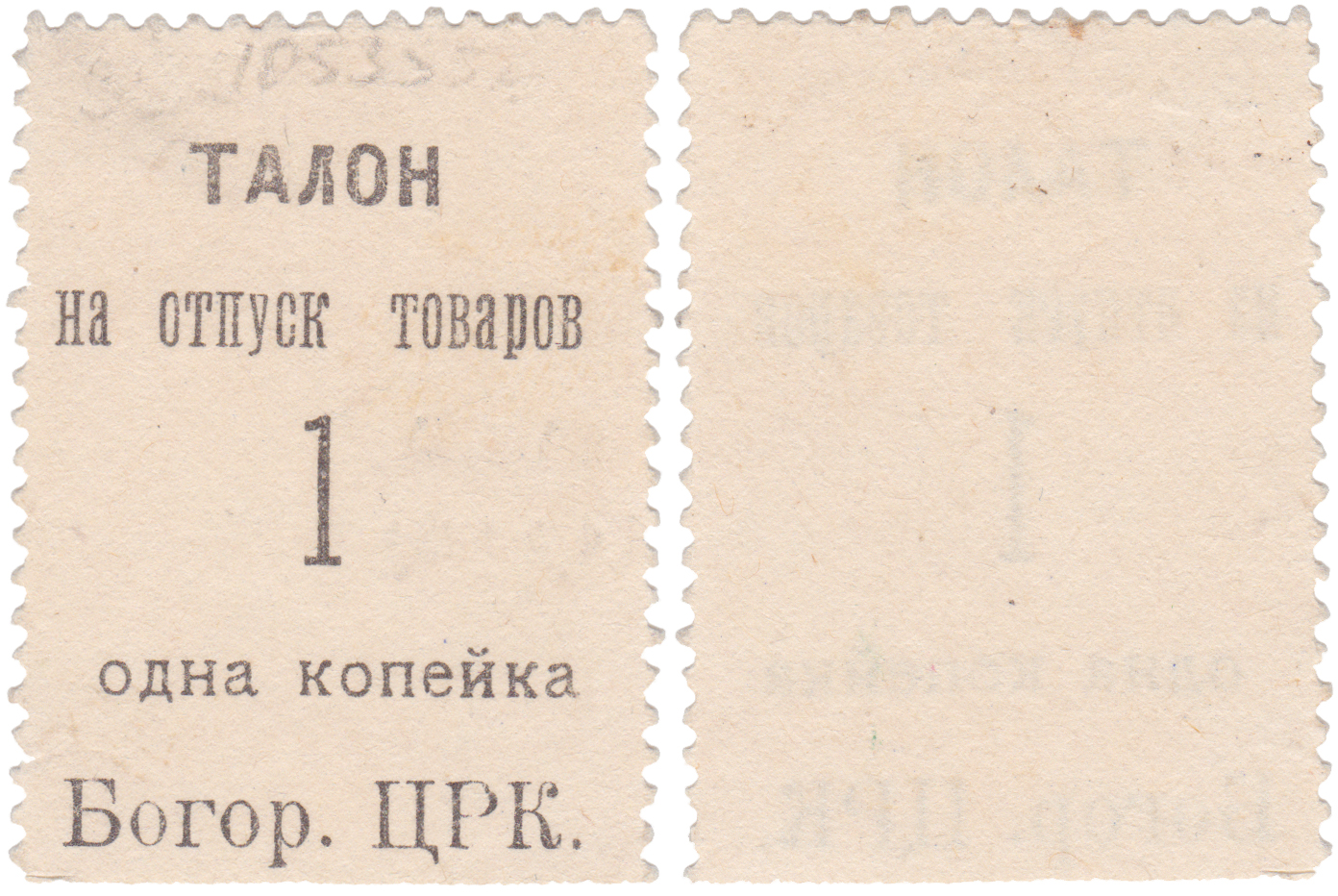
Coupon for the release of goods 1 Kopeck 1924.
Bogorodsky Central Workers.