
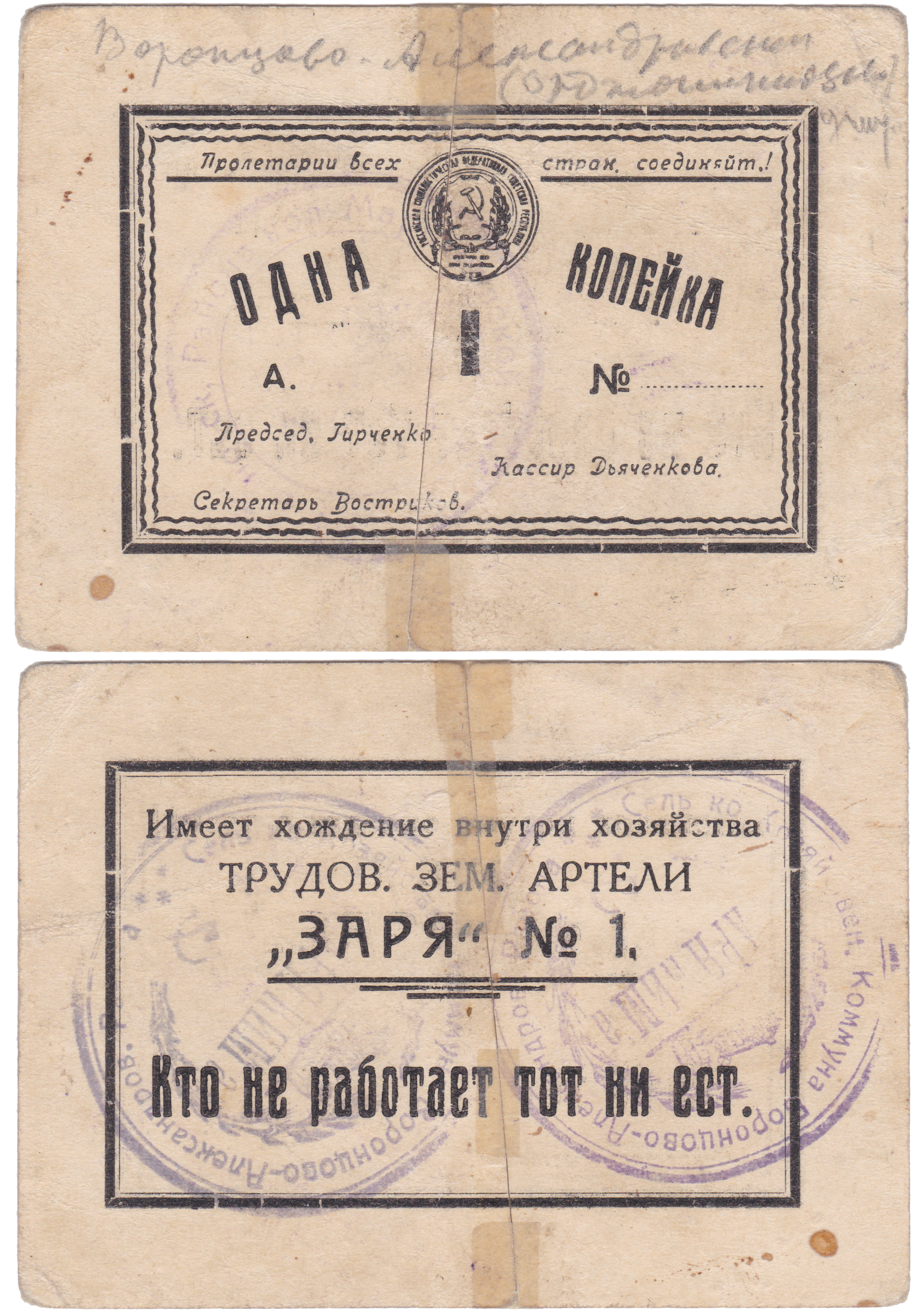
Artel is a voluntary association of people for joint work or other collective activity, often involving sharing in common income and bearing collective responsibility on the basis of mutual surety.
Origin of the name:
On the origin of the word artel there are at least two viewpoints.
The first ascribes to this word an Eastern, Slavic-Turkic origin: either deriving it from the Slavic verb rotitisya — "to promise," "to swear," "to take an oath" (in connection with mutual surety), and the noun rota — "oath" (artel and rota, with transposition, like rye and "rye-grain"); or linking its origin to the Turkic-Tatar root orta meaning "community"; compare the Nogai ortaklyk — "commonality," and the Turkish ortaklik — "partnership," "participation," "company."
The second, supported in its time by M. Fasmer and Academician F. Korsh, argues for a Western European origin: from the Italian artiere — "craftsman." However, the routes by which this word entered Russian popular speech (already in the 16th–17th centuries) are not sufficiently clear.
In Soviet times, the most widespread type of production enterprise in agriculture was the agricultural artel — the kolkhoz.
At the end of the 18th century, the distribution of Caucasian lands to landowners and imperial dignitaries began. Thus the prominent feudal lord Count A. R. Vorontsov, who owned landholdings in many provinces of Russia, received a generous gift from the empress in the Caucasus.
By decree of Catherine II in 1788, land in Georgievsky Uyezd was demarcated for A. R. Vorontsov "... below the village of Otkaznoye, on the right bank of the Kuma River." The count received more than 15,000 dessiatinas of steppe along the Kuma. Earlier, a settlement had existed here, founded in 1781 by retired soldiers. The soldiers obediently vacated the count's allotment, resettling in neighboring farmsteads and villages. At Vorontsov's suggestion, some of the peasants from the village of Vorontsovka in Voronezh, which also belonged to him, resettled here.