
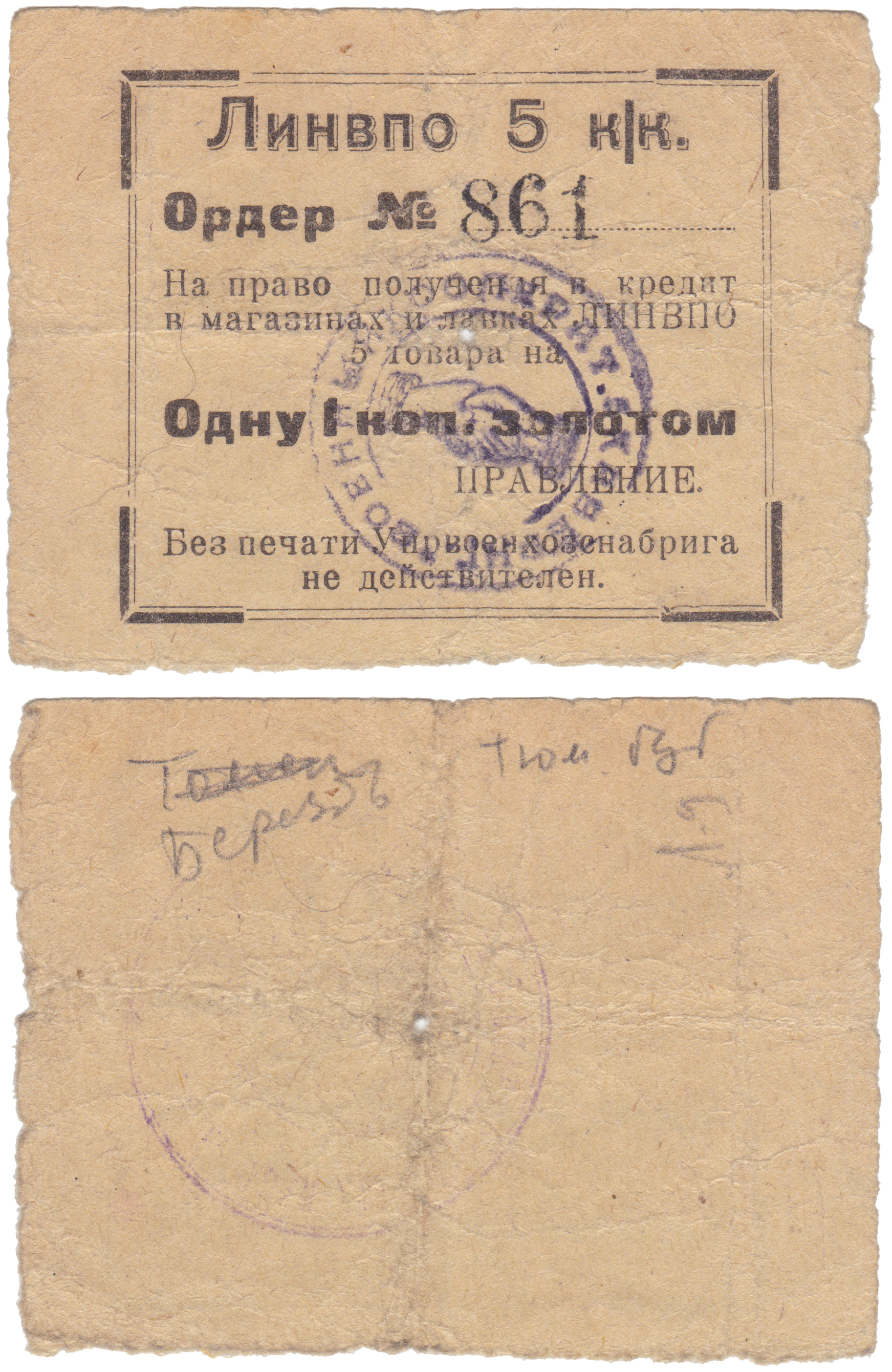
Military-Consumer Society (October 1921 — July 1924), a grassroots unit of the system of military-consumer cooperation (divisional, provincial, garrison, naval M.-C.S.), uniting military consumers (Red Army soldiers, naval personnel, command staff, employees of the military and naval departments) numbering at least 300 people.
The tasks of the MCS were joint purchasing, production and sale of foodstuffs and basic necessities to MCS members, and procurement and supply to the army and navy on a contractual basis of food and fodder.
MCSs included production enterprises, cottage-industry artels, and agricultural farms. MCSs were an improved form of cooperatives operating under the "Regulations on Voluntary Military-Cooperative Associations" (4 October 1921) and the "Standard Charter of a Voluntary Military-Cooperative Association" (15 April 1922). MCSs had the right to open their branches wherever this was necessary under the billeting conditions of military units, OGPU troops, and the militia. Within the territory of a military district (front, separate army), the coordinating body for MCSs was the district (front, separate army) Military-Cooperative Directorate.
In July 1922, the 5th Separate Kuban Cavalry Brigade (abbreviated as the 5th SKCB) was formed in connection with the disbandment of the 5th Kuban Cavalry Division during the reduction of the Red Army.
From August to October 1923, the cavalry brigade was commanded by K. K. Rokossovsky.
In 1926, the town of Beryozovo lost its town status, becoming a village. After the discovery of the Beryozovo gas field in 1953, Beryozovo received the status of an urban-type settlement.