
The Sormovo Plant was founded in 1849. From 1851, metal vessels began to be built there. But the crisis of 1857 undermined the plant’s solvency, and in 1860 all its shares were bought up by one of the directors, D. E. Benardaki, who became the sole owner. He transformed the works into a powerful plant; in 1870 he installed the first open-hearth furnace in Russia, which made Sormovo metal renowned as the best in the country. In 1870 Benardaki died. On behalf of his sons and heirs, the plant was managed by the talented engineer K. M. Okunev, who organized the production of double-deck vessels, the first of which was the “Perevorot,” causing a technical sensation.
On February 4, 1872, the heirs formed the joint-stock company “Sormovo.” It was established “for smelting cast iron, producing iron and steel, making from them goods for sale, building machinery, ships, rolling stock for railways, rails and the like, as well as the extraction itself of all kinds of metals and minerals.”
In the same year, construction began on the Sormovo Plant’s grounds of a railcar workshop and the related wheel, woodworking, and tire (bandage) shops. The forging and rolling shops were expanded, new equipment was installed, in particular a five-ton steam hammer and more powerful rolling mills.
The tremendous scale on which production unfolded, the increase in the number of workers, and the unprecedented income of the owners—all indicated that the plant was becoming the largest enterprise in the national industry.
In 1870, the first open-hearth furnace in Russia was built in Sormovo to the designs of engineer A. A. Iznoskov. This made it possible, during the shipbuilding crisis, by quickly building new workshops and making maximum use of the available space, to switch from 1873 to railcar manufacturing, and from 1888 to locomotive building. Per month, the plant could produce 250 freight cars and 10 passenger cars, as well as steam boilers, water-supply pipes, all kinds of tanks, propellers, wheels for ships, rails, bolts, nuts, and much more. Over 44 years, from 1873 to 1917, the plant produced almost 62,000 freight cars, 592 flatcars, 439 tank cars, 2,501 passenger cars of various types, and 16 cars for an electric tram.
In 1894, the Sormovo Plant fully passed from the ownership of Benardaki’s heirs into the property of the joint-stock company, and its full name read as follows: “Joint-Stock Company ‘Sormovo’—Mechanical, iron foundry, shipbuilding, locomotive and railcar building, steelmaking and ironworking plants. Sormovo, Nizhny Novgorod Governorate.”
The first workers of the Sormovo plants were serfs. The master craftsmen were free men hired from outside. At the beginning of the 20th century, 8,000–10,000 people worked in twelve workshops. Only adult men were employed; adolescents were allowed only for auxiliary work.
The Society’s shop carried all basic foodstuffs, footwear, clothing, household items, and haberdashery. From 1896, books and school supplies began to be sold in this shop. Prices there were not always lower than in private shops, but the quality was always better, since the shareholders themselves monitored the procurement of goods.
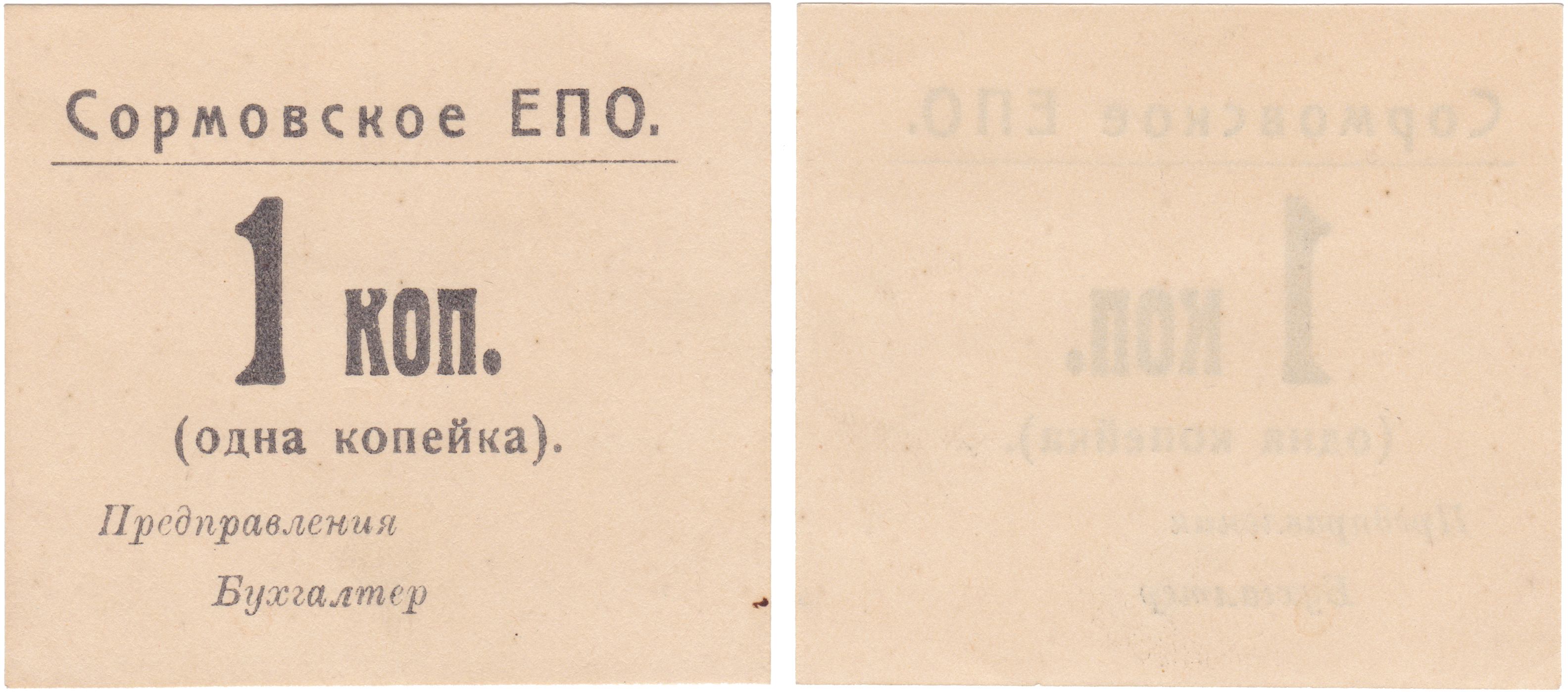
Lunch in the Society’s canteen consisted of two dishes, tea, and bread. For the first course they served soup with a mandatory piece of meat weighing 100 grams; for the second, buckwheat or millet porridge. One pound of white bread and two pounds of black bread were issued, along with several glasses of tea with two lumps of sugar. Such a lunch cost 3 kopecks. Payment in the canteen was made with tokens that were received in the workshop. Their value, as in the shop, was deducted from wages and transferred to the canteen. An outsider could eat there for cash. Over a year, 22,545 lunches were served for 6,763 rubles 50 kopecks.
The issues of scrip of the Sormovo Unified Consumers’ Society can be divided into two groups—scrip for receiving goods in the shop and scrip for payment in the canteen. This scrip belongs to the second issue of money for the canteen.
By a special decree of the Supreme Council of the National Economy dated June 30, 1918, the Sormovo Plant was nationalized. In 1920, the first domestic tank, “Fighter for Freedom, Comrade Lenin,” was built. From 1922 it has been called “Krasnoye Sormovo.”