
Beginning in the 17th century, one of the most important items in the budget of the Russian state became revenue from the sale of alcoholic beverages. Despite its profitability, the alcohol business turned into a constant bone of contention in society. On the one hand, it replenished the treasury; on the other, the price of this prosperity was the degradation and subsequent loss of many human lives, and the разрушение and decline of traditional social foundations. Over the following centuries, the country’s authorities tried unsuccessfully to resolve this extremely painful and controversial issue. Only at the turn of the 19th–20th centuries did the Russian Empire finally find a compromise solution, reflected in the emergence of Guardianships for People’s Sobriety.
Guardianships for People’s Sobriety were a broad range of state-and-public organizations. They were created not only to protect wide segments of the population from drunkenness, but also to promote and instill a sober way of life among the masses.
In 1894, alongside the introduction of the state wine monopoly, Minister of Finance S. Y. Witte put forward the initiative to create Guardianships for People’s Sobriety. The minister’s proposal was supported by the most influential state dignitary of the Russian Empire, the Ober-Procurator of the Holy Synod, K. G. Pobedonostsev. And on December 20, 1894, Emperor Nicholas II approved the organization’s charter, thereby launching a broad public movement across the country.
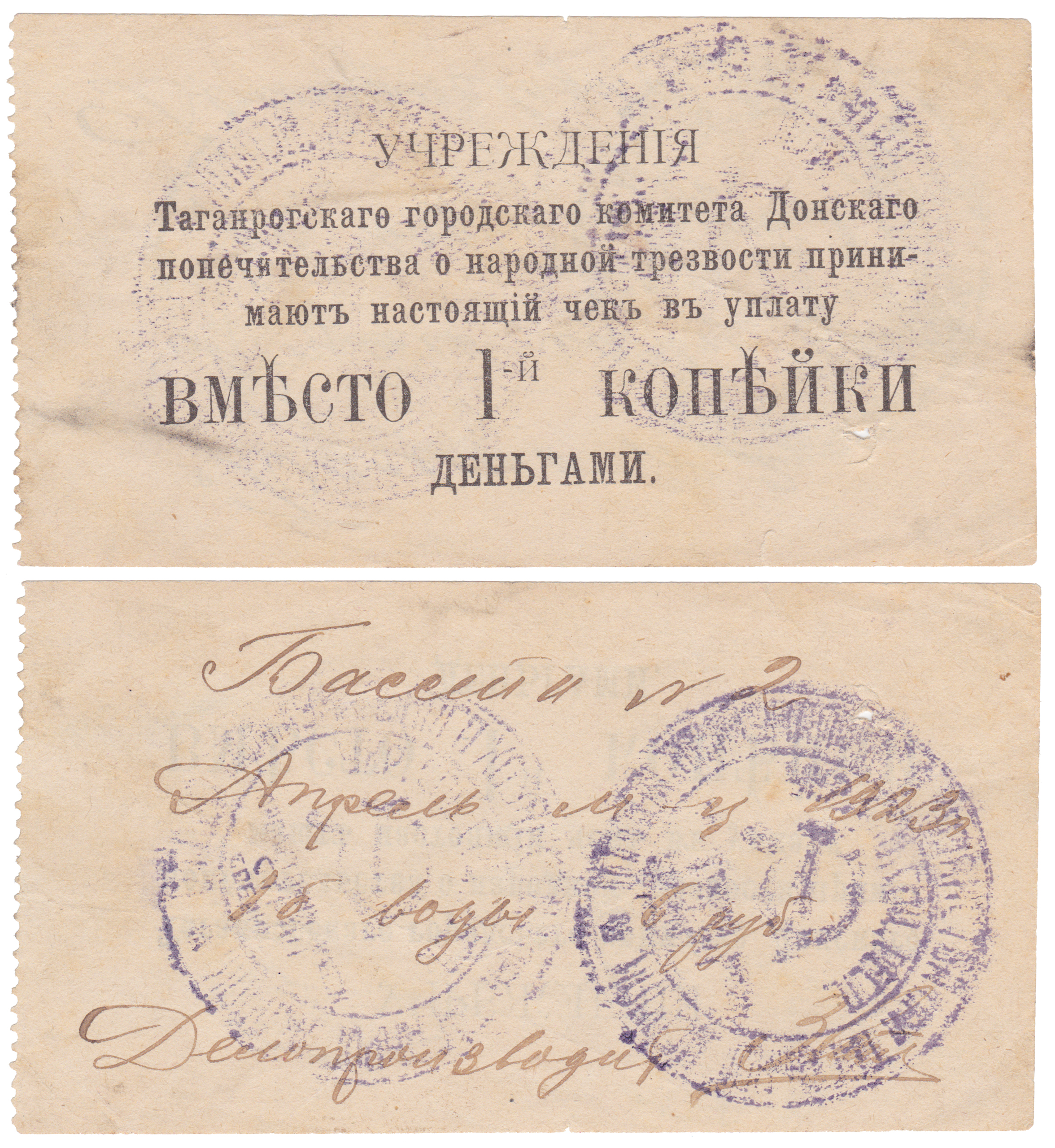
In Taganrog, the most important manifestation of public initiative should be considered the establishment in 1900 of the city committee of the guardianship for people’s sobriety and Sunday schools. Under the committee, two tea rooms and three library-reading rooms operated; public festivities, performances, charity dance evenings, and other entertainments were organized, with their arrangement handled by one of the committee’s energetic figures, the director of the technical school, N. P. Olovyagin.
To a large extent, it was precisely thanks to the efforts of the guardianships that the ban on the sale of спирт, wine, and vodka during the First World War was adopted and successfully observed throughout the country. But, ironically, the very successes of the 1914 prohibition became the reason for a significant reduction in state funding and in the activities of the guardianships.