
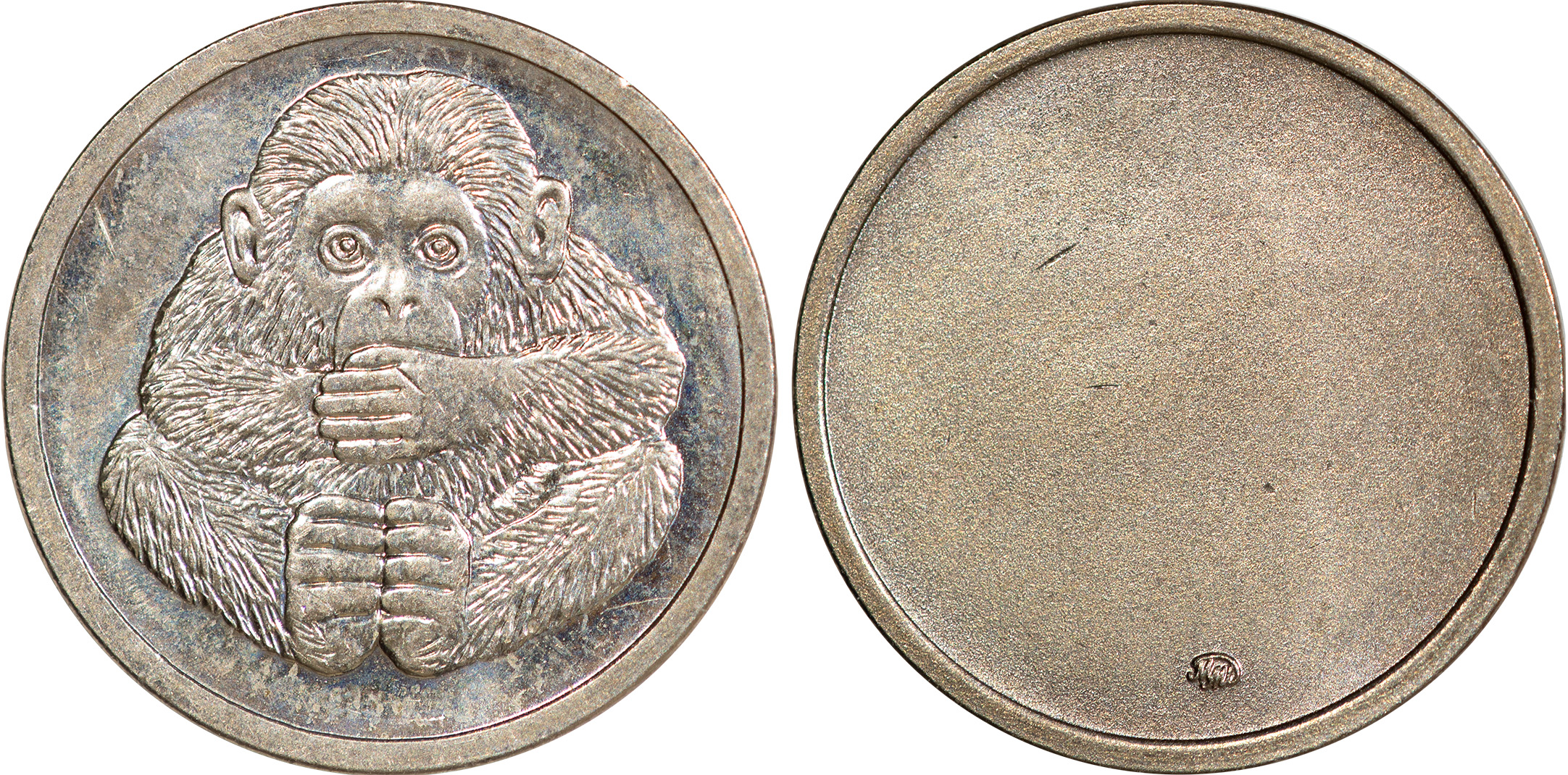
? Three symbolic tokens of the Moscow Mint. The Three Wise Monkeys (Jap. 三猿, sanzaru, or 三匹の猿, sambiki no saru — “three monkeys”) depict three monkeys symbolizing the Buddhist idea of not doing evil and detachment from what is false. “If I do not see evil, do not hear about evil, and say nothing about it, then I am protected from it” — the ideas of “not seeing” (見ざる, mi-zaru), “not hearing” (聞かざる, kika-zaru), and “not speaking” (言わざる, iwa-zaru) about evil.
The “Three Monkeys” became popular in the 17th century thanks to a carved panel above the doors of the Sacred Stable at the famous Shinto shrine Toshogu in the Japanese city of Nikko. Most often, the origin of the symbol is linked to the folk belief Koshin (庚申), which has roots in Chinese Taoism.
It is believed that the symbolism of the three monkeys goes back to the blue-faced deity Vajrayaksha, who protects people from spirits, illnesses, and demons. In the Koshin belief, he was called Shomen-Kongo (青面金剛) and was often depicted accompanied by three monkeys.
According to the tradition of the Tendai Buddhist school, a monk named Saicho brought the three monkeys to Japan from China at the beginning of the 8th century.
A phrase similar to the symbolism of four monkeys appears in the Confucian sayings book “Lunyu”: “Do not look at what is improper; do not listen to what is improper; do not speak what is improper; do not do what is improper” (非禮勿視,非禮勿聽,非禮勿言,非禮勿動).
Parallels to the symbolism of the three monkeys can be found in Taoism (“Zhuangzi” and “Liezi”), Hinduism (“Bhagavad Gita”), Jainism (“Naladiyar”), Sikhism (“Guru Granth Sahib”)[3], Judaism and Christianity (“Ecclesiastes,” “Psalms,” and “Book of Isaiah”), Islam (the Quranic surah “Al-Baqarah”), and other texts and teachings.