
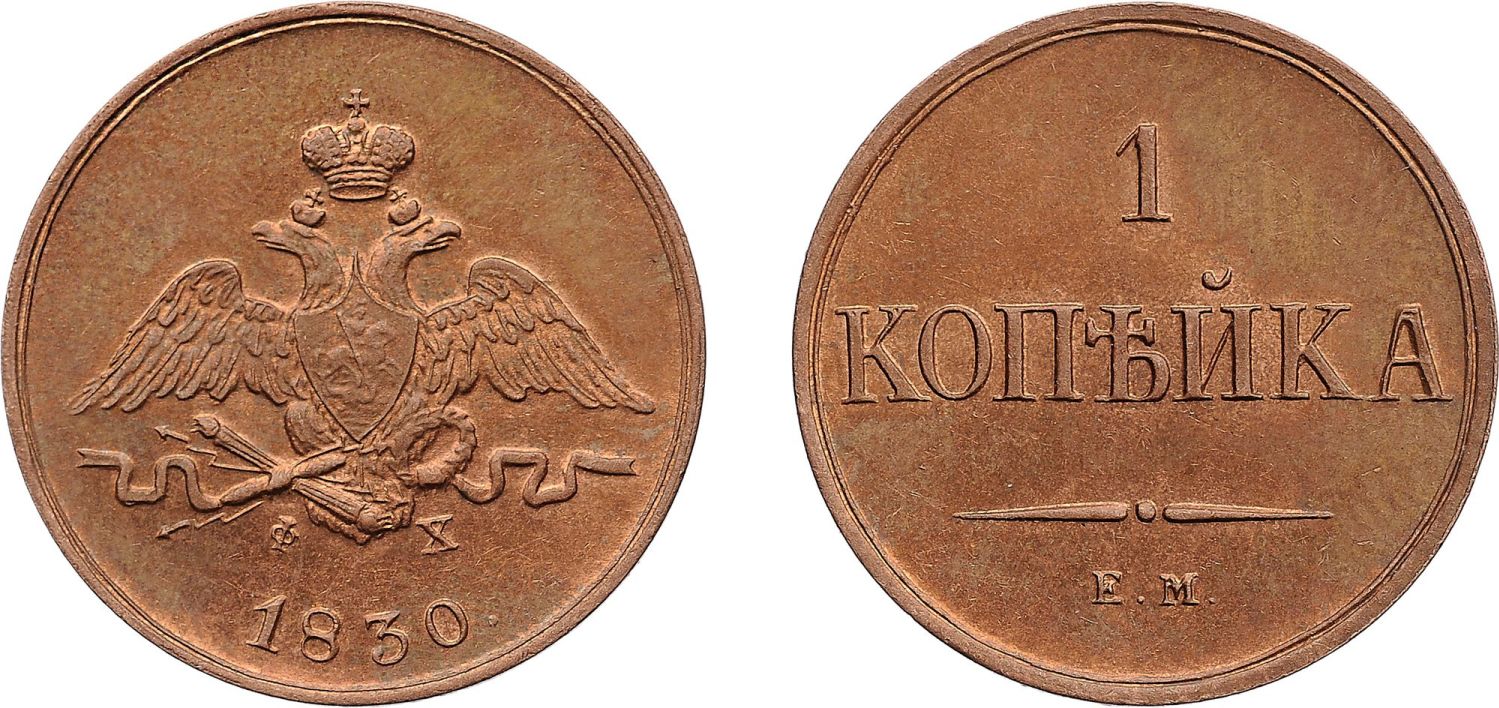
Since 1830, new copper coins began to be minted for circulation. Their weight and design were reduced. A new coat of arms appeared on the coins, which many unofficially call “Masonic” or “wings down.” The obverse bore the coat of arms, with the year of minting beneath it.
State assignation notes continued to depreciate. By 1830, their rate stood at 27 silver kopecks per ruble in assignations. Copper coinage still served as small change for paper money.
June 15 — the plague riot in Sevastopol.
In 1829, Russian troops returning from the war against the Turks brought the plague from beyond the Danube. It struck southern Russia. To prevent the epidemic from mowing people down and spreading further, quarantine was declared in a number of cities, including Sevastopol. That is, leaving them was forbidden. From March 10, 1830, a so-called general cordon was introduced. None of the residents had the right to leave their homes. The city turned into one vast prison. Due to undernourishment and hunger, diseases began to develop. Such a penal regime lasted eighty days. At the same time, officials and officers, having passes, freely visited one another, held parties and balls. Work continued in all institutions, and work went on aboard ships, in the Admiralty, and in naval crews.
A few days before the riot, in the Shipyard Settlement, a sailor’s widow, Zinoviya Shcheglova, died. Every deceased person was to be examined by the staff doctor—just in case: what if it was death from the “terrible contagion,” and then the quarantine would be extended.
Staff doctor Shramkov arrived at the settlement and immediately declared that Shcheglova had died of the plague. To put it mildly, no one was glad to hear it. First, because the quarantine would automatically be prolonged. Second, and much more importantly, the very figure of the staff doctor inspired disgust. Later, when the investigation was underway, testimony was taken from 900 women whose health this doctor had “checked.” All of them ended with the same standard phrase: “Suffered abuse at the hands of staff doctor Shramkov.” What kind of abuse it was becomes clear if one listens to the wife of a non-commissioned officer, Nadezhda Kirillova. She stated that both Shramkov and another staff doctor, Verbolozov, were “lecherous, lustful old men.”
The historian Feoktist Khartakhay, who studied this matter, published a brochure in 1861 called “The Women’s Riot in Sevastopol.” Indeed, the catalyst for the citywide uprising was women’s discontent—apparently quite justified: who would like it when officials of the city administration regularly and with impunity rape women—someone’s widows, wives, and daughters?
Outraged townspeople, along with army and naval units that went over to their side, storm the house of the governor, Lieutenant General Nikolai Stolypin. The governor himself is killed at once—as “the main culprit of the people’s sufferings.”
A second column of rebels captures the head of the quarantine cordon, Rear Admiral Skalovsky, the city commandant, Lieutenant General Turchaninov, and the city head, Nosov. From all of them written pledges are taken that “there was no plague in the city.” Turchaninov issues the following order: “I announce to all residents of the city of Sevastopol that the internal quarantine line in the city has been removed; residents may communicate with one another without hindrance; in churches, services are permitted to be conducted.” Only later did investigators report to Emperor Nicholas I in astonishment: “The riot was not suppressed—it stopped by itself. The very next day the residents returned to their everyday concerns.”
The Sevastopol commandant, Lieutenant General A. P. Turchaninov, who by court decision, “for cowardice and for the committed violation of all service duties,” was stripped of all ranks and awards and reduced to the ranks. The most interesting thing is that it might not have happened at all. For that, it would have been necessary for the pledges “there is no plague in the city” to have appeared two years, or at least one year, earlier.
The fact is that the epidemic was simply assigned. At first—just in case. During the Russo-Turkish War of 1828–1829, there truly was an outbreak of plague in the active army. The warships that took part in the war were based in Sevastopol, and quarantine was a reasonable measure.
And profitable for the authorities. Provisions and fodder for livestock were supposed to be delivered to the city by approved suppliers. The treasury allocated substantial funds for this—the city was to be supplied to the highest standard. But that was only on paper. The supply contracts went to those who “paid off” the city administration. Goods reached the city in smaller quantities and of wretched quality. The difference settled into the pockets of “respectable people.”
But, as luck would have it, the war ended with a victory for Russian arms, and no cases of plague were ever recorded in Sevastopol. The quarantine had to be lifted.
It had to be—but there was no desire to, because the gravy train was working flawlessly. They needed more than a single death from plague—it would not have impressed anyone. They needed those at the top to be convinced: the epidemic exists, it is ruthless, people are dying in heaps—send money, and more of it.
How was it done? Very simply. First, by falsifying mortality statistics. Here is the testimony of Rear Admiral Salti: “The quarantine office tries to present all ordinary diseases as plague.” Here is what Admiral Greig said: “For 5 months people did not hear of anyone falling ill and dying a natural death; whoever fell ill in the crews or at home was declared to have the plague.” How far the staff doctors and the city administration went in their desire to keep the quarantine and continue milking the treasury is shown by the records of the investigative commission: “Some women who died in childbirth, but were declared plague victims, were dragged by day through the whole city in the most shameful condition, without washing the blood off them. And almost naked, bound and bloodied infants…”
Second, natural mortality had to be increased somehow. The fact that people were dying from rotten hardtack, spoiled flour, and stinking salted meat with which the administration supplied the city seemed not enough. And so they came up with compulsory bathing—supposedly only bodily cleanliness would save Sevastopol residents from contagion. On paper it looked splendid—mass hygiene procedures carried out. It did not specify exactly how. And it was like this: in winter, the population of the poorest settlements was herded to bays that did not freeze over and forced to sit in the water. And when, after such “bathing,” pneumonia and fevers began to reap a harvest of death, the city administration relaxed. Hooray! Lots of corpses! Let’s tighten the regime! And even more money to fight the contagion! This was in the spring of 1830. What happened in the summer is already known.