
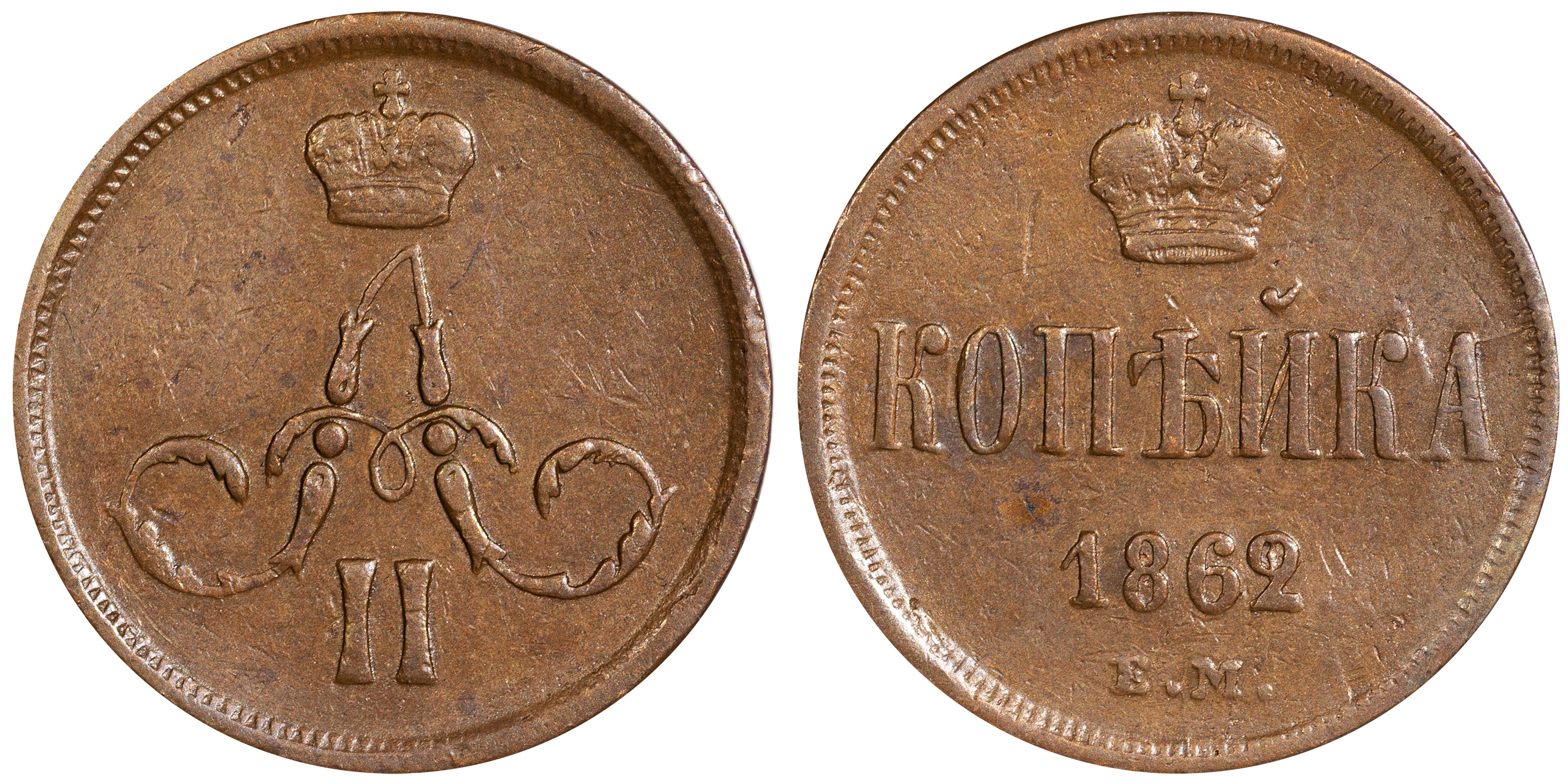
From May 1, the exchange of paper credit notes was opened at a gradually increasing rate announced in advance. At first, the value of a half-imperial was set at 5 rubles 70 kopecks, and the value of a silver ruble at 110 and a quarter credit kopecks. As the rate rose, by July 1, 1863 it was to reach 5 rubles 30 kopecks per half-imperial and 103 kopecks per silver ruble.
On August 26, in Novgorod, the millennium of Russia was officially celebrated.
In June, Grand Duke Konstantin was appointed Viceroy of Poland. The unrest continues and intensifies.
All Sunday schools were closed until special rules governing them are issued.
On March 23, in Saint Petersburg, the first vocational school for boys and girls was opened.
From this year, the state statement of expenditures and revenues for each year, previously secret, began to be published for general information. In other words, for the first time in Russian history, a consolidated state budget was compiled and made public.
In the spring, Lev Nikolaevich Tolstoy, almost in love with Elizaveta Andreevna Bers, went to the Bashkirs to take a kumis cure. In August he returned to Moscow and for the first time paid attention to the middle of the Bers sisters, Sofya Andreevna. On September 16 he proposed, and on September 23 the wedding took place. He was 34, she was 18. After the wedding, without stopping in Moscow, the Tolstoys left for Yasnaya Polyana.
Tchaikovsky, P. I., and Apukhtin were drawn into a homosexual scandal in the Saint Petersburg restaurant "Shotan." Both friends were disgraced throughout the city under the nickname "bugry."
In the summer, N. G. Chernyshevsky and other leaders of the secret revolutionary society "Land and Liberty," which was planning to begin an uprising in the summer of 1863, were arrested. This society had branches in Moscow, Nizhny Novgorod, Kazan, Kharkov, and other cities. It included several hundred people: students, minor clerks, officers, and writers. It was led by the Russian Central People's Committee in Petersburg. Chernyshevsky would spend 678 days in the Peter and Paul Fortress. Before being sent to penal servitude, he would be subjected to a civil execution: raised onto the scaffold, a board reading "State Criminal" hung on his chest, a sword broken over his head, and then he would be chained to a pillory. In prison Chernyshevsky would write the novel "What Is to Be Done?"
In England, a law was enacted establishing joint-stock companies with limited liability of shareholders for the affairs of their company. The number of joint-stock companies and their capital would grow rapidly.