
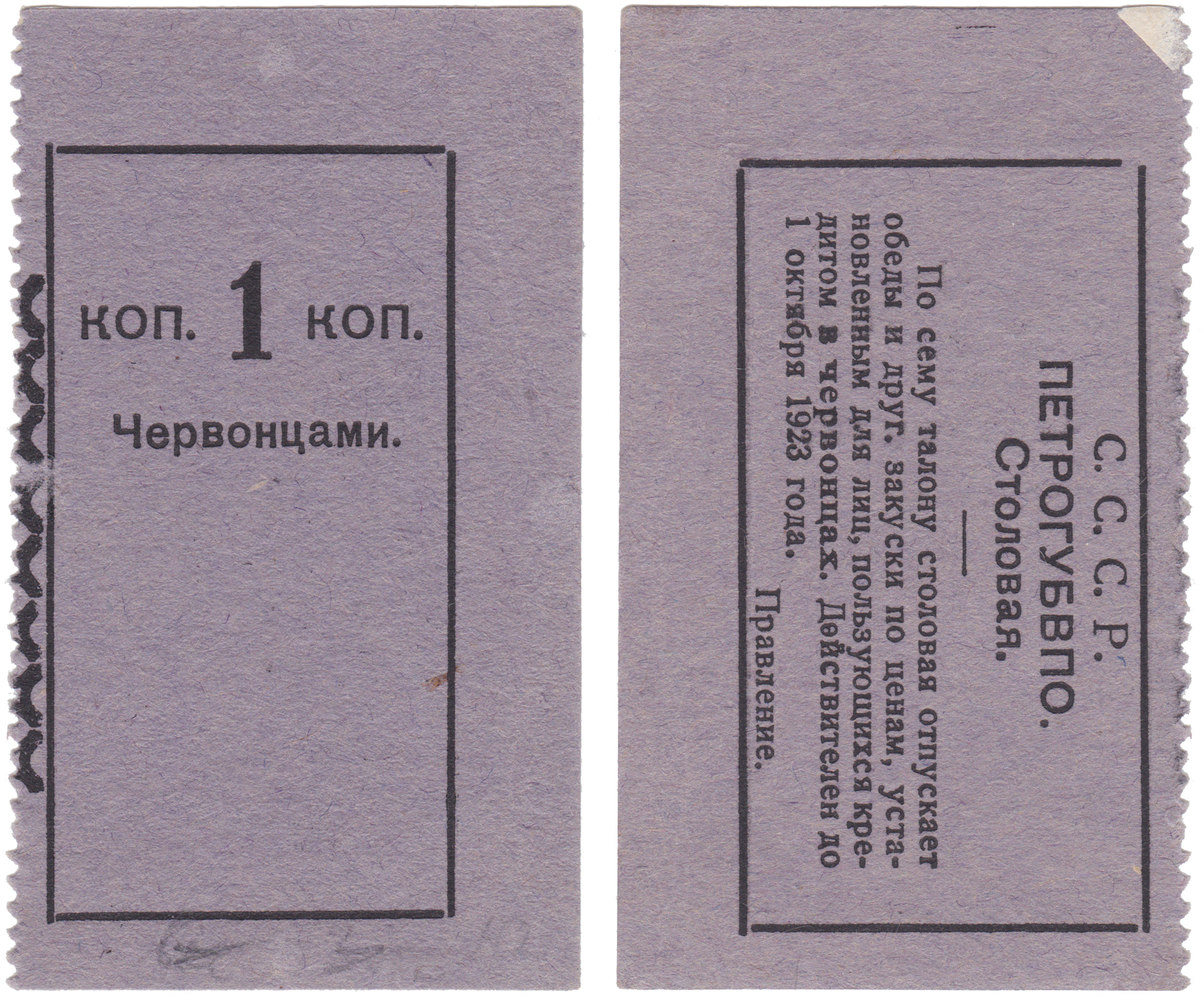
The Petrograd Provincial Military-Consumer Society was located in Petrograd at 3/5 Herzen Street, Bolshaya Morskaya.
The Soviet Union was in great need of a solid financial and monetary system, which required stabilizing the ruble exchange rate and reducing the issuance of banknotes not backed by gold. Thanks to the monetary reform of 1922–1924, the financial system significantly strengthened its position. But to finally defeat inflation in 1922, the government decided to create a stable Soviet currency. That currency became the gold chervonets.
The gold chervonets (the “Sower”) of the 1923 type was minted to the standards of the pre-revolutionary Nikolai 10-ruble gold coin of the 1897 model. The coin contains 7.74235 g of 900 fine gold, weighs 8.6 g, and has a diameter of 22.5 mm. The obverse depicts a peasant sower with a basket over his shoulder against the backdrop of an industrial city.
In December 1922, a denomination of the sovznak was carried out. Old 1922-issue money was exchanged for new money of the 1923 model. One hundred old rubles were exchanged for 1 new ruble, equal to 1 million rubles in banknotes withdrawn from circulation.
Gold chervontsy were used mainly for foreign payments (in parallel with Tsarist gold 10-ruble and 5-ruble coins, which began to be minted again for the same purposes from 1924 using dies preserved at the Leningrad Mint). However, the Sower chervontsy did not enter broad circulation, and exchanging paper money into them was heavily restricted. The chervonets was regarded as an exclusively urban currency.
From late 1922 through May 1923, the purchasing power of this gold coin was extremely high. The widespread introduction of the chervonets into the financial system led to it, starting in October 1923, becoming the unit of account for all currencies and goods, and it remained of great importance for monetary circulation up to the very monetary reform.
However, the gold-coin standard did not last long in the USSR. After 1925, the Sower gold chervonets gradually went out of circulation, since in most capitalist countries a transition to curtailed forms of the gold standard—the gold bullion standard and the gold exchange standard—was already underway. The pure gold standard introduced in Russia in the early 1920s was, after all, an attempt to step into the same river twice, to return to the 19th century of monometallism.