
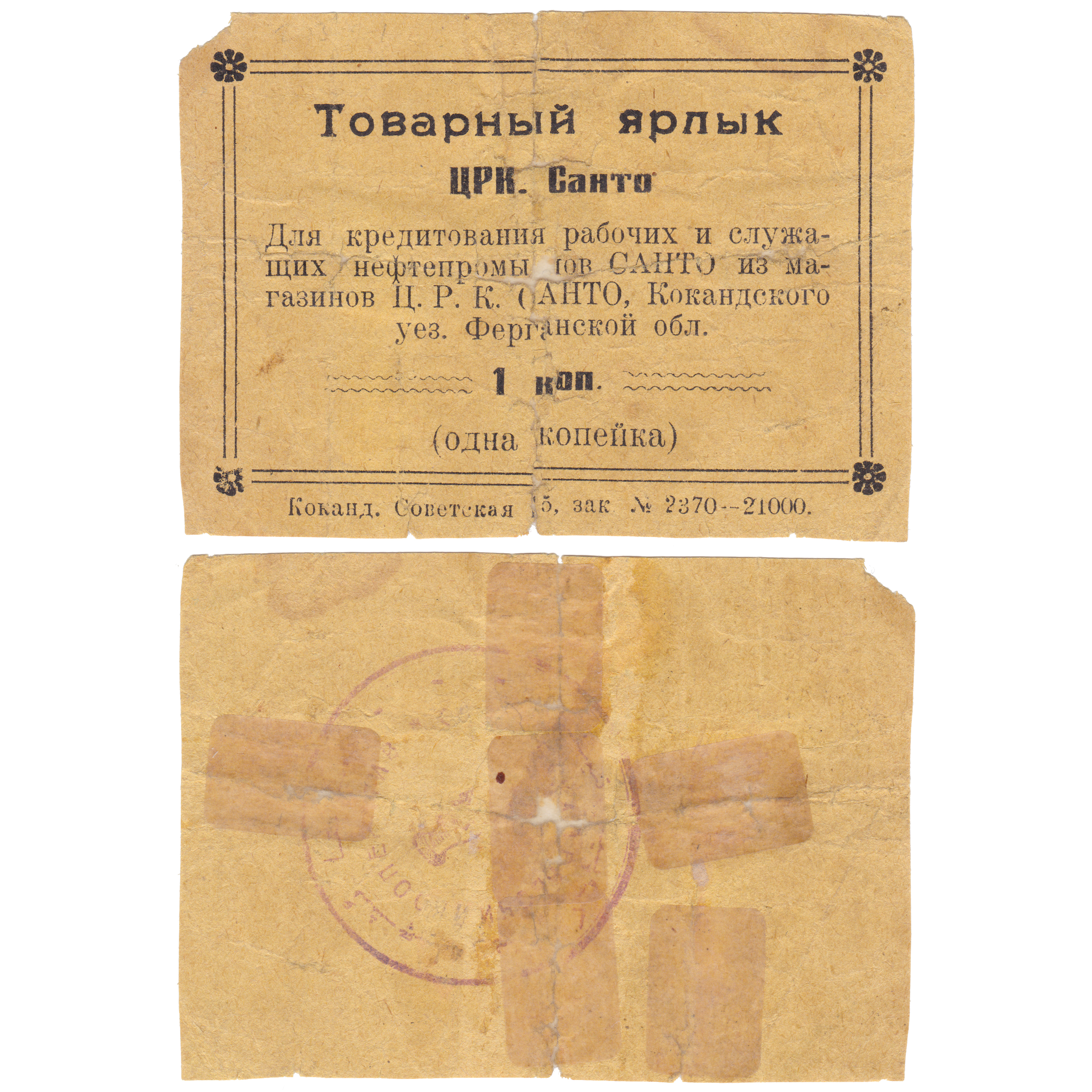
The banknote is depicted in A. Kuznetsov's catalog "Paper Money of Russian Turkestan".
Kokand Uyezd was an administrative-territorial unit of the Fergana Oblast of the Turkestan Governor-Generalship. The administrative center was the city of Kokand.
Kokand Uyezd occupied the western part of the Fergana Oblast and bordered the Khujand Uyezd to the west, the Namangan Uyezd to the north, the Margelan Uyezd to the east, and the Samarkand Uyezd to the south.
Geographically, the uyezd was divided into two parts: a southern upland and a northern lowland. The southern, larger part included the northern spurs and foothills of the Alay Range. The northern part included the southwestern section of the Fergana Valley.
In 1893, 246,880 people lived in the uyezd. The population consisted of Sarts, Turks and Tajiks, Kyrgyz, and Uzbeks. According to data from 1883, the number of Russians did not exceed 360 people.
In 1866, imperial troops completely seized Tashkent. After the capture of Tashkent and the Fergana Oblast, Central Asia was in political dependence on Russia. The Turkestan Oblast became part of the Russian state. In 1876, the Fergana Oblast was formed in place of the Kokand Khanate.
By a special assignment of the Russian state, a group of scientists was sent to Central Asia, including to Kanibadam, to study natural resources. In Kanibadam, vast underground resources were discovered, including oil and coal. The Shurab coal mine, an oil-processing enterprise, and settlements for Russian emigrants were built.
In 1916, an oil-processing plant was built near the SANTO settlement, and in Kanibadam a cotton-ginning plant and an oil mill were built. The construction of the railway, the launch of the first industrial enterprises, the establishment of coal and oil extraction, and cooperation with Russian specialists led to the emergence of a working class in Kanibadam, which fundamentally changed the socio-political, economic, and cultural life of the people. As enterprises grew and industry developed, the city's population also increased. In 1917, Kanibadam had 30,000 residents, and the SANTO settlement had more than 1,010 residents.
The victory of the bourgeois revolution in February 1917 in Russia affected not only Russia's socio-political life but also changed the lives of the peoples of Central Asia. Workers of the SANTO coal mine in Kanibadam organized a Council of Workers and Soldiers. This Council defended workers' interests and established workers' control over production.
When the October Revolution took place in Russia, the "Kokand Autonomy" was formed in Kokand, whose leaders called on the people to fight against the revolutionary government. Supporters of the Kokand Autonomy temporarily surrounded the Red Army garrison. The temporary autonomous "government" of Kokand did not last long. In a very short time, revolutionary forces overthrew this government.