
The construction of tram tracks in Pyatigorsk was first considered at the beginning of the last century. At the time, the authorities did everything possible to turn the Caucasian Mineral Waters region into world-class resorts that could outshine the French Vichy, popular then among the Russian nobility.
One of the key tasks was transport development. In Pyatigorsk, luxurious villas and boarding houses were located in a difficult spot—on the fairly high southern slope of Mount Mashuk. To make it easier for visitors to reach the “spa waters” life, this small narrow-gauge line was built. Tourists arriving at the railway station would transfer to the tram and, within a few minutes, ride up to the top.
On September 1, 1903—marking the 100th anniversary of Kavminvody—the cars were first put into service in Pyatigorsk.
The Pyatigorsk tram became one of the very first in Russia. Even in the capital, Saint Petersburg, people were still getting around by horse-drawn trams at that time. Its construction and launch cost the Kavminvody administration 493,000 rubles.
At first it was a single-track line, and only later, around 1907, two tracks were laid. The transport system was also unique for its special narrow gauge, like its European “counterparts.” Today, the same gauge exists only in Kaliningrad and Yevpatoria; in other Russian cities, trams have long been running on “standard-gauge” rails.
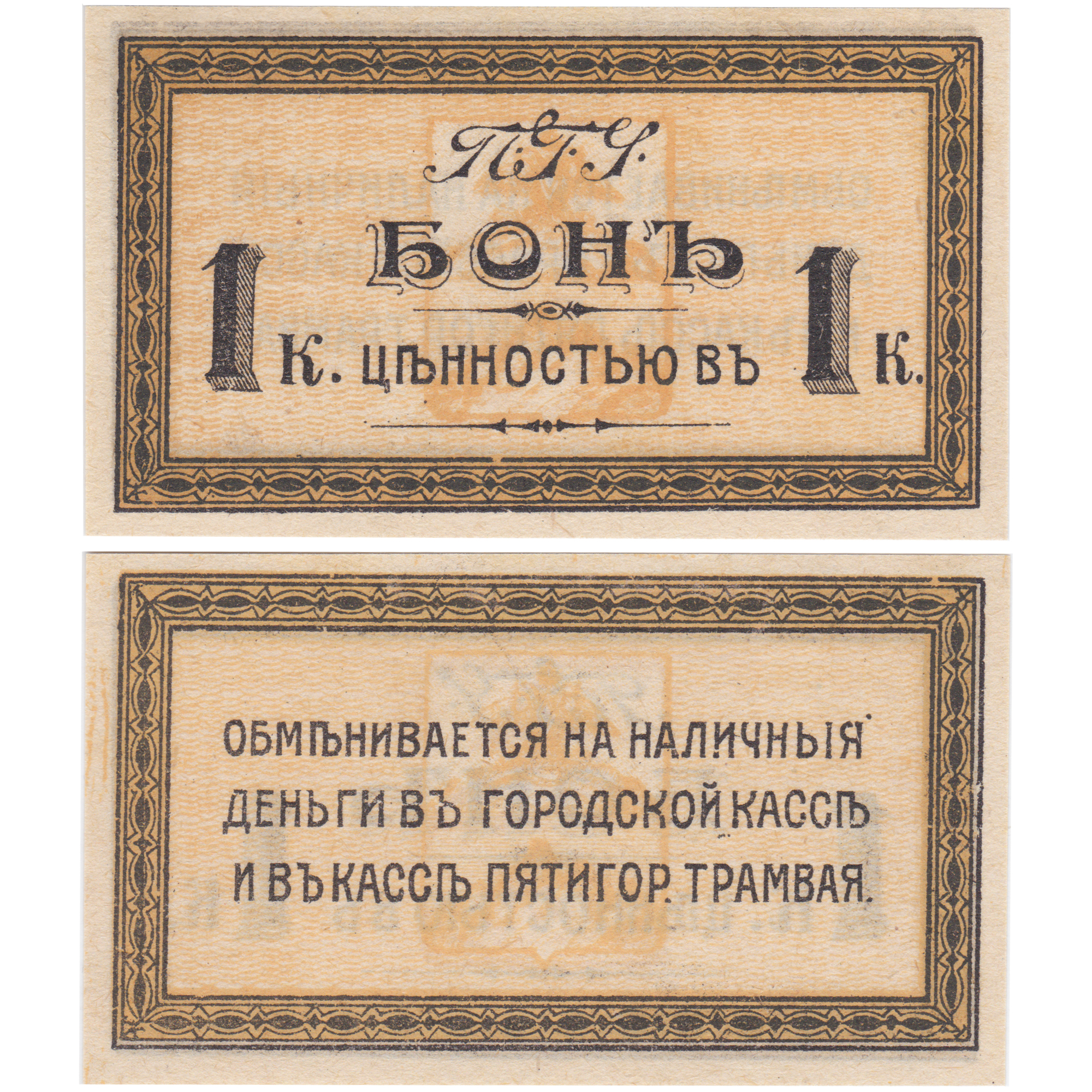
In 1918, during the Civil War in the North Caucasus, the Pyatigorsk city administration, amid a severe shortage of small change, issued money substitutes—scrip notes in denominations of 1, 2, and 3 kopecks—which could be used to pay tram fares or to purchase goods and services at the tram administration’s shop. In the lattice pattern of the background on both sides of the change notes, the pre-revolutionary coat of arms of Pyatigorsk is depicted: “The shield is divided into two halves: in the upper— the coat of arms of the Caucasus Oblast; in the lower—Mount Beshtau (or the Five Mountains) with a mineral-water spring flowing out at its foot.” On the front side is the inscription “P. G. U. Scrip worth 1 (2 or 3) k.” On the reverse: “Exchangeable for cash at the city treasury and the Pyatigorsk tram cash desk.”
This is so-called “Notgeld” (Ger. Notgeld—emergency/forced money): a money substitute, money for extraordinary circumstances, special means of payment put into circulation by local authorities or private companies to cover a shortage of funds, and recognized (de facto) by the authorities as equivalent to ordinary money.
These strange documents are witnesses to the tragic events of the Civil War in Southern Russia, where in many cities power changed hands many times. With it, money changed as well. The new authorities sometimes recognized the money of the previous regime, often for lack of their own. And sometimes, when a government left, it took all the money with it.
Monetary signs from the Civil War period often were not money in the full sense of the word. Some “money” was issued by local authorities and non-governmental organizations. The tram had its own money too. The tram is a living witness to the life of the city in which it “lives.”
It was precisely at this time that such “tram money” appeared, so that people could at least somehow pay and receive change when paying fares. Officially, they were not called money, but most likely they functioned as such in practice and were accepted for payment. The socio-economic importance of urban public transport was extremely high; most city residents used the tram. Despite the ephemeral nature of such money, the population treated it with full trust.
Similar “tram money” appeared in Yekaterinodar, Rostov-on-Don, and Odessa.