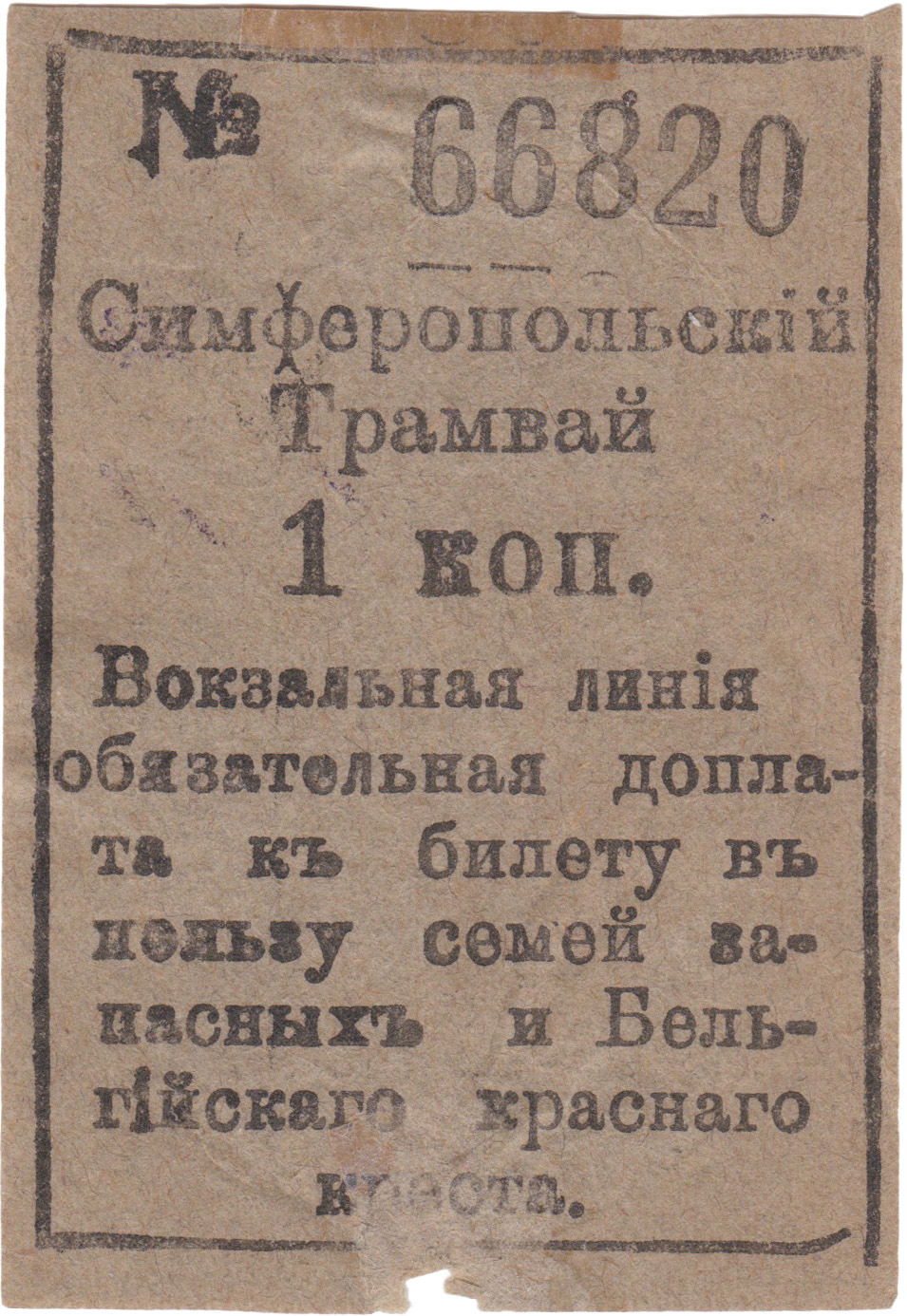
In 1911, the City Duma entered into an agreement with a Belgian concessionaire, engineer E.L. Bernard-Bormann, who contributed funds to establish the "Belgian Anonymous Society of Simferopol Electric Trams and Lighting." Within two years, the construction of the power station and the tram depot building was completed.
The laying of tracks and installation of poles began in the summer of 1913, with the track gauge set at 1000 mm. The work was supervised by E.L. Bernard-Bormann, director of the joint-stock company in Simferopol.
At the beginning of 1914, the first motor cars (17 units) from the "Ragheno" plant began arriving from Belgium, followed later by three open trailer cars from the Gudarville plant. Test runs were conducted in the depot area in June.
On July 31, 1914, at 11 a.m., a ceremonial inauguration of tram service took place on the premises of the central station of the Belgian Anonymous Joint-Stock Company. The first tram line was the "Station Line," which ran from the railway station along Station Street, Ekaterininskaya Street, Pushkinskaya Street, Dvoryanskaya Street, Fountain Square, and then along Sevastopolskaya Street, Kantarnaya Street, and Nizhnegospitalnaya Street.
The second line, the "Sevastopol-Feodosia Line," was opened in October 1914 and ran from a dead end on Novo-Sadovaya Street, along Sevastopolskaya Street, past the Bazaar, and along Salgirnaya Street to the Feodosia Bridge.
After the completion of a new bridge across the Salgir River, the tram line was extended across it to the Khristoforov House on August 15, 1915.
The third line, the "Betlingovskaya Line," was opened on August 29, 1914. The route ran along Podgornaya Street, Shkolnaya Street, Lazarevskaya Street, Fabra Lane, and along Pushkinskaya Street, Gogolevskaya Street, Markovskaya Street, and Betlingovskaya Street to the Shestirekovskaya Settlement. The depot inventory included 17 motor cars and 7 trailer cars. During the period of the revolution and the Civil War, the tram service was almost completely suspended.
Voluntary surcharge on the ticket in favor of the families of reservists and the Belgian Red Cross 1 Kopek 1914.