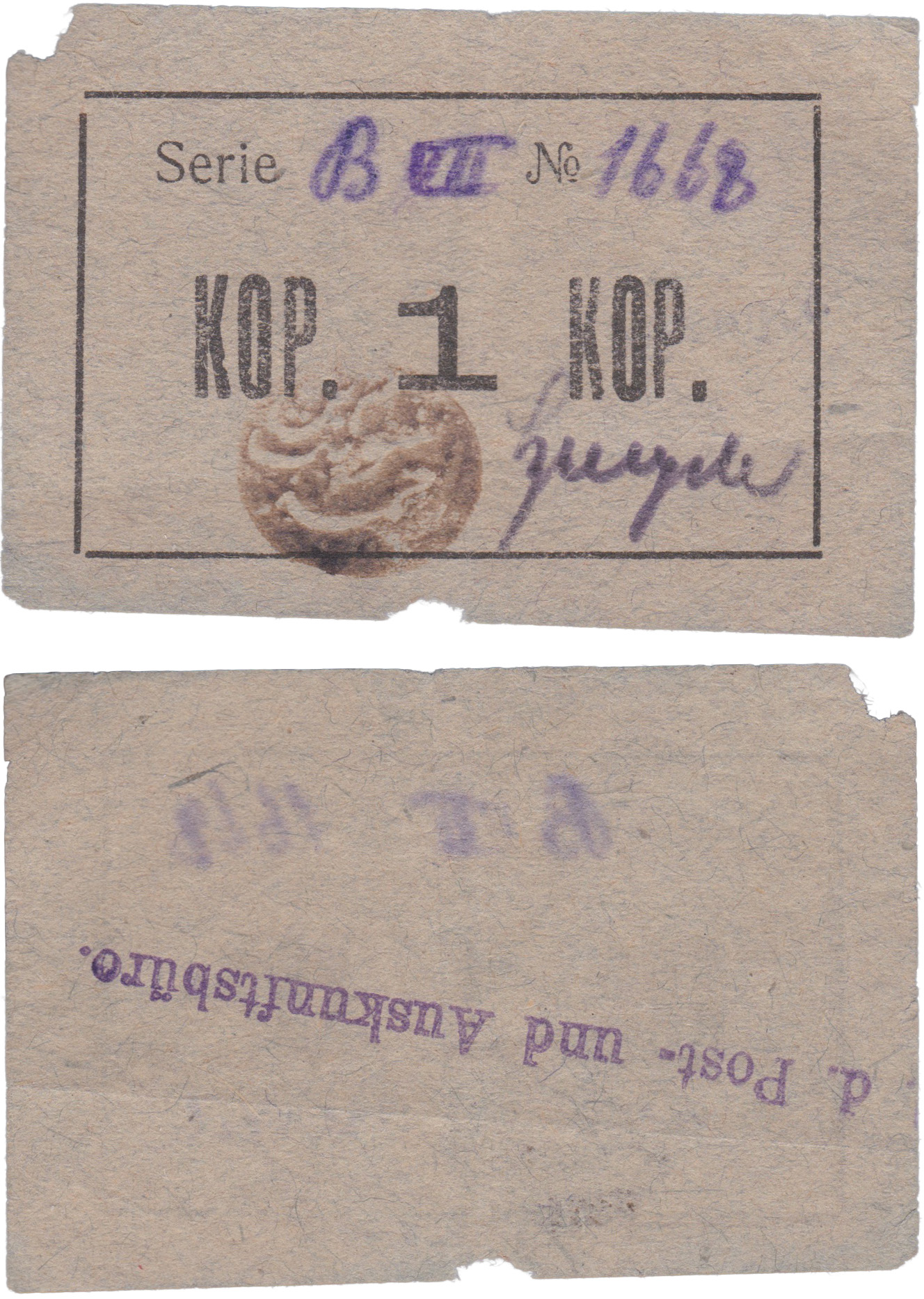
Inscription on the reverse: d. Post- und Auskunftsbüro. (Post and Information Office.)
During the First World War, numerous prisoner-of-war camps were established on Russian territory. One such camp was located in Dauria, at a station on the Transbaikal Railway, situated approximately 50 km from where the railway crosses the Chinese border.
Dauria station was founded in the early 20th century during the construction of the Kaidalovo branch line (now part of the Transbaikal Railway). During the First World War, a camp for Austro-Hungarian prisoners of war was organized there.
By 1916, the camp held about 11,500 people. By 1917, the camp continued to function despite the political and social upheavals in the country (the February and October Revolutions).
These tokens were used for internal circulation within the camp — to pay for services and purchase goods.
The camp in Dauria was guarded by the 720th Foot Perm Druzhina of the State Militia. The guard ensured the safety of both the prisoners of war themselves and the surrounding areas.
After the revolution, maintaining order in prisoner-of-war camps became increasingly problematic. The issue of camp security became more acute. By 1917, the number of military personnel had become so limited that there were not enough people to perform guard duty, protect prisoners of war, and secure the railways. The guarding of prisoner-of-war camps was assigned to state militia druzhinas, which were not always known for their discipline.
In June 1920, the Presidium of the People's Assembly of the Far Eastern Republic (FER) issued a final resolution on the liquidation of the camps for "former prisoners of war of the imperialist war" and simultaneously declared their contingent to be "free citizens of the Far Eastern Republic." The authorities ceased to pay attention to the fate of the former prisoners. However, for several thousand new citizens of the FER, long-awaited freedom in this situation became forced. Prisoners of war who remained in assembly points on the territory of "White" Russian Primorye suffered the same fate. From the autumn of 1920, they were transferred to "free maintenance" and forced to vacate the premises they had previously occupied, which essentially meant being thrown out onto the street. The last prisoners of war left Vladivostok only in mid-1921, with the assistance of foreign consulates and Red Cross missions.
1 Kopek 1917.