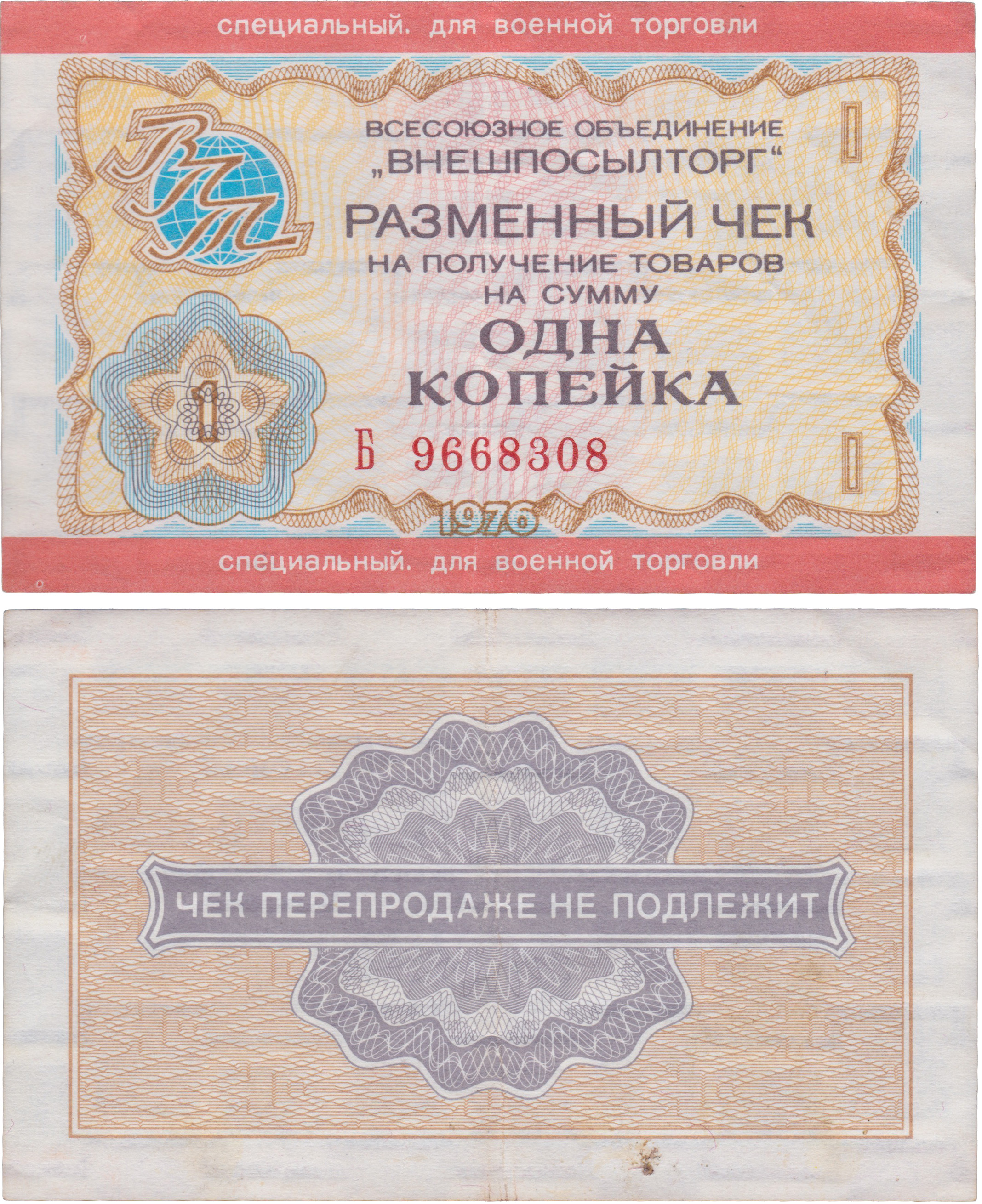
Issue for military personnel of the Limited Contingent of Soviet Forces in Afghanistan.
Military personnel of the Soviet contingent in Afghanistan received their financial allowance through a special system. In addition to a doubled ruble salary (with no income tax deducted), officers and warrant officers were issued an extra amount in checks from the Foreign Trade Procurement Commission. For enlisted men and sergeants, such checks were practically the only source of income, as they were not entitled to ruble pay.
The payment amounts varied: privates and sergeants received 4–8 rubles per month; junior officers and warrant officers about 100 rubles; senior officers and generals up to 150 rubles. By the end of the war, these amounts had increased significantly, with payments for officers nearly doubling.
VPT checks were a special form of quasi-currency, with denominations ranging from 1 kopeck to 100 rubles. They were not Soviet money in the direct sense and could only be used in specialized stores abroad or at the "Beryozka" chain within the USSR. This system prevented an uncontrolled circulation of rubles in the Afghan economy and isolated military personnel from the local currency, which had no value in the Soviet Union. Additionally, the checks served as an effective tool for material incentives in combat conditions, and their circulation was easily controlled through strictly designated retail outlets.
At Voentorg (military trade) stores, checks could be used to purchase scarce goods: Japanese audio equipment, watches, carpets, quality clothing, and food. Saving up for large purchases was relatively quick — over a two-year service period, a junior officer could accumulate enough for a Zhiguli car, while a senior officer could even afford a Volga. There was even a practice of priority car purchase if an officer could pay 25% of its cost with checks.
The high value of the checks gave rise to a black market, where their exchange rate reached 3.5 Soviet rubles per one check — a level comparable to the unofficial dollar exchange rate. To combat speculation, large-denomination checks were marked with special stamps, and purchases at Beryozka stores required a military ID.
This complex financial system reflected the enormous economic costs of the Afghan campaign for the USSR. According to various estimates, total expenditures over the ten-year conflict ranged from 30 to 40 billion rubles — up to 3% of the country's annual GDP. Thus, the VPT check mechanism simultaneously addressed the objectives of currency control, personnel incentives, and protecting the Soviet financial system during a local war.
Exchange certificate for receiving goods in the amount of 1 Kopeck 1976.
All-Union Association Vnesposyltorg. Without stripe. Series D.