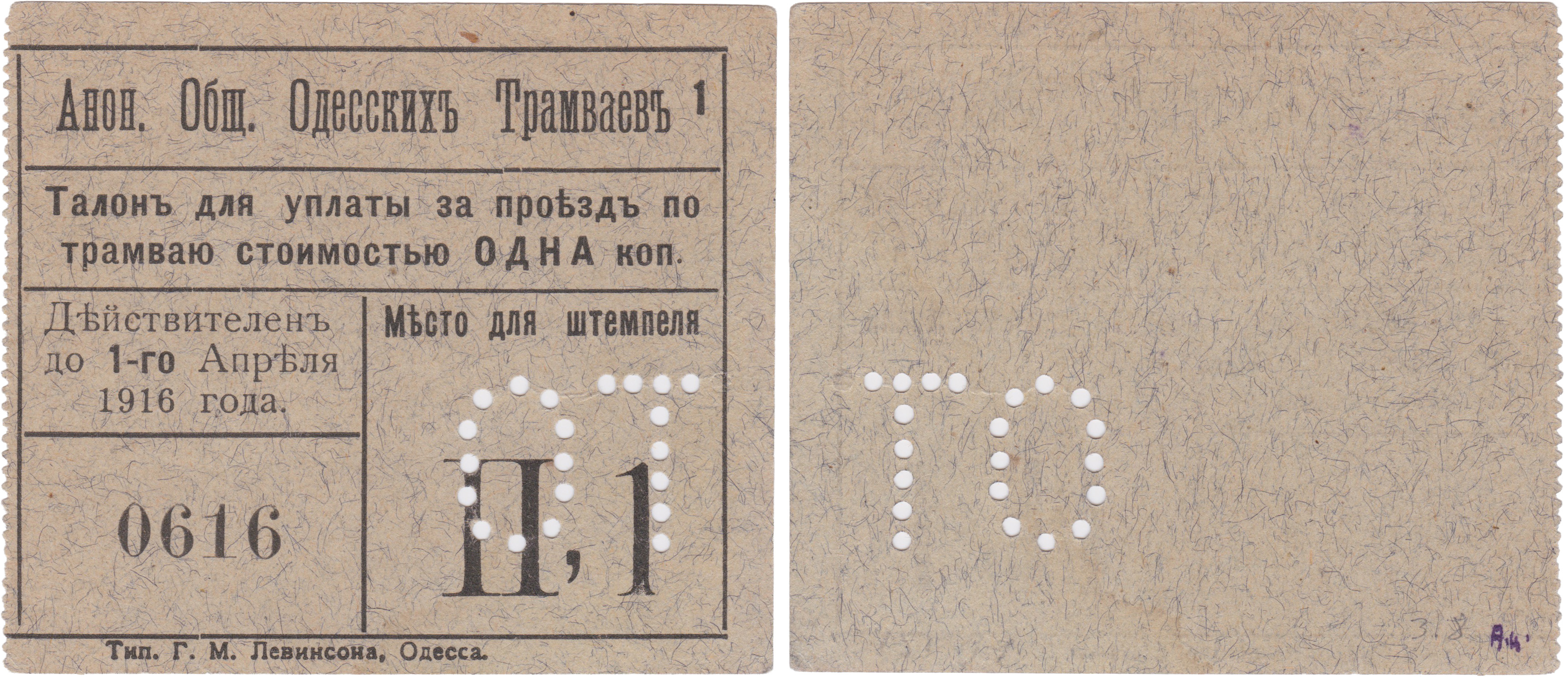
The word “anonymous” means “joint-stock,” i.e., with bearer shares, without indicating the shareholder’s name. The “Belgian Company of Odessa Horse Railways” was established in 1880 and was engaged in the construction and operation of railcars with horse traction, and later steam traction, in the city of Odessa.
The “anonymous company” tokens appeared during World War I. They were intended so that, under conditions of the near-complete disappearance of coins from circulation, conductors could give passengers change. Possibly, in an era of monetary shortage and confusion, they could serve as small change. Only in 1924, when the monetary system was brought into order, was a decree issued by the Council of Labor and Defense “On prohibiting the issuance of monetary surrogates.”
At the very beginning of 1870, Messrs. Chizhevich, Scaramanga, Kolman, and Shmetov submitted a document to the Odessa City General Duma according to which the above-mentioned gentlemen undertook to build horse railways in Odessa. On February 27, the concessionaires paid 27,000 as a deposit into the city treasury. The City Duma spent exactly one year reviewing the concessionaires’ application. And now you demand that officials respond to your inquiries within 30 days…
Thus, in February 1871, a “draft” contract was signed between the concessionaires and the executive Duma, after which the draft was sent for approval to the Ministry of Internal Affairs. Yes, at that time the Ministry of Internal Affairs had far more of those very “affairs” and powers. But by then changes had occurred in the city’s administrative structure, and the ministry returned the draft for discussion in the Odessa Duma of the updated composition.
Less than three years passed before, in March 1874 (!), the new Duma finally approved and sent to the Ministry of Internal Affairs a draft for establishing horse railways in Odessa. But at that time the Ministry of Railways and the Ministry of Internal Affairs began a debate over which agency had jurisdiction over this matter. In November 1874, a compromise was found: “Odessa within the city limits was under the jurisdiction of the Ministry of Internal Affairs, and in the port it fell under the authority of the Ministry of Railways and Finance.” In the end, this issue too was agreed upon. But in January 1875, it was decided to revise the contract and approve it once again. The commission that was formed demanded widening the gauge between the rails from 4 to 7 feet (with maintenance and repair of the paving to fall on the concessionaires). And, after 5 years of ordeals, the contract was signed (November 11, 1875). And already in January 1876, the concessionaires submitted to the City Duma three copies of the project (together with plans, drawings, and descriptions of the roads). The City Duma considered these documents incomplete and sent them back for revision (modern entrepreneurs may find this situation painfully familiar). In April 1876, all documents were signed. The concessionaires purchased materials and began work. But, as it turned out, the place allocated by the city for the tram track lay above a main water-supply pipeline. On March 20, 1876, a collapse occurred, and the track ended up under water. The concessionaires appealed to the City Duma with a request to relocate the water-supply pipe. But the Odessa Waterworks Company refused to move the pipe. Work on laying the first line of the Odessa tram was halted. In early May, there was a joint site visit by the entrepreneurs and city officials to the авария site. Next I will quote Chizhevich himself (1878): “We gathered, talked, came to the conclusion that it would be good to move the water pipe, and dispersed, having done nothing. And that is where the matter stopped, so the collapse can still be seen even now.”
The concession for laying horse railways was a very costly undertaking (though it promised large profits in the future). Therefore, as early as 1875, negotiations with potential investors began in London. But as soon as the press published information about the issuance of shares of the Horse Railway Company in Odessa, the entire London press erupted with articles about the impossibility of organizing horse railways in Odessa. For example, the well-known newspaper The Times argued that Odessa was built on hills, and therefore horse railways there were impossible! Despite this, in July 1876, permission to issue shares was obtained.
And then came 1877. The Odessa concessionaires were again very unlucky. War began between the Russian Empire and Turkey. And most shareholders demanded the return of their initial contributions. The Odessa entrepreneurs’ idea was completely destroyed.
And in August 1879, an agreement was concluded between the Odessa City Duma and representatives of the Belgian Horse Railway Company (the contract on behalf of the company was signed by the French subject Pierre Clement Bonnet). And already in 1880, the first horse-railway line in Odessa was opened.
Coupon for paying for travel at a cost of 1 Kopeck 1916.
Anonymous Society of Odessa Tramways, P,1.