
The village of Kasyanovo in the Nizhneingashsky District of Krasnoyarsk Krai.
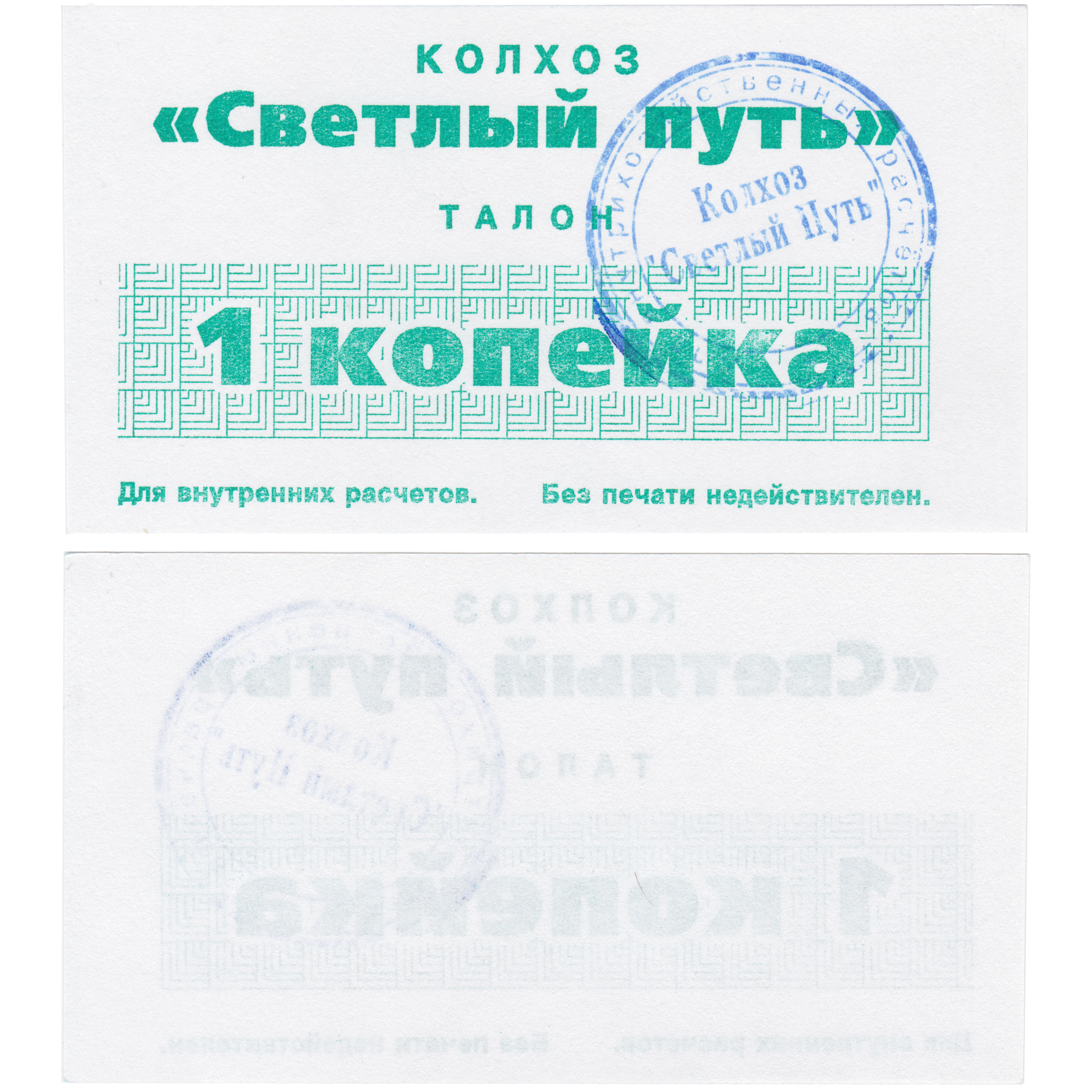
The vouchers of the “Svetly Put” Collective Farm may possibly be collectible forgeries.
The longest series of banknotes. // Collector’s Shop 1998. No. 7. P. 3.
Vladimir POLYAKOV
When perestroika began, numismatists of paper money had it easy—where did the former dreary standard requests to search for rarities from different periods of the past go, when any enterprise had the opportunity to issue rubles and vouchers, checks and orders, and all one had to do was manage to accumulate information and not refuse offers to acquire new issues. At first even collectors who had been collecting banknotes for more than a year easily got caught out by not acquiring simple private issues, relying on their easy availability in the future as well. In reality it turned out that many of them flashed by like meteors, and finding them now is almost impossible. Today there are few collectors who hastened to research the issues, determine print runs, varieties, and elements of rarity. If a number of private issues had typographic data about the print run, then most had no such data, and at times even the year of issue is hard to establish. And after some time, when forms of ownership began to break down, abuses of these issues appeared, forgeries; private issues began to cease circulating fairly quickly, were withdrawn, and destroyed. Nothing remained—neither the notes themselves, nor drawings, nor descriptions. Many of these issues will become rare or even unique, but the true state of affairs will be known only when collectors take up research.
About three years ago a series of notes came into my hands, primitively designed, with some variety in the drawings, in which one could trace that they were ordered and produced at the same time. We are talking about notes that relate to agricultural enterprises of the Nizhneingashsky District of Krasnoyarsk Krai. Over the course of a year, bit by bit, it was possible to gather some data: they were ordered during one of the zonal meetings along the lines of the collapsing Agro-Industrial Complex, and were prepared in one place for everyone who wished to acquire their own currency. However, further events developed quite differently. In the district (the meeting was not in the district center) all the prepared signs remained unredeemed, and later were even partially burned when the premises were cleared for other needs. One former collector saved part of the notes from destruction when he saw preparations beginning for a bonfire. The little old man who supervised the clearing of the room said that the ledger listed either 12 or 15 agricultural enterprises, but exactly how many and which ones he did not remember. He also said that the ink color of the stamp mattered. Black was for livestock workers, purple for crop growers, blue for administration and pensioners, and red for those either not living in or not working at the collective farm. There were 17 denominations in total, the same number for all; one thousand pieces of each denomination were printed, so there could have been no more than 250 sets, and how many remained is unknown.
In total, notes from seven collective farms and agricultural cooperatives were found in two small boxes. The denominations were: 1, 2, 3, 5, 10, 15, 20, 25, 50 kopecks; 1, 2, 3, 5, 10, 25, 50 and 100 rubles (17 denominations). It turned out that a single full set contained sixty-eight notes! I have never encountered such a long one-time series again, although I have been collecting for over 50 years!
It has been noted that there are no more than ten sets of notes of the “Mayak” collective farm that bear the stamp of the “Svetly Put” collective farm (a set of one stamp color, 17 pieces, and not 68 as in other cases). Apparently, during preparation for stamping they mistakenly used a different seal, but did not discard the defective pieces due to the need for an even count.
For a number of agricultural enterprises the names did not correspond to the names of that period. It turned out that the organizations ordering the notes intended to make some changes not only to names but also to the statuses of agricultural formations. For example, “Lenin’s Precepts” was in fact “Lenin’s Path” (the village of Sokolovka). They wanted to change the signboard of the branch in the village of Kasnovka from “Verny Put” (the management in the village of Pavlovka) to “Svetly Put.” They were going to bring back “Red Fighter” from the period of consolidation, although the village with the same name had already ceased to exist. Transforming the “Estonia” collective farm into the “Siberian” cooperative would surely have deprived the district of a stable, highly profitable farm with established traditions and hardworking people.
These series, as in a mirror, reflect a difficult period in the life of rural districts.
If any collectors of paper money need these sets (I have several for exchange), write to me; I will definitely reply.
Lieutenant Colonel of the Medical Service (retired)
Vladimir POLYAKOV,
staff correspondent of “LK”.
“30099, Novosibirsk-99,
P.O. Box 147.
The longest… forgery // Collector’s Shop 1999 No. 5(14) P. 4
Vladimir CHAGIN
This story began about two years ago, when one collector from the city of Novosibirsk started offering to notaphilists who collect modern local money substitutes notes of several Siberian farms: the “Mayak” collective farm, “Lenin’s Precepts,” and others. But since these notes had never and nowhere been encountered before and, besides the name of the farm and the denomination, contained no other concrete information, they immediately raised doubts about their authenticity.
Nevertheless, as later became clear, some collectors did buy these notes, and in the end they ended up in full in the “Catalog of Modern Self-Financing and Private Monetary Signs” (Kyiv, 1998), published by P. Ryabchenko, taking up more than eight pages there! In the catalog, the farms that allegedly issued the notes were attributed to the Nizhneingashsky District of Krasnoyarsk Krai; the localities on whose territory they allegedly were located were also indicated: Sokolovo, Maksakovo, Verkhny Ingash, Aleksandrovo, Kasyanovo, Sretenka. I note at once that some of these villages in fact bear different, though similar, names: Sokolovka, Maksakovka, Kasyanovka, Stretenka.
So what are these “internal settlement” vouchers of seven collective farms and agricultural cooperatives?
Their full set (according to the catalog) consists of no less than 493 notes! This enormous figure was formed from 17 denominations of each issue (from 1 kopeck to 100 rubles), multiplied by four—by the color variants of the stamps—plus 17 notes of the “Mayak” collective farm with the stamps of the “Svetly Put” collective farm. The notes are of one type, which, according to the owner of the notes, is explained by the fact that all of them at one stroke “were ordered at some meeting.”
But it was not even this incredible number of notes from a remote district of Krasnoyarsk Krai, which suddenly appeared on the collectors’ market, that aroused suspicion… First, in 1991, the year in which the notes were allegedly issued, there was no special need to print kopeck denominations (1, 2, 3, 5 up to 50 kopecks) (and a year later, due to inflation, kopecks lost any meaning at all). It is no coincidence that kopeck notes in local issues of Krasnoyarsk Krai of that time simply do not exist. For example, the earliest self-financing checks of the Krasnoyarsk plant of medical preparations, from 1989, already had the smallest denomination of 1 ruble.
Second, the very method of producing all these agricultural notes (using a computer, modern copying equipment) clearly does not correspond to the time of their supposed issue. Practically all notes of enterprises and farms of Krasnoyarsk Krai at the beginning of the newest period of monetary creativity (1989–1992) were printed in the old, typographic way.
The most amusing thing in this whole story is the explanations that were given about the names of the farms indicated on the vouchers and their location.
At first it was cautiously asserted that the vouchers were issued in Khakassia. It was pointed out that in Khakassia, which was part of Krasnoyarsk Krai, there were, oddly enough, not a single collective farm (see the information reference book “Krasnoyarsk Krai. Enterprises and Organizations.” Book 1, 2. Krasnoyarsk, 1991)!
But then, luckily for the Novosibirsk collector, it was discovered that on the vast territory of Krasnoyarsk Krai there is the Nizhneingashsky District, in which there really are collective farms “Mayak” and “Pobeda”—in the villages of Verkhny Ingash and Aleksandrovka. Now it was necessary to tie the remaining five collective farms/cooperatives to the district—and here all sorts of explanations came into play.
Where, for example, did the “Siberian” agricultural cooperative suddenly come from on Nizhneingash land? It, it turns out, was renamed from the collective farm (or maybe state farm) “Estonia,” though unsuccessfully: this renaming “caused no less than national outrage!” (All quotations are from the written explanations of that same Novosibirsk collector who distributed the vouchers.) But—such is reality—in the Nizhneingashsky District there never was and is no collective or state farm “Estonia.” There is a village called Estonia, which is not at all the same thing. So there was nothing from which to rename the “Siberian” cooperative. Another example: “Lenin’s Precepts” is “Lenin’s Path,” but since Lenin ended with paralysis, they wanted to reword it, and “Svetly Put” seems to sound better than “Verny Put,” but, it seems, in the village of Kasyanovka they still haven’t gotten out of poverty… Are any comments required to all this?!
However, regular readers of “Collector’s Shop” can now themselves become acquainted with similar explanations regarding the “Nizhneingash” notes—in the article “The Longest Series” (“LK,” No. 7, 1998).. The article is signed with the name of that very collector from Novosibirsk and enriches our knowledge about the “Nizhneingash” notes with new, sometimes dramatic details. It turns out that all these notes were doomed to be burned, but (oh, miracle!) “part of the notes was saved from destruction by one former collector who saw the preparations beginning for the bonfire.” Another good man became the source of invaluable information about the notes themselves: “The little old man who supervised the clearing of the room said that the ledger listed either 12 or 15 agricultural enterprises.” The old man was also initiated into the secret of stamp colors: “He also said that the color of the stamps mattered. Black—for livestock workers, purple—for crop growers, blue—for administration and pensioners, and red—for those not living or not working in the collective farm…”
Assigning such great significance to each stamp color—this, it seems, has never happened in the entire history of monetary emissions! True, what practical necessity there could be for such a color separation of livestock workers and, for example, crop growers—one could never guess! Equally mysterious remains the category of “those not living or not working in the collective farm.” One wonders: if they neither live nor work in the collective farm, why stamp special money for them?! In general, the further you go into the Nizhneingash forest, the more firewood, as they say…
…The article provides precise information regarding all denominations of the “Nizhneingash” vouchers, scrupulously counts their number, and provides other details. But at the same time it does not say a word about where and when the “zonal meeting along the Agro-Industrial Complex” took place at which the vouchers were allegedly ordered, where they were printed (“in one place”). And all the heroes of the action to save the vouchers also remained unnamed—“one former collector,” “a little old man”… The secret of these omissions, in my view, is obvious and simple: all precise information (dates, surnames, and so on) is easy to verify, and this verification will expose the makers of the vouchers completely…
So what is the conclusion?
All these so-called collective-farm vouchers of the Nizhneingashsky District of Krasnoyarsk Krai are nothing other than forgeries for collectors, produced, evidently, at the same time when they began to be offered to notaphilists, i.e., in 1997.
Moreover, to increase their number without any special additional costs, each series was stamped with the same seal in four different colors. The farm names were taken as the most common—hoping it would slip through… But after collectors to whom the vouchers were offered raised questions about the place and time of their issue, they were ultimately tied to the Nizhneingashsky District. As we see, not quite successfully…
Yes, the “Nizhneingash” vouchers are indeed the longest series of notes—but of counterfeit notes.