Marriage bonds.
In January 1897, the city council announced a tender to build a tram system in Yekaterinodar, and 23 companies expressed a desire to take part. But only one of them—the “General Traction and Electricity Company” from Paris—was able to meet all the requirements of the Yekaterinodar council. This immediately created difficulties. The Parisians, seeing that they had no competitors, began to dictate their terms and propose amendments to the contractual obligations. This greatly displeased the top command of the Kuban Cossack Host and the appointed ataman. At their urging, the Yekaterinodar council halted negotiations with the Parisians.
Only in April 1899 was a contract to create the Yekaterinodar tram network signed with the “Traction and Electricity Company” from Liege, Belgium—incidentally, a subsidiary of that same Paris company.
On December 10, 1900 (a year and a half after the concession was signed), the Yekaterinodar tram was ceremonially opened.
Building the tram network cost the Belgians 400,000 rubles. The fare was set at 5 kopecks for adults and 3 kopecks for students. At the time, this was comparable to the price of a pound (about 400 grams) of rye bread or a kilogram of potatoes. The Belgians recouped their investment in a few years.
Yekaterinodar became the 18th city in the Russian Empire to have a municipal tram. Moreover, unlike many other cities, the Yekaterinodar tram used electric traction from the very start. Police officers and telegraph and postal workers rode free of charge. The cost of hiring a horse-drawn cab in Yekaterinodar immediately dropped by half.
Under the agreement, the “Parisian-Belgian” company built the tram network and operated it for 40 years, recouping its investment and making a profit. After 40 years, the tram would pass into the ownership of Yekaterinodar. The city did not have to wait 40 years and had the right to buy out the tram network from the Belgians after 25 years of operation. In practice, the Belgians lost the concession in less than 20 years.
World War I and the subsequent revolution and Civil War led to a noticeable decline in both tram operations, but Yekaterinodar’s public transport continued to run despite all the changes of power in the city. In 1920, the Yekaterinodar tram was nationalized by the Bolsheviks who came to power and, together with the hydroelectric power station, was merged into the “Vodeltram” trust. Due to the consequences of the Civil War, some routes (in particular, “Krasnaya Street — Vladikavkaz Railway Station”) remained closed for a long time.
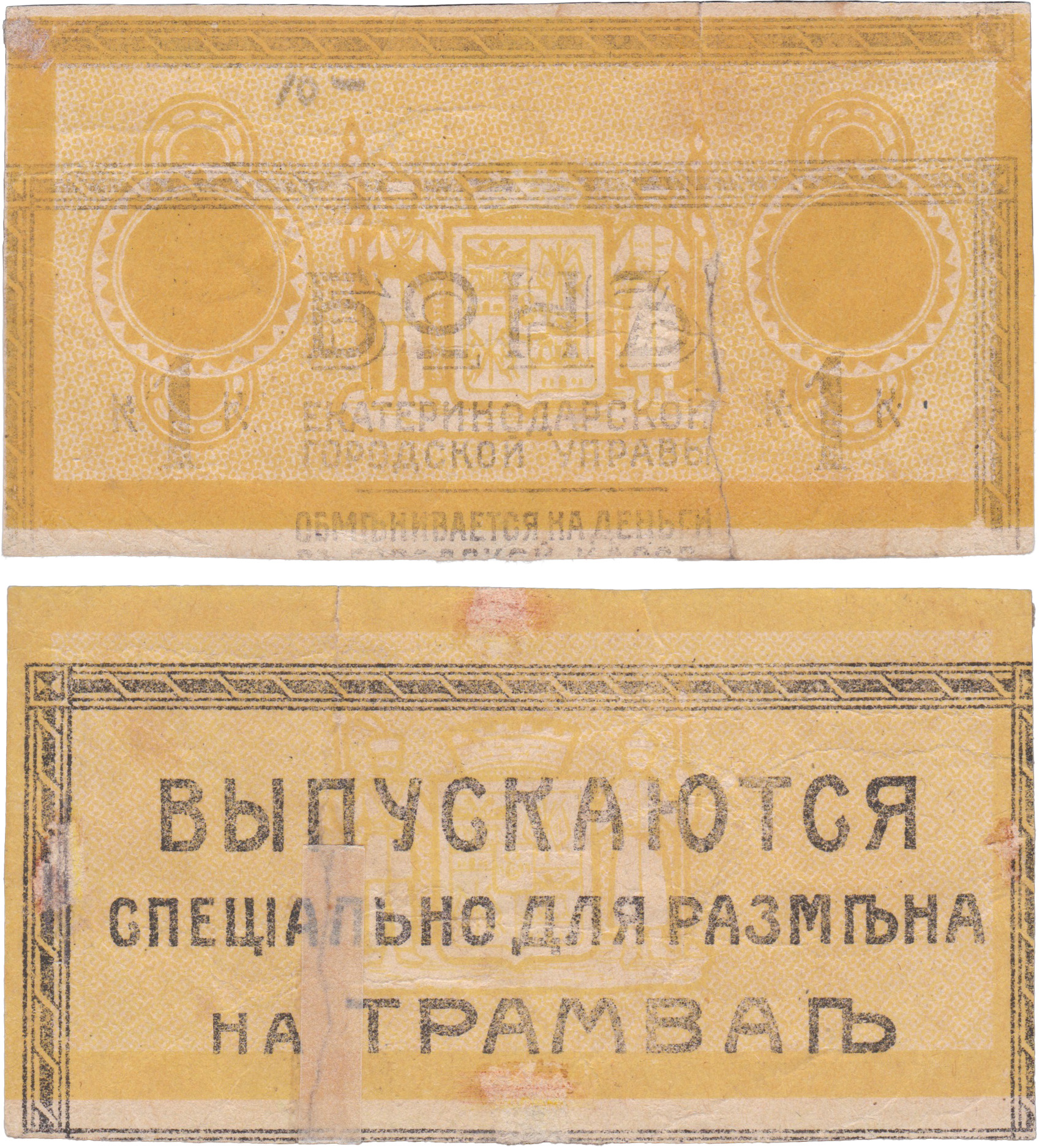
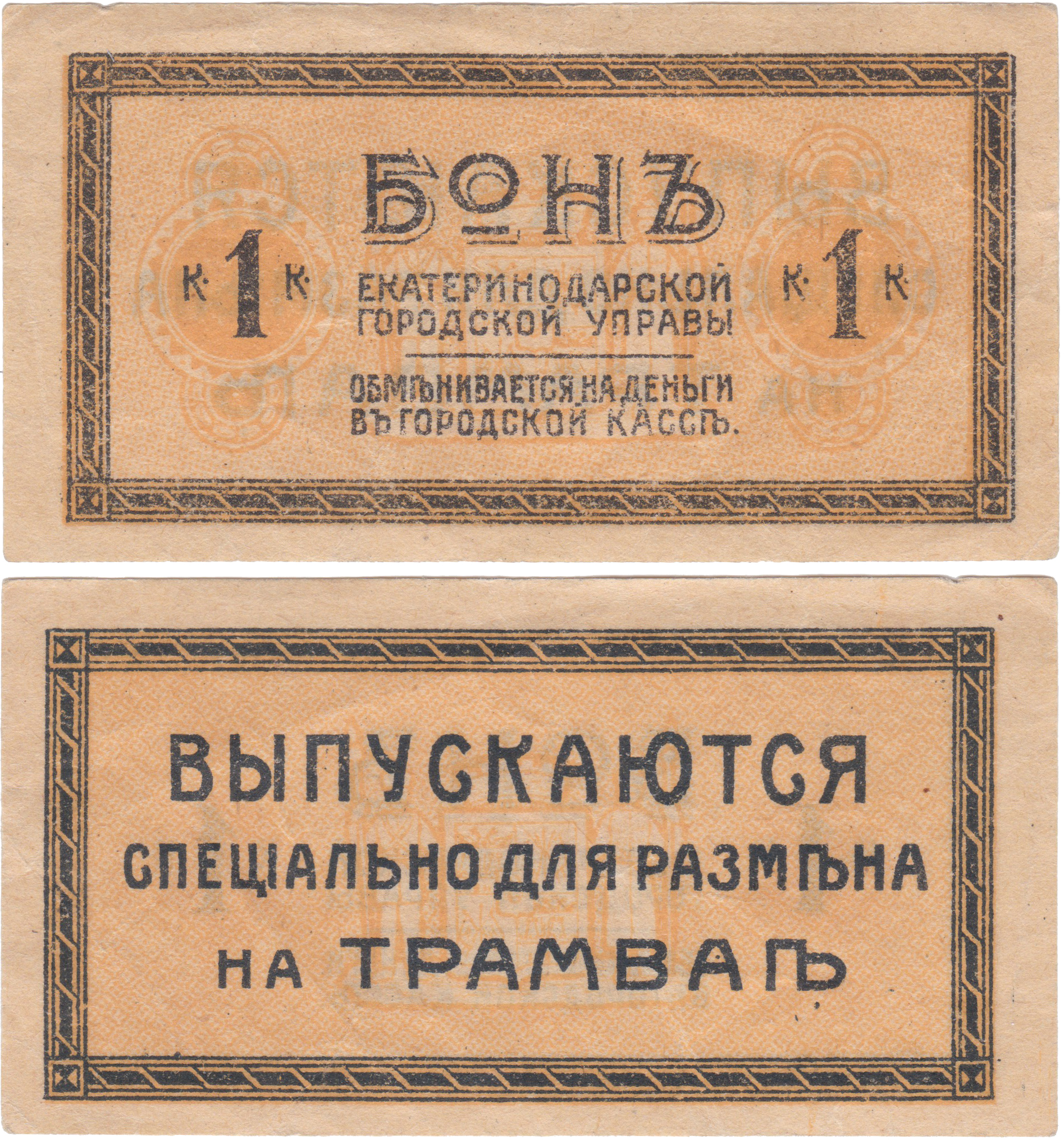
Bona 1 Kopeck 1918.
Yekaterinodar City Council.