
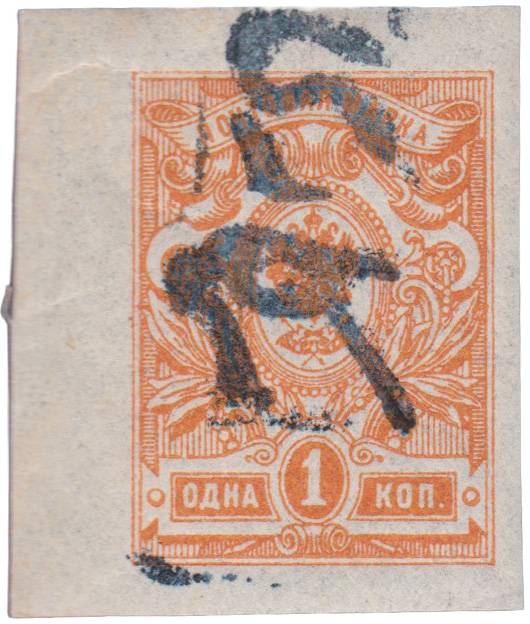
Speculative issue. Black overprint in Farsi: Sarkar-i-Ali (Supreme Authority).
Enver Pasha, an uprising against the Soviets with the aim of creating a Pan-Turkic state.
The Basmachi uprising (1918–1930s) was an armed resistance of the local population (predominantly Turkic peoples) in Central Asia to the establishment of Soviet rule. Initially, it was a spontaneous movement motivated by the defense of Islam, the traditional way of life, and opposition to grain requisitioning. It was not unified and consisted of many detachments led by different field commanders (qurbashi).
Enver Pasha was one of the most tragic and ambitious figures of the era. A former Minister of War of the Ottoman Empire, one of the Young Turk leaders, and an ideologue of Pan-Turkism and Pan-Islamism. After defeat in World War I and the collapse of the Ottoman Empire, he sought a new path. In 1921 he arrived in Bukhara, where Soviet power had already overthrown the emir. Enver offered his services to the Red Army, but then defected to the Basmachi in order to unite the scattered Basmachi detachments and create a single Pan-Turkic Islamic state on the territory of the former Emirate of Bukhara and Turkestan. He proclaimed himself “Commander-in-Chief of all the armed forces of Islam, son-in-law of the caliph, and representative of the Prophet.”
For a short time (late 1921 to early 1922), Enver managed to unite substantial forces under his command and inflict a number of defeats on the Red Army, taking control of a significant part of Eastern Bukhara.
It was precisely during this period, in the winter of 1921–1922, that these legendary stamps appeared in the city of Dushanbe (which at the time was a small village and Enver’s headquarters).
They were based on leftover postal stocks of the old Emirate of Bukhara—stamps depicting Emir Sayyid Alim Khan. These stamps had already ceased to be valid after the fall of the emirate in 1920.
A hand-applied overprint (often crooked and sloppy) was added in Farsi, in Arabic script: ساركار علی — “Sarkar-i-Ali,” which can be translated as “Supreme (Highest) Authority” or “Supreme Government.” This was the title adopted by Enver Pasha.
This is a classic speculative issue. The main target buyers were not local residents but foreign philatelists. The organizers (Enver’s entourage, possibly with the participation of adventurers from Afghanistan or Persia) understood that the story of Enver’s struggle attracted the attention of collectors worldwide. Many sheets of these stamps were produced and sold abroad to replenish the movement’s treasury.
Enver Pasha’s success was short-lived. In the summer of 1922, the Red Army launched a major offensive. On 4 August 1922, Enver Pasha was killed in battle near the village of Chaghan (in what is now Tajikistan). With his death, organized Basmachi resistance declined, although isolated pockets persisted for many years.