
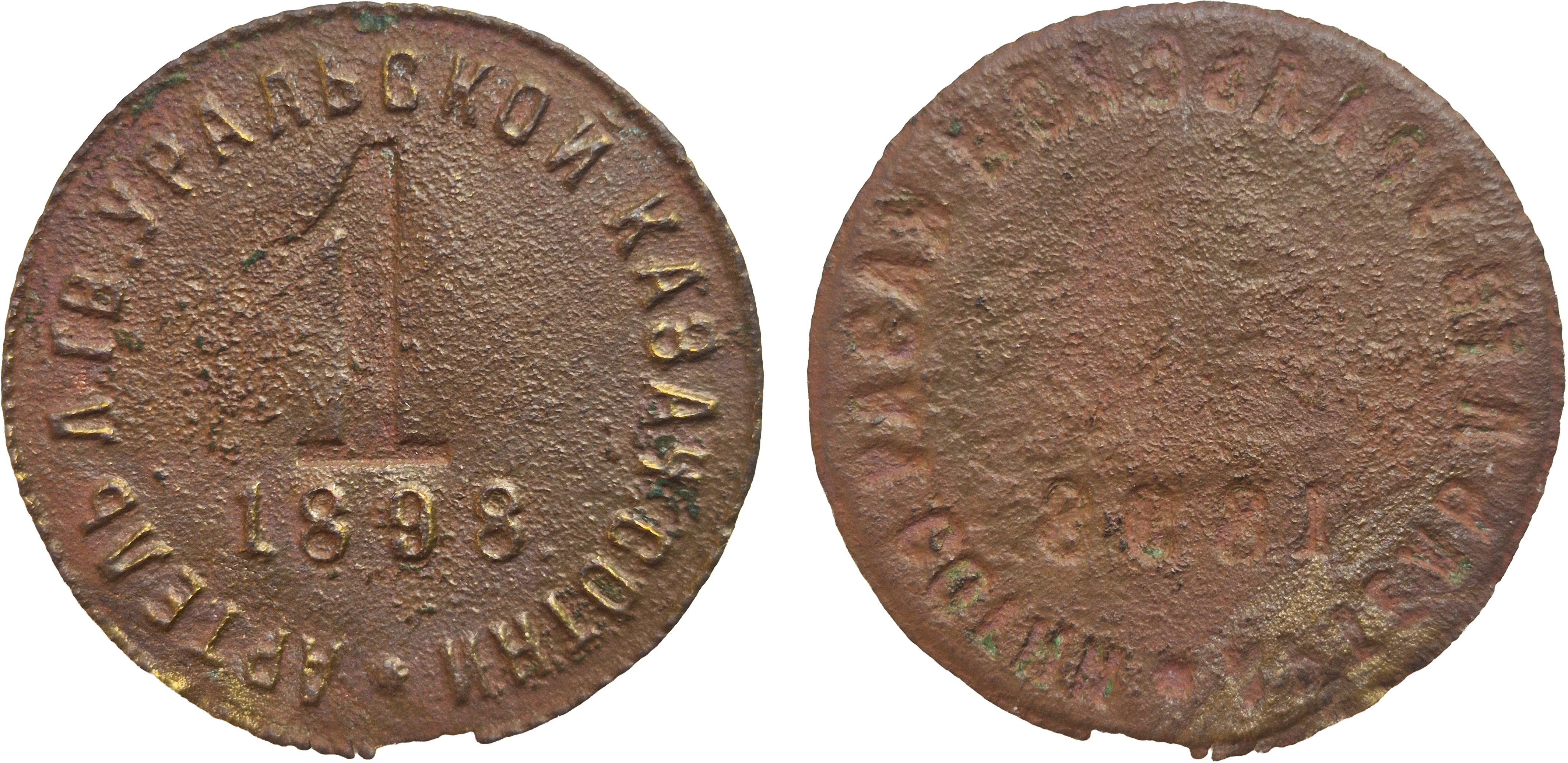
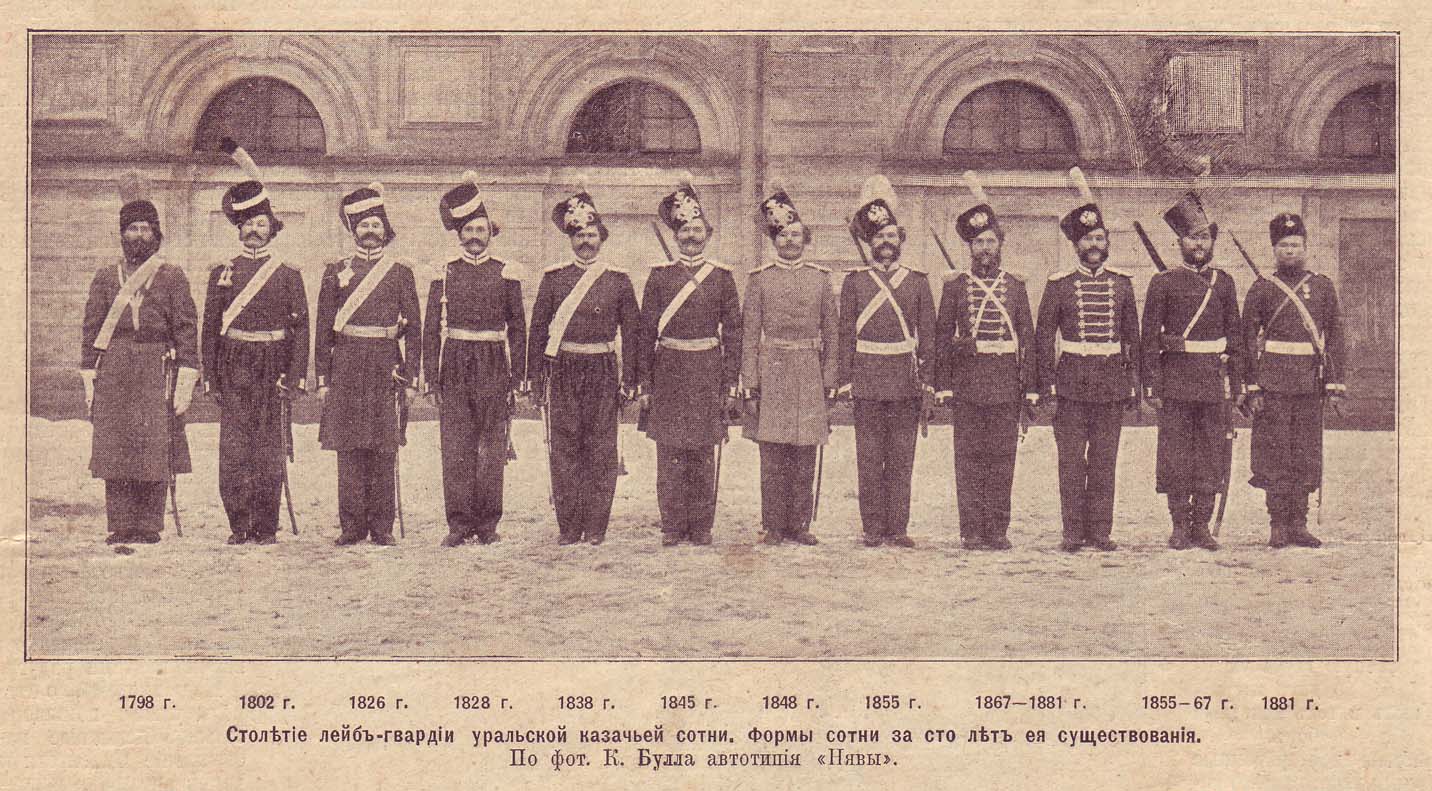
Russian Emperor Paul I placed particular trust in the Ural Cossacks. On April 23, 1798, a Supreme rescript was issued in the name of the Host Ataman of the Ural Cossack Host, Major General D. D. Donskov, calling up a hundred Ural Cossacks for service in the capital. On the same day, a decree was issued by which the Ural Hundred was granted to the Leib Guard. The hundred began performing guard duty at the Tsar’s chambers in St. Petersburg itself and at the suburban palaces, serving as the Emperor’s personal escort.
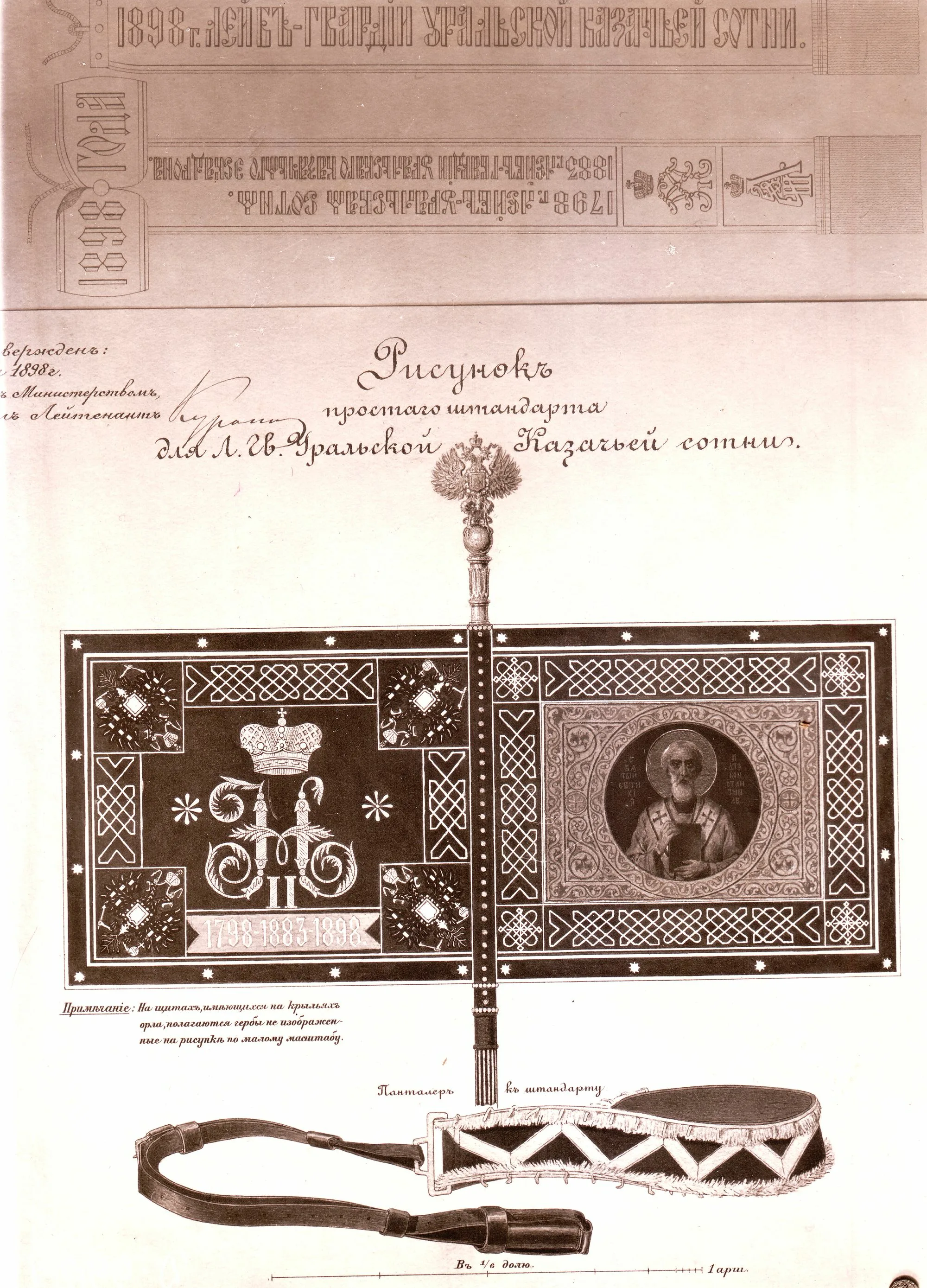
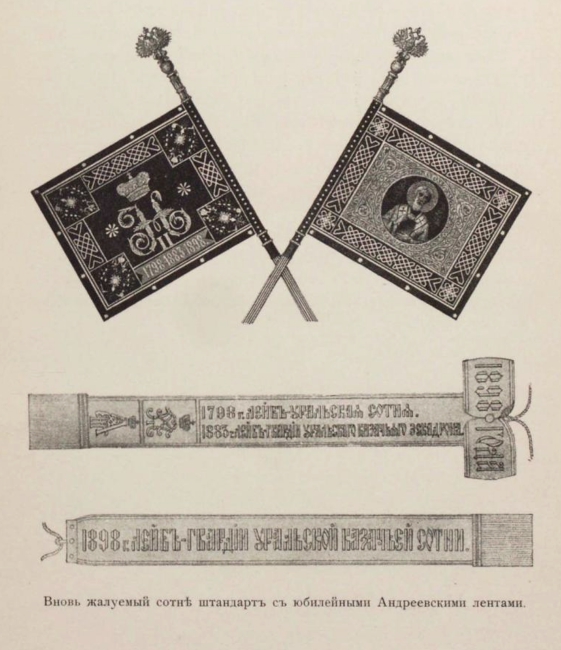
On June 4, 1897, the Supreme assent followed to celebrate, on September 4, 1898, the centennial jubilee, with the grant to the hundred of a new standard with St. Andrew’s jubilee ribbons.
An artel (from the Turkic word “orta,” community) first appears in documents of the second half of the 17th century, replacing another word of likewise Eastern origin—vataga. The meaning of the word artel in popular speech is quite conditional; the people adapt it generally to all those cases when one has to act not alone, but with several persons who have joined together to achieve some goal. The beginning of the artel’s existence in our forces dates to the time when the regular army was established in Russia.
Under the 1711 штат (tables of establishment), an army soldier, a private, was allotted annual cash pay of 10 rubles 80 kopecks; by the 1720 table this pay was increased to 10 rubles 98 kopecks. This sum included an allotment for uniforming (5 rubles 32 kopecks) and for provisions, about which (except for bread), under the “Military Regulations of 1716,” he was obliged to take care himself both in peacetime and in wartime, both in his own land and in foreign land. However low the prices of foodstuffs might be, it was not possible to subsist alone on the money the soldier received from the treasury. The natural consequence of this was the formation of the soldiers’ artel.
The items necessary for company хозяйство (company economy/household) were bought with communal company funds, with the permission of the authorities, though only after a prior resolution of the company assembly, which was convened with the permission of the company commander once or twice a month. At these assemblies, among other things, the question of the amount of deductions from pay into the artel was discussed. The company assembly drew up resolutions that were entered into a special journal, signed by the literate enlisted ranks who took part in the assembly. These same assemblies elected the company хозяйин (company steward) and four detached artel men.
Count Langeron thus characterizes the structure, merits, and shortcomings of the artels of Catherine’s time: “The Russian soldier,” he says, “has what no soldier in Europe has—his property. This property is called an artel; it is formed from the sum received from the economical subsistence monies for the winter period and from half or one third of his pay withheld from the soldier, with his consent; this sum is in the hands of four old soldiers of each company, elected by the other soldiers and called artel men; this sum constitutes the common property of the company, and neither the company nor the regimental commanders must, under any pretext, interfere with it. With this sum they buy small carts, to which they harness 2–3 horses, and which on campaign serve to transport soldiers, baggage, and to take in the sick or wounded. Part of this sum is also used during the camp gathering to purchase meat, vegetables, etc., since the treasury issues only flour and groats. The remainder of the sum stays in the hands of the artel men, and in well-managed regiments each soldier, independently of his share in the carts, horses, and the rest, has another 8–10 rubles invested in the artel. Comrades inherit after the deceased, unless he bequeaths his share to a friend or relative.”
“The artel,” Count Langeron continues, “offers many advantages: it provides the soldier with a certain property, support, occupation, and provisions. It is impossible to imagine to what degree the soldiers are attached to their horses and how much they care for and feed them. Moreover, a soldier who wishes to desert is restrained by the fear of losing the 8–10 rubles invested in the artel; this same thought of property makes them defend the carts fiercely when they are subjected to an enemy attack.”
But on the other hand, the artels, according to Count Langeron’s testimony, presented certain inconveniences: they took from the company’s formation at least 8 soldiers, burdened the army with an enormous number of horses and carts (Count Langeron’s regiment, consisting of 5 battalions, had about 350 artel horses and 70 carts), and, finally, encouraged plunder.
“This latter has taken such root in the artel,” Langeron admitted, “that the first thing soldiers do when they are quartered is to steal hay and oats, bring them to their company commanders, and thus set up stores for them. These expeditions are carried out at night or in cool weather and usually under the command of a non-commissioned officer.”
Having compared the artel’s merits with its shortcomings, Count Langeron found that “artels are more useful than harmful.”
From 1848 begins a noticeable improvement in the material life of the Russian soldier. From January 1 of that year, all line and non-line enlisted ranks, except orderlies, were ordered to be issued 20 pounds of salt per person per year free of charge. From January 1, 1850, line enlisted ranks of all field troops began to be issued weekly, except during four fasts, five half-pound portions of meat per person. These two orders, as well as the introduced “free works,” part of the money from which was credited to the artel fund, made it possible to provide the soldier’s subsistence without deductions from his pay into the artel.
With the passage of time, artels increasingly lose their original form, and at present their role in military organization is negligible, being expressed chiefly in the election of an artel man.
In various branches of the Imperial Army and Navy, “officers’ assemblies” were established, in which special payment tokens (metallic) were in use. On October 12, 1874, the Emperor approved the regulation submitted by the Military Council concerning the charter of officers’ assemblies, which were intended to achieve the following goals:
— mutual rapprochement of the members of the officers’ society;
— providing them entertainment in time free from service;
— promoting the development of military education among officers;
— reducing the cost of officers’ living.
Under officers’ assemblies, to achieve these goals, as far as possible there were established: a dining room, buffet, library, fencing and gymnastics hall, rooms for visitors, places for games (including military games), lectures, a theater hall (for performances), a dance hall, a shooting range, a bowling alley, etc. According to the approved Charter, such games as billiards, chess, and dominoes were permitted in officers’ assemblies; card games were allowed by decision of the General Assembly of Officers, but gambling was prohibited.
The Charter of officers’ assemblies of 1874 introduced settlement tokens: “To facilitate officers in settling accounts with the buffet, the Assembly has its own tokens, priced (denominated) at the value of a snack, a glass of tea, a dinner, etc.; each member of the Officers’ Assembly or visitor may buy them at once in as many as needed, but in no case may they circulate outside the Assembly.” These payment tokens were coin-like жетоны (tokens) bearing a regimental cipher, or the full name of the officers’ assembly.
The use of such means of payment was abolished on December 3, 1903, when a new “Regulation on the Officers’ Assembly” was approved, which stated: “All cash settlements, both for items of consumption and for games, are made in cash before leaving the officers’ assembly. Settlements in dining rooms and buffets are made upon receipt of the bill, and in rooms for visitors—at the end of the day. Members who have not paid money upon presentation of bills are deprived of the right to further use of the Assembly’s premises.” Instead of payment tokens, “subscriptions” were introduced—annual (or one-time, for guests) tickets, which had to be purchased for cash in order to use the facilities of the officers’ assembly.