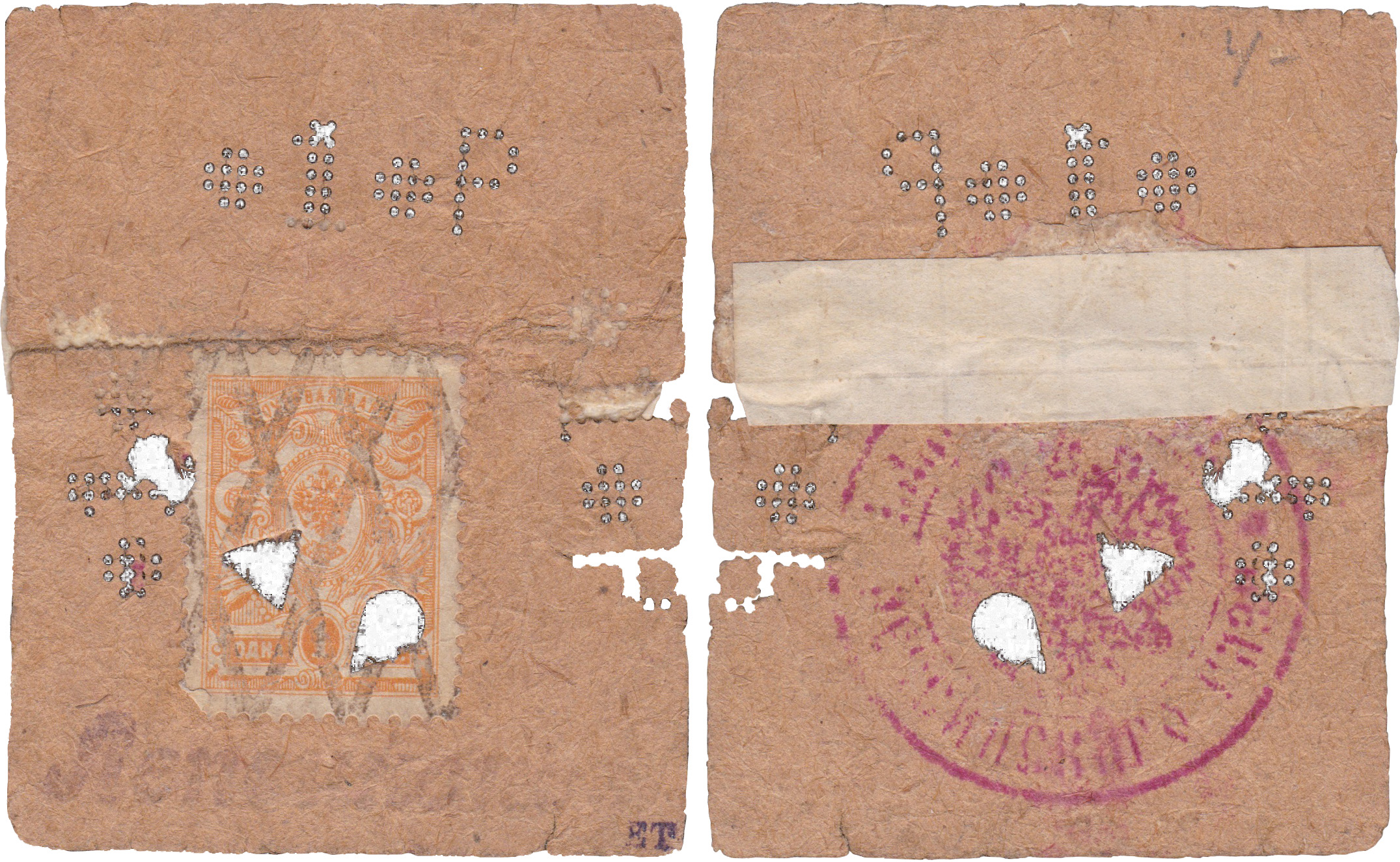
Seal with the “large eagle.” Purple stamp “Lepsinskoye”.
Lepsinsk is a small Cossack town of the Semirechye Region, the center of the uyezd of the same name. It grew out of the Lepsinskaya stanitsa, founded by Siberian Cossacks—settlers from the Biysk and Kuznetsk lines—in 1855 in the Chubar-Agach valley, near the Chinese border, in the very heart of Russian Dzungaria.
The Cherkassy defense was the combat activity of peasants from twelve Russian villages of the Lepsinsk uyezd (Semirechye Region) in the rear of White Guard forces.
During the first 3 months of the siege—the defense—the thirty-thousand mass of peasantry, compressed around the village of Cherkasskoye, used for monetary settlements “credit notes of the Semirechye Regional Council,” secured by a stock of opium kept in the State Bank and, for greater reliability, signed by the Regional Military Commissar (numbers 8045–8054 and onward). However, in view of the limited capacity of the Verny printing house, the Lepsinsk uyezd executive committee, being in constant need of monetary signs, began issuing its own money, setting an example for other towns and villages.
Issued were 1 ruble, 3 rubles, 5 rubles, and 10 rubles. The exact amount of the issue is unknown, but approximately it equals 25,000 rubles, mainly in denominations of 5 and 10 rubles.
In view of the absence of a printing house in Lepsinsk, the notes were made by “hand” means.
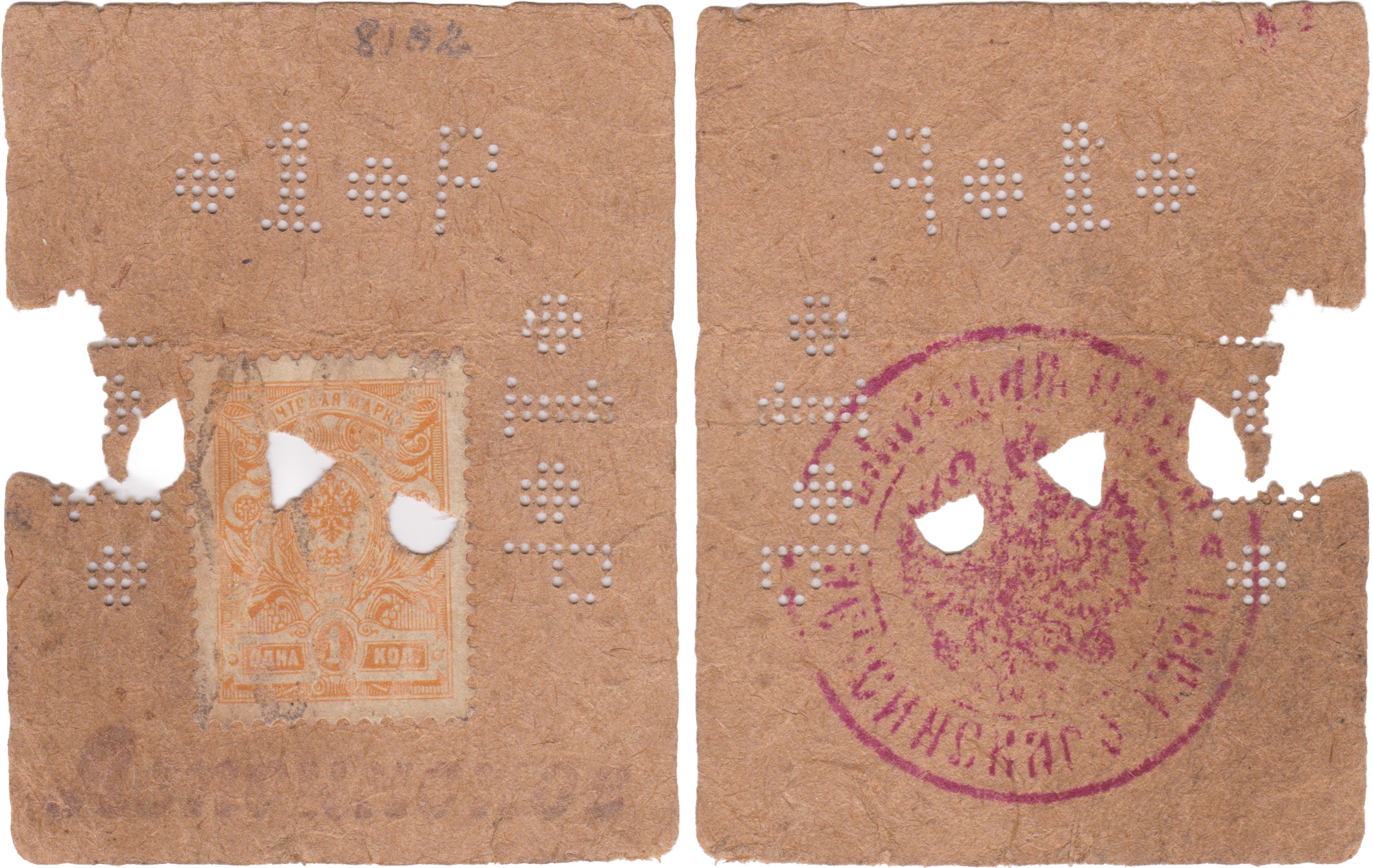
The 1 ruble note is a 1 kopek postage stamp with serrations, pasted onto a piece of brown wrapping paper, averaging 45 × 60 millimeters.
In the lower part of the note there is a rubber stamp (in italics) in purple or red ink—“Lepsinskoye.” Above the stamp and to its sides, perforation was punched: *1* r. On the reverse is a red round seal in two variants:
1. Main Cash Office of the Lepsinsk Treasury (in the center, an eagle of the imperial type).
2. Lepsinsk Uyezd Treasury (an eagle of the imperial type above the text).
At the end of the year the notes were redeemed, and they were cancelled by punching three holes through the stamp—one ovoid, one semicircular, and one triangular. The size of each hole is about 5 × 5 millimeters.
This example was followed by the Military-Revolutionary Committee of the Cherkassy Front when the shortage of monetary signs of regional and uyezd production began to be felt noticeably.
1 ruble with stamp 1 Kopeck 1918.
District Treasury. Lepsinsk.