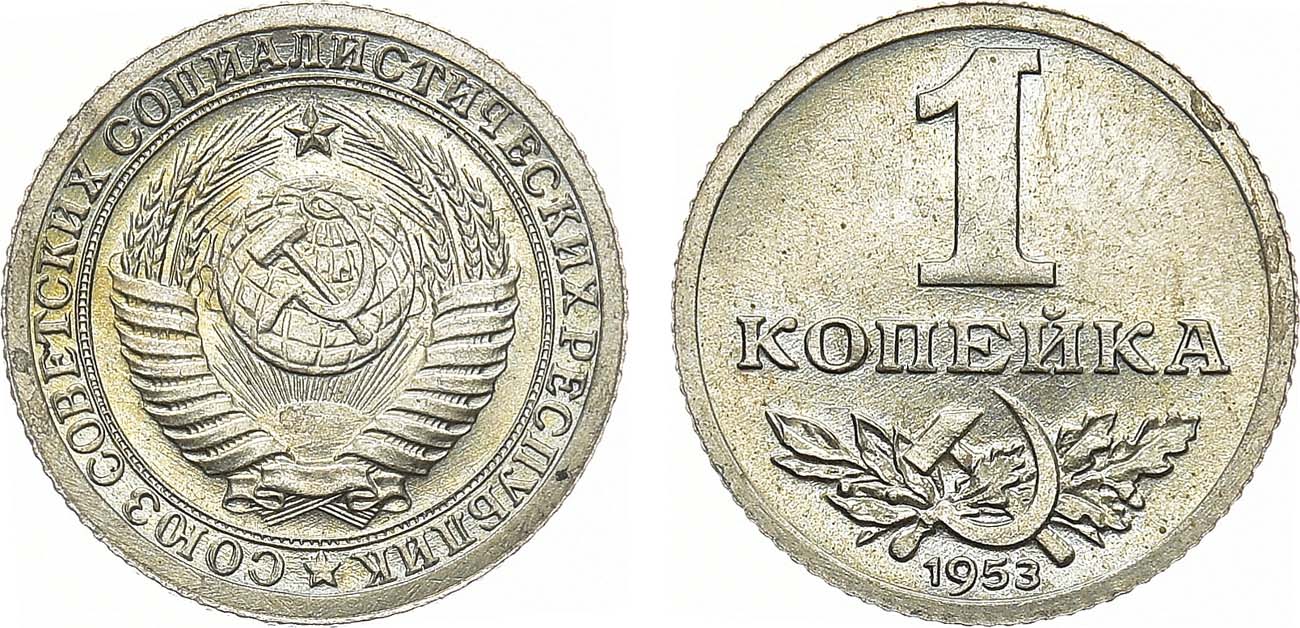
Trial.
Copper-zinc-nickel alloy.
Obverse: a circular inscription around the coat of arms of the USSR (type I).
Reverse: crossed hammer and sickle against a background of laurel and oak branches (type II).
Reeded edge.
In the early 1950s, in specially equipped experimental technical laboratories, under a strict secrecy classification, experimental trial strikes of new-standard Soviet circulation coins were carried out. Initially, several different new coinage alloys were tested, using regular circulation working dies for 20-kopeck and 3-kopeck coins dated 1951 and 1952. Alloys of aluminum, brass, cupronickel, and even virtually pure magnesium were tested. Trial strikes on blanks made of non-magnetic stainless steel were also produced using circulation dies for 5-kopeck coins dated 1951.
Two obverse "designs" of the 1953 coins are known, and nine reverse designs.
The trial series includes eight denominations: 1, 2, 3, 5, 10, 15, 20, and 50 kopecks. In making trial pieces of different denominations, from 4 to 5 different alloys were used.
There are differences in the execution of certain design elements when striking coins of different denominations. For example, the five-pointed star shown at the top of the state coat of arms of the USSR (on the obverses) may be flat (50, 20, 15, 10 kopecks), "faceted" and raised (5 and 3 kopecks), or "faceted" and split (2 and 1 kopecks). There are other die differences as well.
A careful study of the reverse designs allows one to trace the evolution of the artist's imagination during their development. The author or authors of the designs, in their "artistic search," modified or added individual elements, changed the fonts of the denomination numerals and the inscription of the denomination and date, and engaged in "ornamentation" of the open field of the coin flan. Above the denomination numerals on some coins, a small flat five-pointed star would appear and disappear. By analyzing the search for the artistic concept of the reverses of the trials, three groups of designs can be distinguished.
The first group includes specimens in which large denomination numerals, occupying one half or more of the coin field in height, are placed at the center of the coin field (three variants on a plain field and one in which the background for the denomination numerals is a composition of two intersecting oak branches with leaves and acorns). The interior field of the denomination numerals has horizontal hatching. On these reverse variants, the word "KOPECKS" is placed below the denomination numerals, and lower still are the date numerals "1953." The coin field is bounded by a raised rim. On two of these types, along the rim on the inside, there is a narrow or wide circular inner band with fine transverse hatching. In one variant, between the denomination inscription and the date numerals, there is a separator mark in the form of pointed-ended lines with a dot in the middle.
1 Kopeck 1953.