

Diagonal handstamp overprint. Print run: 100 copies.
At first, the stamps were produced as the actual need for them arose. Then, when collectors became interested in them—collectors not hesitant to pay large sums for rare stamps—the issuance of these stamps gradually began to be aligned not with the zemstvo’s need for them, but with collectors’ demand. As a result, an entire trade in zemstvo stamps emerged, the monopolist of which was the brother of the former chairman P.P. Ganko, who did not abandon this profitable occupation even after he himself took the chairman’s seat.
To give zemstvo stamps special value in the eyes of collectors, the stamps were produced in relatively small quantities—far below the real need for them—with the aim that the stock would quickly run out and they would become a rarity.
The value of such rare stamps rose to fabulous figures: for a 3-kopeck stamp enthusiasts paid as much as 100 rubles. Sometimes the chairman of the board used such a brilliant method: he ordered issues of stamps with some exceptional feature differing from the rest of the order (an inverted numeral, a different color, without perforations, etc.), and moreover in a limited quantity. He bought such issues in their entirety at face value into his personal ownership, and then sold them at a high price.
Alongside this, even those stamp issues that were ordered by the board for the needs of the zemstvo post were often produced with certain peculiarities in order to attract even greater attention from collectors.
Operations with stamps are conducted by the chairman of the board, P.P. Ganko, on an enormous scale. He has issued a stamp catalog in which some specimens (of one kopeck) are priced at 40 rubles. A complete set of various specimens of zemstvo stamps, printed with all kinds of artificial combinations—stamps turned upside down, lack of perforations, change of color, etc.—is sold by him, excluding those already the rarest and valued at hundreds of rubles apiece, for 476 rubles 10 kopecks, whereas he himself acquired these stamps from his own board for 5 rubles 75 kopecks.
Among other things, in one foreign journal these operations are advertised with an image of the “seal for parcels of the Poltava zemstvo district board.”
Citing a whole series of characteristic examples of the activities of the “collector-monopolist” P.P. Ganko, the audit commission says that an unbearable atmosphere has formed in the zemstvo, exerting a demoralizing effect on the zemstvo service staff.
One of the members of the audit commission of the Poltava uyezd zemstvo, Mr. Bykov, learned of Mr. Ganko’s trade by chance abroad. It turns out that among foreign collectors the modest name of the chairman of the Poltava uyezd zemstvo board is widely known. Russian major collectors are also well acquainted with Mr. Ganko’s “trade.”
The report of the audit commission provoked stormy debates.
Called to account, Mr. Ganko denied selfish aims in his trade.
“I was a collector, like many others,” he declared.
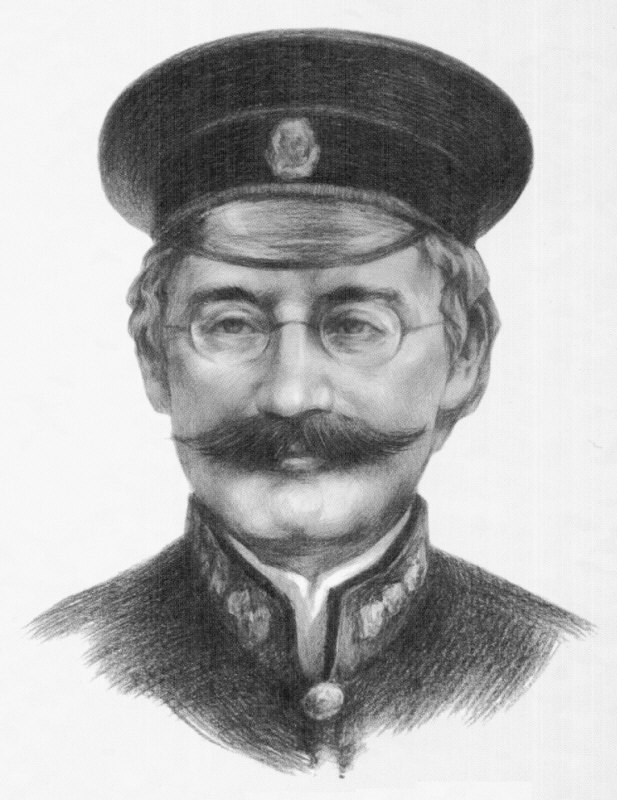
The audit commission proposed that the assembly recognize that the actions of P.P. Ganko did not correspond to the dignity of the chairman of the board. The assembly adopted this resolution by secret ballot.
Monuments series. The first commemorative issue of zemstvo stamps was released in Poltava Uyezd in 1909. It was dedicated to the 200th anniversary of the defeat of the Swedes at Poltava and consisted of 7 stamps.
The stamps were printed at one of the best printing houses of that time, Golike and Vilborg in St. Petersburg, and were very successful. Their format, the theme of the design, and the design itself were unusual for those times.
Five of them, in a picturesque frame, depict several monuments erected in honor of the 200th anniversary of the Battle of Poltava. On the 1- and 2-kopeck stamps there are images of monuments installed on the battlefield in 1909. The third stamp (3 kopecks) bears an image of the “Monument of Glory” located in Poltava; the fourth (5 kopecks) reproduces a monument in honor of the commandant of the Poltava garrison. The 6-kopeck stamp shows a monument erected in 1849 on the spot where Peter I rested after the battle. The 10-kopeck stamp depicts the burial site of Russian soldiers who died in the Battle of Poltava. The last stamp in the series (15 kopecks) bears a portrait of Peter I.
On March 1, 1903, the zemstvo post of Poltava Uyezd (Poltava Governorate) was opened. Mail was dispatched twice a week from the uyezd center, the city of Poltava, to 17 volosts of the uyezd. Zemstvo postage stamps were used to pay for private correspondence: ordinary letters were paid with 3-kopeck stamps, and registered letters with 6-kopeck stamps. They are very diverse in printing method and purpose (official, for ordinary and registered wrappers, money correspondence, etc.).
Many issues feature the uyezd coat of arms. The stamps were printed in private printing houses, and from 1905 at EZGB.
Imperforate stamps are of unofficial origin and were intended for collectors. The stamps were cancelled with circular, oval, and rectangular handstamps.