
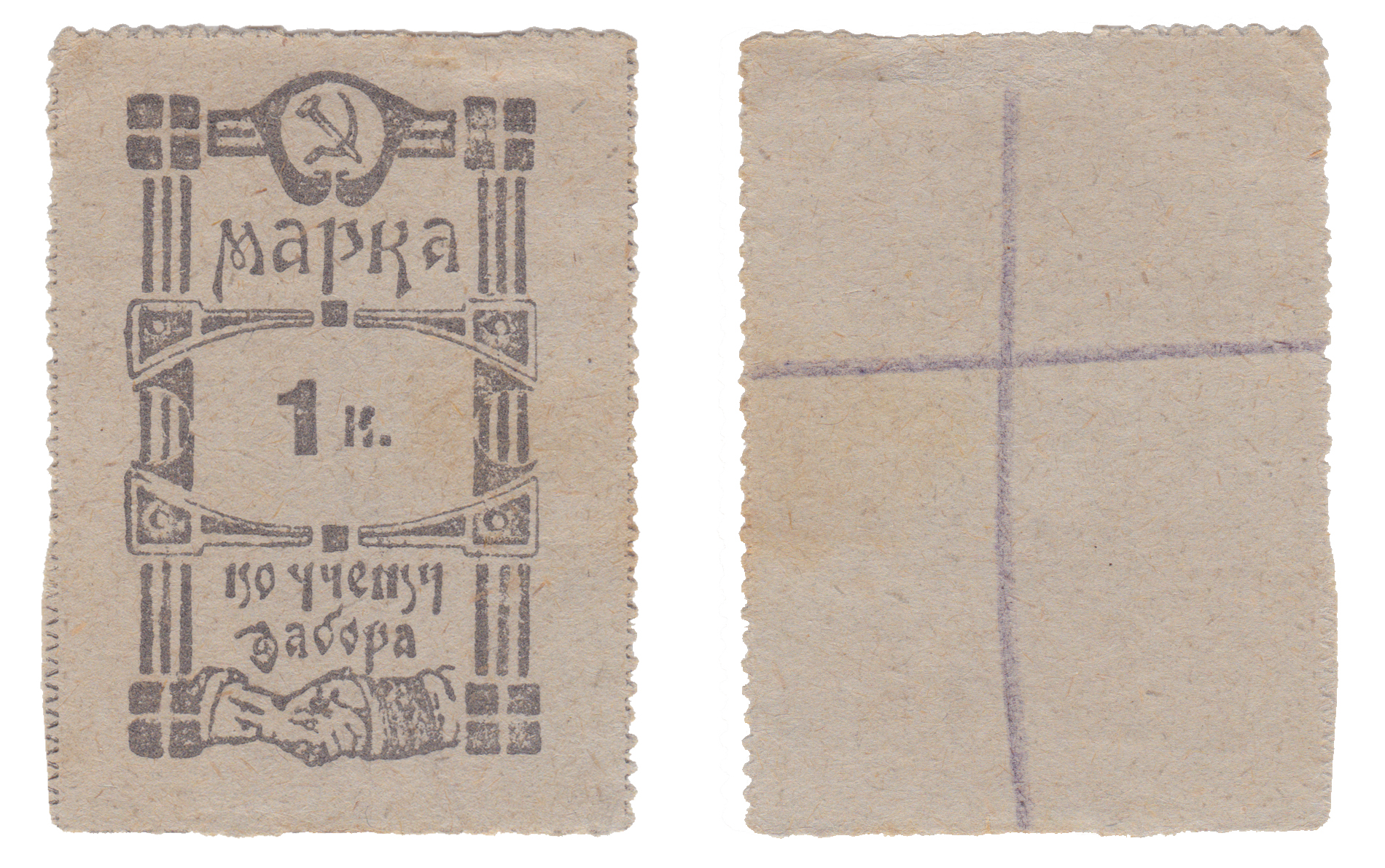
Excerpts from the diary of an Odessa resident, 1928. Here is what he writes:
"Odessa, 6/VI-1928.
They have begun issuing bread by coupons. The coupons are in a ration book for receiving scarce goods by members of the TsRK. Workers are given 1 1/2 f. (600 grams) per day, others 1 f. (400 grams). Everyone who has the right to do so registers with the TsRK. Non-working elements who cannot become TsRK members, and those who have no books at all, buy bread in private bakeries. The price is the same. A queue. They issue 2 1/2 f. (1000 grams = 1 kilogram) per person. At first glance it seems those people are better off than even workers, but that is not so. First, with a ration book, bread is guaranteed for that day. At private shops there are queues, sometimes there is no bread, etc. Second, a single person can take 2 1/2 f. and it is enough, but families either have to stand in the private queue, or have family members stand. In the TsRK, they issue according to the number of persons for whom the ration book was obtained, i.e., for the family, with the right to receive the norm for each family member. Many complain that a pound or 1 1/2 f. is not enough. Such people, for the time being, also have to stand in the line to private sellers. However, the queues are still small. With ration books they will also issue some other products: groats, macaroni, salad oil or sunflower oil, according to the announced norm—whether per family member or per book is unknown; in the latter case, large families will be worse off.
Odessa, 15/VI-28.
With bread the situation is now as follows. In the TsRK they sell only by ration books. There are no queues. There they also sell, without books when available, small doctors' rolls, whiter and more expensive than ordinary bread. Near private bread shops early in the morning there is a queue; all the bread is bought up, and later there is no bread. Some working people, for example washerwomen, the unemployed, and the like, complain that they cannot become TsRK members because they do not have spare money to pay at least a small part of the share contribution. For family workers, as well as clerks, things are more or less good: they get bread at the TsRK without a queue, and if a worker needs more than 600 grams per day, this is offset by the fact that the wife and children, often very young, need less.
Odessa, 20/VI-28. One woman said that to buy a ball at the TsRK one must have a TsRK book (i.e., be a TsRK member) and bring a child along.
17/VI-1928, on Sunday, my TsRK bread shop did not receive bread on time. The manager promised it in 10 minutes, but this went on for up to 2 hours. He telephoned, but nothing helped; until they baked it and delivered it, 2 hours passed. There was a queue of about 60-70 people. One worker was very agitated. He argued with the manager.
21/VI-1928. In general, it has become somewhat easier with bread. Non-members of the TsRK get up at 5 o'clock and receive coupons in private shops, and then, as soon as it is baked, they receive bread without a queue. Yesterday all TsRK members were issued 1 kg of white flour at the price of 15 1/2 k.
28/VI-1928. In Promsoyuz shops, where bread was sold for TsRK members, there is now bread in the mornings with almost no queue, and during the day yesterday there was as much as you wanted with no queue at all. This bread is coarser than TsRK bread, but costs less: 10 p. — 1 k. In TsRK and GPO shops they also often gave in recent days 1/2 — 1 f. without a ration book. White rolls can be seen in large quantities at stalls and from hawkers.
18/VII-1928. White bread is available from private sellers—30 k. per pound. Black bread in the TsRK is 4 and 5 k. per pound. Its quality is steadily improving.
4/X-1928. The TsRK issued new books (ration books) in order to avoid abuses: with the old ones, through various irregularities, people received more bread. With bread the situation is as follows: black bread in the TsRK costs 5 k. per 1 f. At the bazaar: 10 k.; semi-white—20 k.; white—25-30 k. Many who received black bread sold it at the bazaars to private sellers and got whiter bread. This affected those who relied on their bread. The new ration books complicate the situation even more.
6/X-1928. In some bread shops, when issuing bread they demanded, in addition to ration books, membership books as well, to certify that the share had been paid. They did not sell to those who had not paid. For many this is a blow. It is hard to pay a set sum all at once. Even with installments, paying 3-4 r. at once and on the same day is difficult.
In recent months, the bread issued was black, rye, at 5 k. per pound. Then they issued whiter bread, but at 6 k. per pound. Soon, however, it took on the appearance of bread baked from flour mixed with peas, sometimes with beans. Some claimed the flour was mixed with ground corn cobs. Sometimes, however, they issued perfectly good semi-white bread. Suddenly they began issuing black bread at the price of 6 k. They said they deliberately gave white bread a few times to raise the price. After that they again gave white bread several times. From 19/XI again black, and in some shops they charged 6 k. per pound, and in some 5 k.; now everywhere 5 k.
19/XI-1928. In some bread shops, when issuing bread they demanded, in addition to ration books, membership books as well, to certify; it was good rye bread. 20/XI also. 21/XI terrible bread, in which whole peas are found. It tastes of peas. Stomachs hurt."