
The Czechoslovak Corps (Czechoslovak Legion) was a national volunteer military formation created within the Russian Army during World War I, composed mainly of Czechs and Slovaks living in the territory of the Russian Empire, as well as Czech and Slovak prisoners of war who had served in the Austro-Hungarian Army and expressed a desire to take part in the war against Germany and Austria-Hungary.
In the spring and summer of 1918, the corps became drawn into an armed conflict with the Bolsheviks. The Czechoslovak uprising in the Volga region, the Urals, Siberia, and the Far East created favorable conditions for the elimination of Soviet government bodies, the establishment of anti-Bolshevik governments (the Committee of Members of the Constituent Assembly, the Provisional Siberian Government, later the Provisional All-Russian Government, then reorganized into the Russian Government), and the start of large-scale fighting in eastern Russia as part of the Civil War.
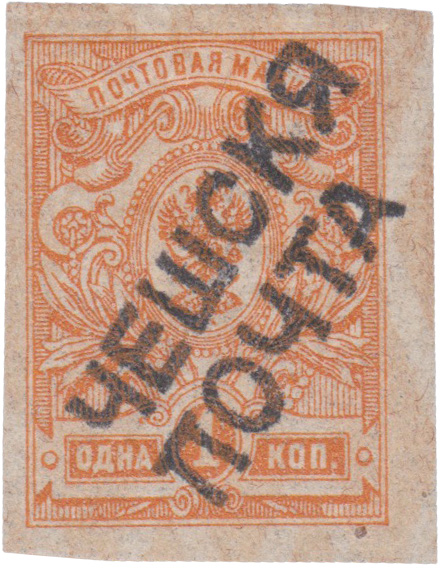
The field post of the Czechoslovak Corps was organized on July 10, 1918, and operated along the railway line from Syzran and Yekaterinburg in the west to Vladivostok in the east during the period of the corps’ direct participation in the Civil War. The first issue of the field post— a typographic overprint in black ink, applied diagonally in two lines in Russian with the words “Cheshskya pochta” on Russian Empire stamps of the 17th issue—was produced in 1918 in Chelyabinsk. The overprint text contains an error: the letter “a” is missing in the word “Cheshskaya.”