
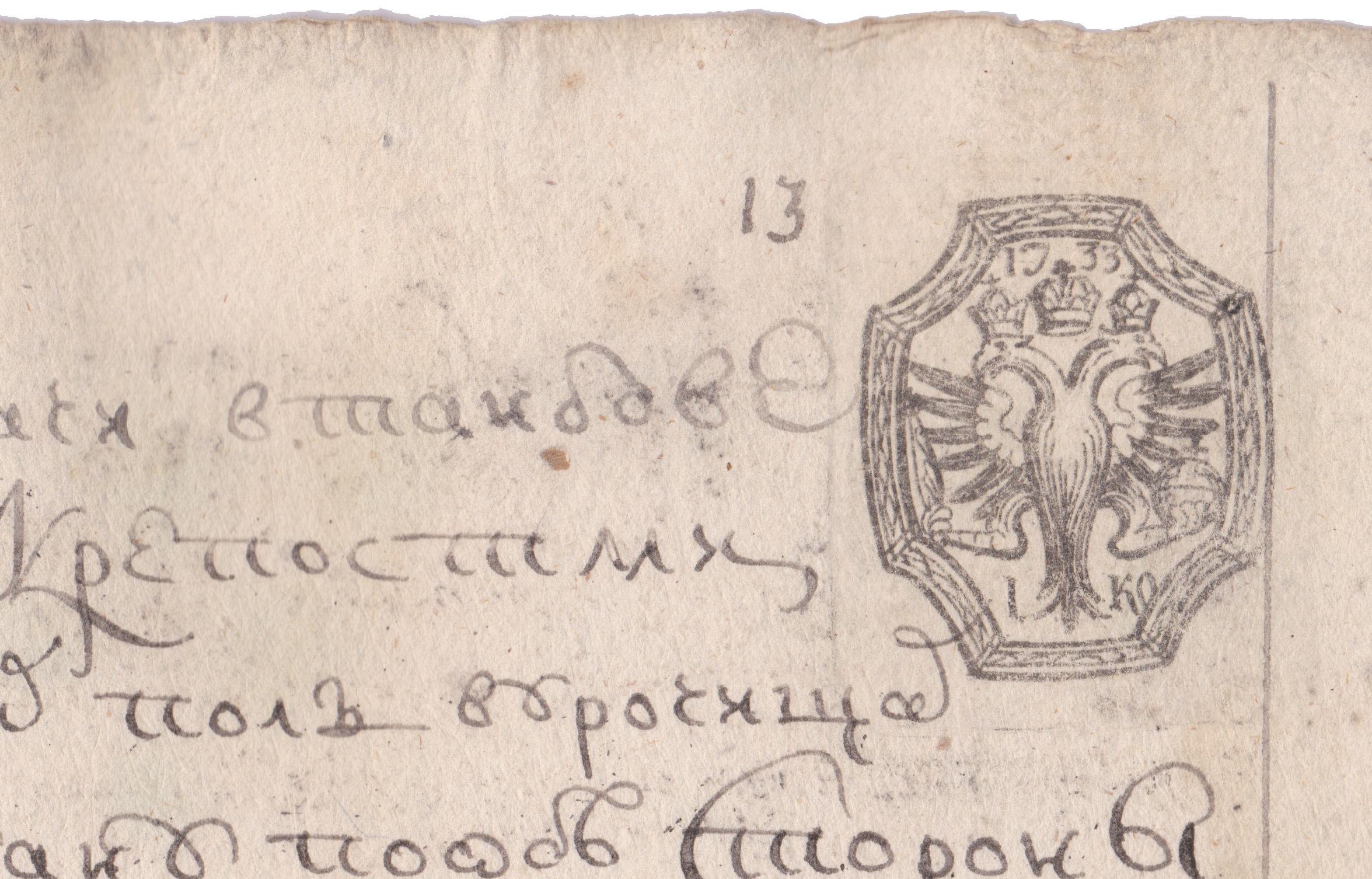
Stamped paper “for drafting bills of sale deeds” (for bonded acts) was introduced in Russia under the decree of January 23, 1699.
The idea of the state issuing stamped paper in Russia is owed to Alexei Aleksandrovich Kurbatov (steward to Count B.P. Sheremetev), who, after traveling abroad with the Count, submitted to Sovereign Peter Alekseevich a proposal for “eagle-marked” (stamped) paper “for the benefit of the treasury.” For his services A.A. Kurbatov was appointed “chief inspector of town-hall law,” and in 1711—vice-governor of Arkhangelsk Governorate.
In 1719 a calendar date appeared on the stamp. In 1720–1723 only the date was placed on the stamps, without the price of the stamped paper.
By the decree of February 13, 1720, the mandatory execution of bonded acts (property acts, bills of sale, mortgages, and certain other written obligations and contracts) on stamped paper was reaffirmed: “all such deeds, with payment of the prescribed duties, are to be written on stamped paper.”
Beginning in 1724, pursuant to the decree of October 17, 1723, stamped paper began to be made with watermarks. The actual manufacture and supply of paper were handled by private makers (practically throughout the entire 18th century). The fact that paper “for stamping” was procured from different makers explains the great variety of eagle images in the watermarks. In practice the state dealt only with stamping and selling stamped paper. The sale of stamped (marked) paper was permitted only to state institutions.
In 1726 new stamp designs were developed for different grades of stamped paper, and they were used until 1798. Only the date, the price of the stamped paper, and the image of the eagle were changed on the stamps.
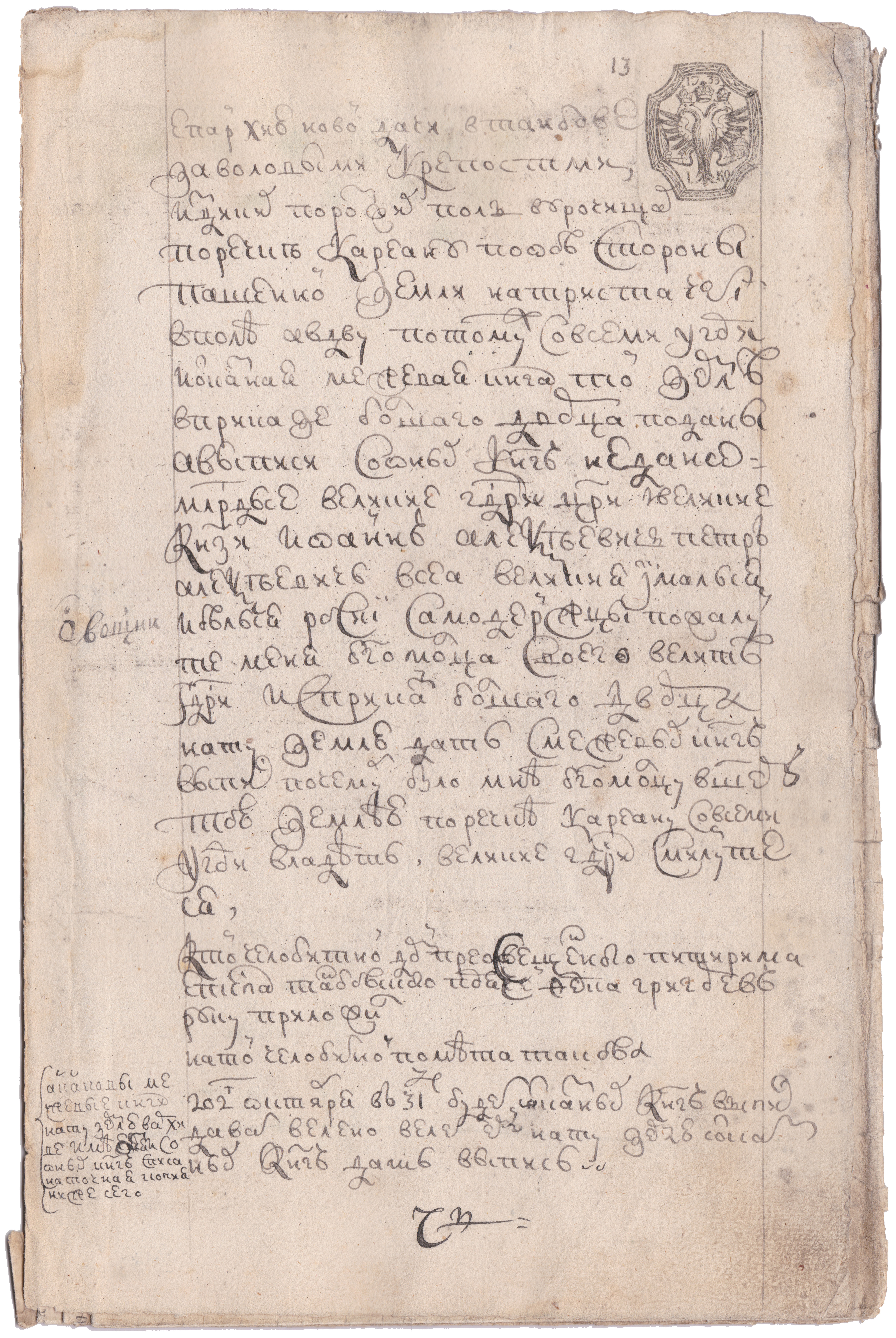
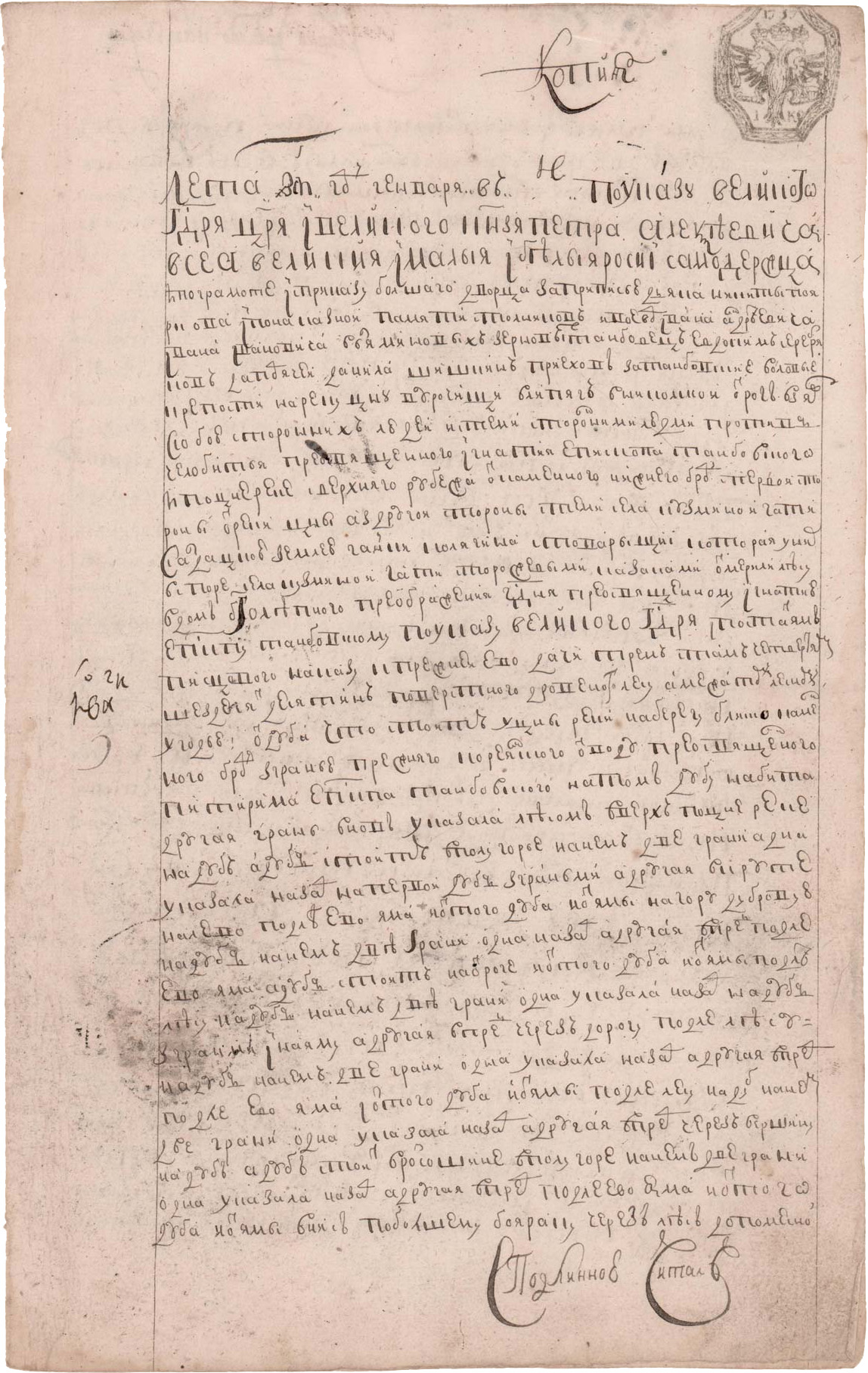
New lands of the Tambov diocese beyond the earthen ramparts, from wild overgrown fields in tracts along the Karean River, on both sides—arable land of three hundred quarters in one field, and in the other two the same, with all appurtenances. And the renunciation boundary book for that land has been submitted to the Prikaz of the Great Palace. But an extract from those books has not been given. Merciful Great Sovereigns, Tsars and Grand Princes Ivan Alekseevich, Peter Alekseevich, Autocrats of all Great and Little and White Russia, grant your favor to me, your praying servant. Order, Sovereigns, from the Prikaz of the Great Palace for that land to give an extract from the boundary books, so that I, your praying servant, might hold that land along the Karean River with all appurtenances. Great Sovereigns, have mercy.
To that petition, at the home of His Grace Pitirim, Bishop of Tambov, after its submission, Fedka Grigoriev set his hand.
On that petition the note is as follows:
In the year 202, on October 31, it is ordered to give an extract from the renunciation books; order that he be given an extract for that land from the renunciation books.
And whatever boundary books for that land exist in the archive, from those books an exact copy has been written below.
New lands of the Tambov diocese beyond the earthen ramparts, from wild overgrown fields, in a natural boundary along the Karean River, on both sides—arable land of three hundred quarters in one field, and in the other two the same, with all appurtenances. And the renunciation boundary book securing possession of that land has been submitted to the Prikaz of the Great Palace, which administered the tsar’s personal holdings and the civil affairs of the clergy. But an extract from this book has not been given. Merciful Great Sovereigns, Tsars and Grand Princes Ivan Alekseevich, Peter Alekseevich, Autocrats of all Great and Little and White Russia, grant your favor to me, your praying servant. Order, Sovereigns, from the Prikaz of the Great Palace for that land to give an extract from the boundary books, by which I, your praying servant, would henceforth hold that land along the Karean River with all appurtenances. Great Sovereigns, have mercy.
That petition, at the home of His Grace Pitirim, Bishop of Tambov, after it was submitted, was signed by Fedka Grigoriev.
On that petition the note is as follows:
In the year 7202 from the Creation of the World, 1693 from the Nativity of Christ, on October 31, an extract from the renunciation books, securing for Pitirim, Bishop of Tambov, the landholding, is to be issued; order that he be given an extract for that land from the renunciation books.
And whatever boundary books for that land exist in the archive, from these books an exact copy has been made, which follows below.

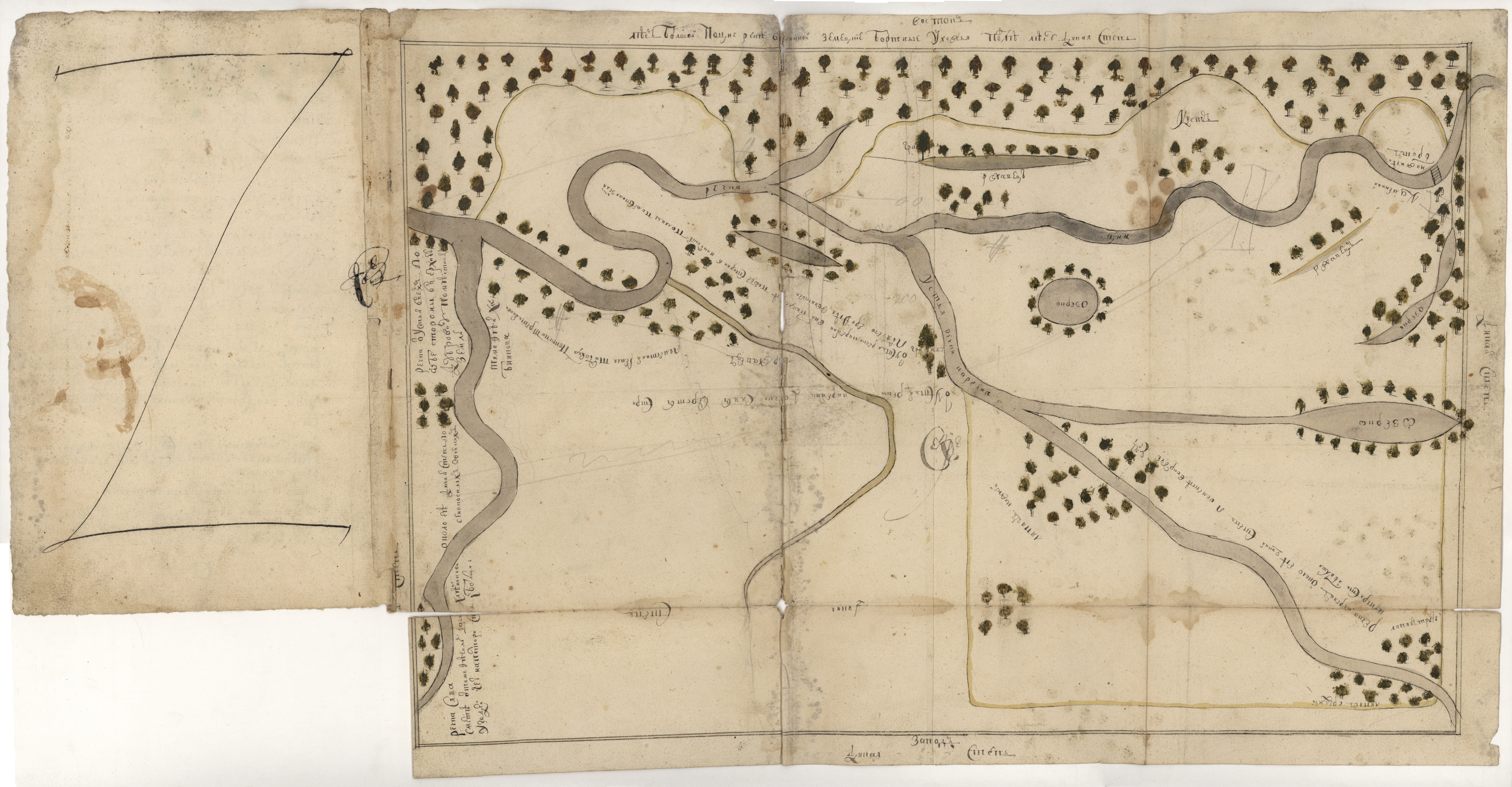
East. A large forest along the Tsna River, ancestral estate land; Zemetskie borthunting grounds; next to the forest, the Wild Steppe.
East. A large forest along the Tsna River in hereditary land ownership; Zemetskie lands for tree-hollow beekeeping; next to the forest, the Wild Steppe.
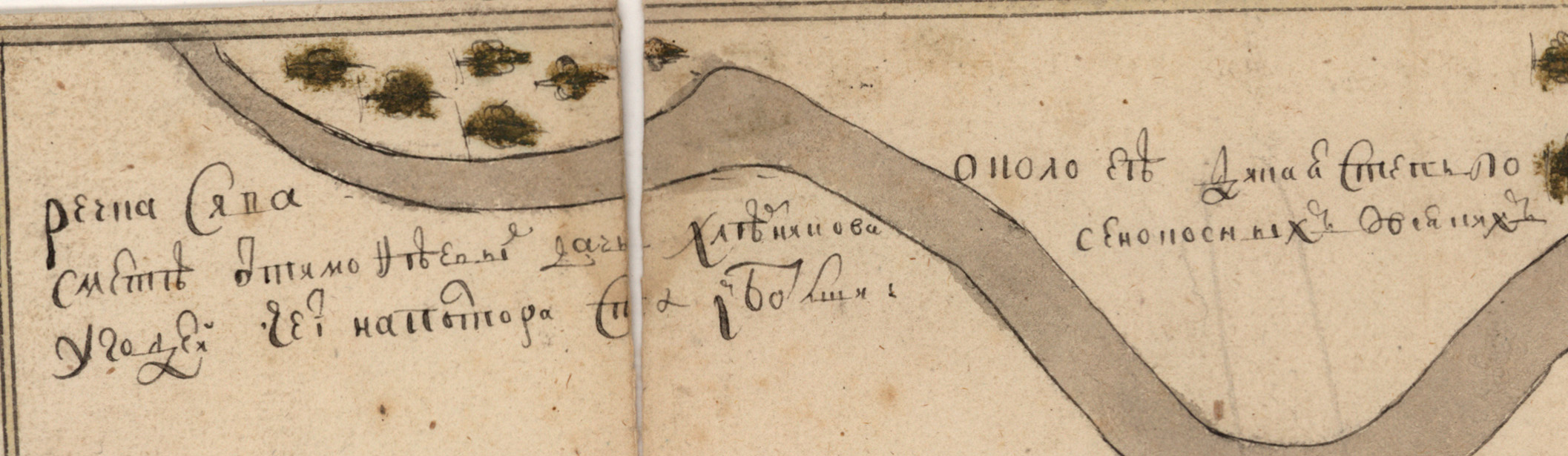
Syava River; around it the Wild Steppe, by estimate from Timofey Khlebnikov’s allotments—hayfields and all kinds of lands—quarters to one hundred and fifty and more.
Syava River; around it the Wild Steppe, by estimate from the hayfield holdings and all kinds of lands of Timofey Khlebnikov—one hundred and fifty quarters and more.

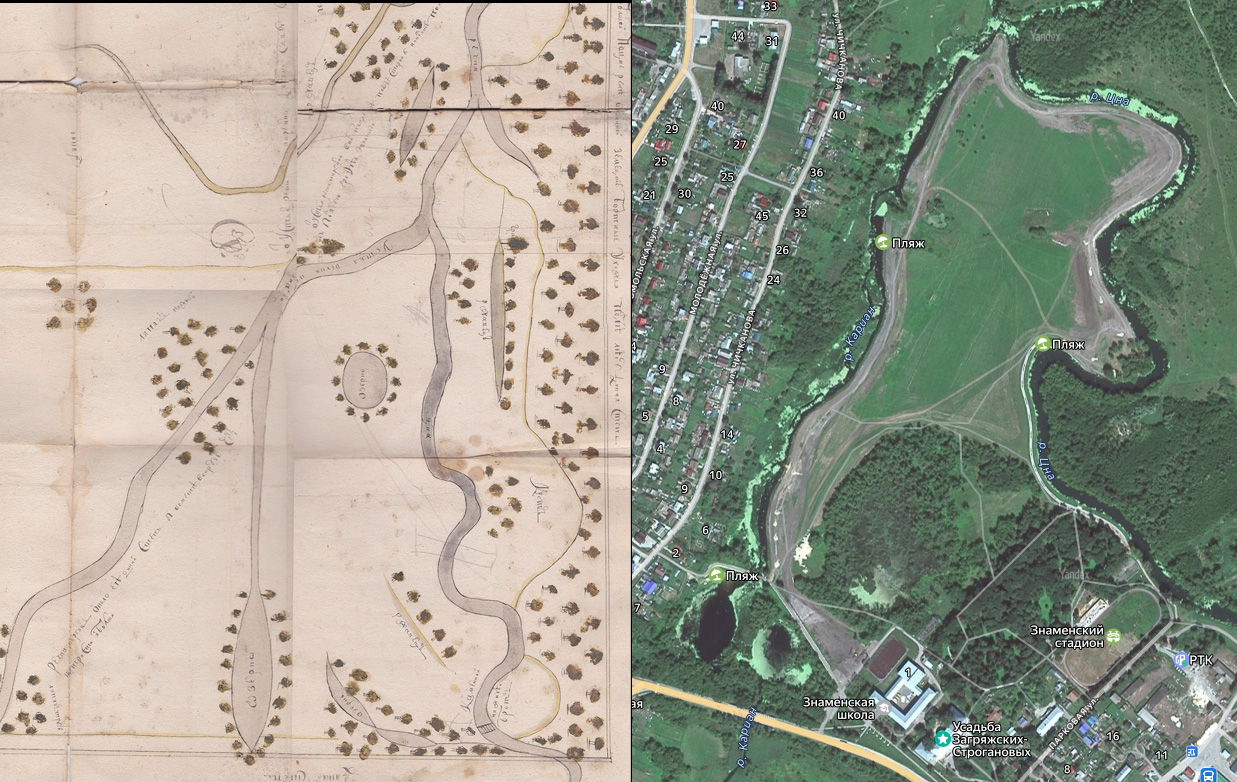
Karean River; around it the Wild Steppe, by estimate in the округ—quarters to three hundred and more.
Karean River; around it the Wild Steppe, by estimate in the district—three hundred quarters and more.
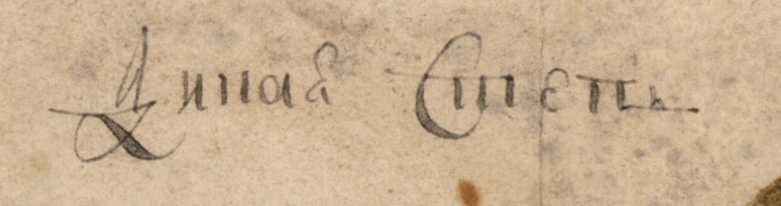


Wild Steppe.
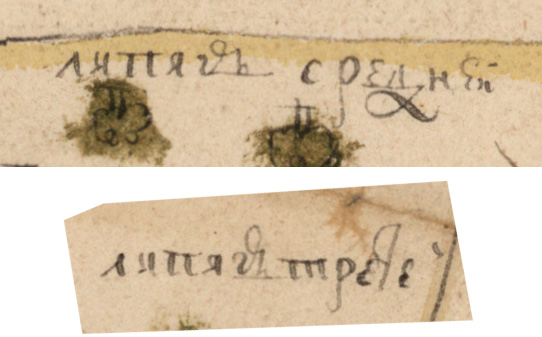
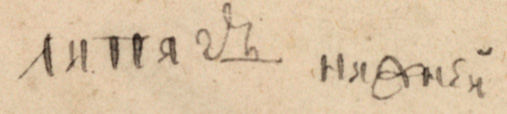
Lipyag Middle. Lipyag Third. Lipyag Lower.
Lipyag:
1) linden regrowth (or a linden grove/wood);
2) a name used for small geographic features in Russia: villages, rural settlements, townlets, hamlets
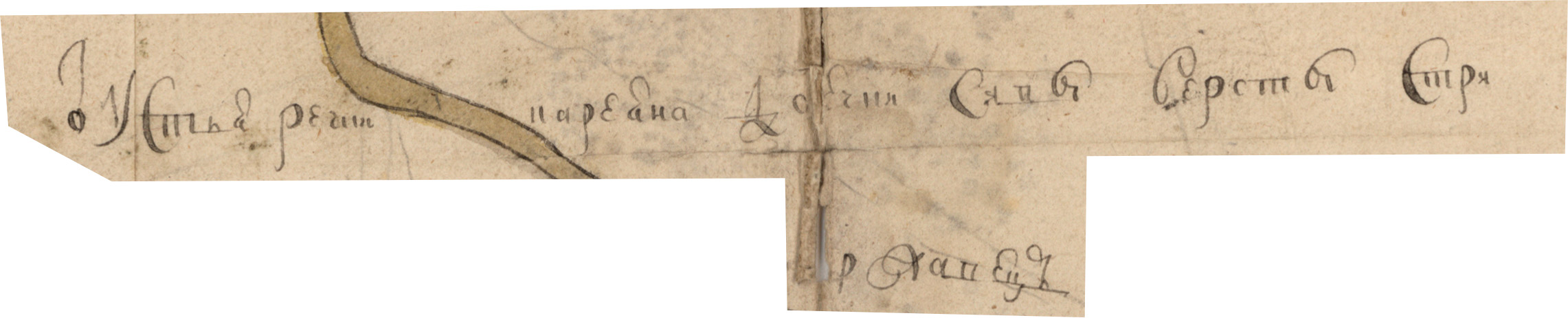
From the mouth of the Karean River to the Syava River—about three versts. Rzhavets.
From the mouth of the Karean River to the Syava River—about three versts. Rzhavets.
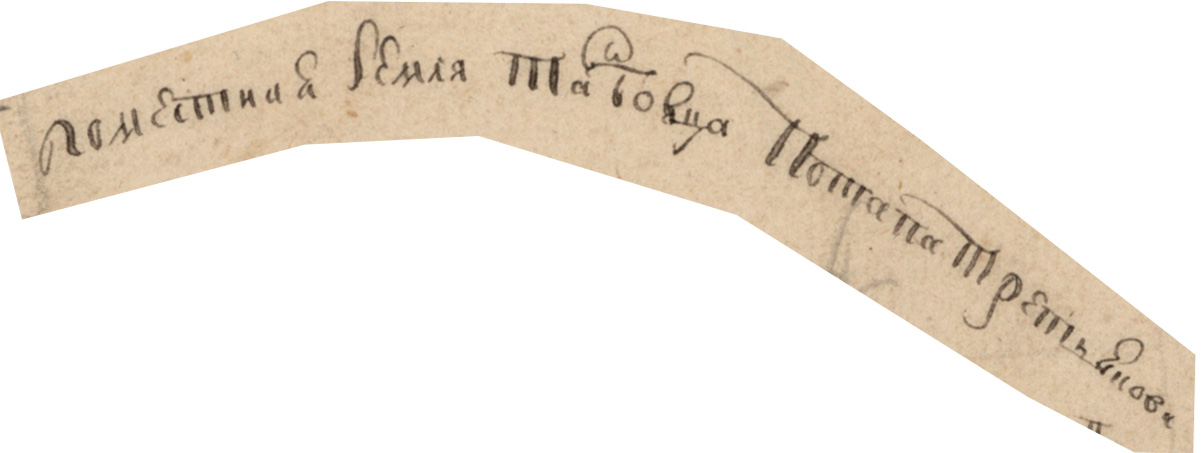
Service land of the Tambov man Potap Tretyakov.
Service land of the Tambov man Potap Tretyakov, granted to him for service or noble origin.
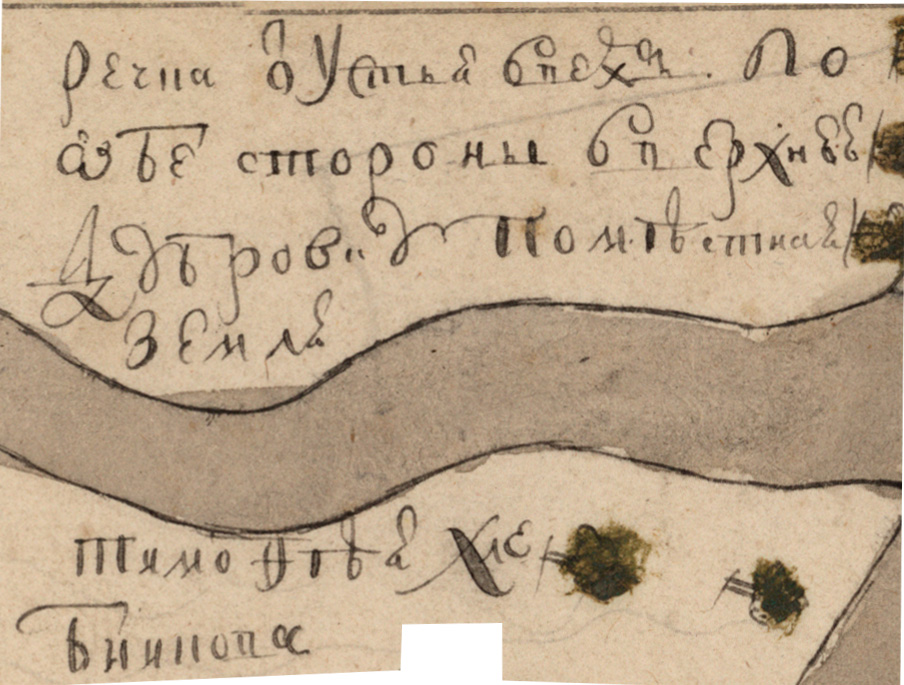
River from the mouth upstream. On both sides up to Upper Dubrovka—service land of Timofey Khlebnikov.
River from the mouth upstream; on both sides up to Upper Dubrovka—service land of Timofey Khlebnikov, granted to him for service or noble origin.

From the mouth of the Karean River downstream along the Tsna River, on both sides—Nikolskie Poliany—service land of the pod’yachy (clerk) Erofey Ivinsky.
From the mouth of the Karean River downstream along the Tsna River, on both sides of Nikolskie Poliany—service land of the pod’yachy, i.e., an assistant to a dyak; a scribe and records officer of a prikaz chancery, Erofey Ivinsky.
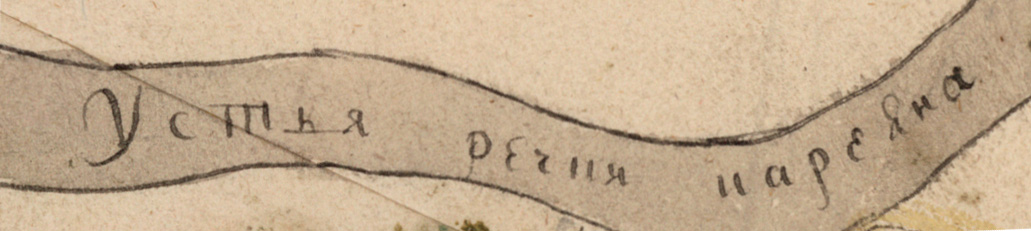
Mouth of the Karean River.
Mouth of the Karean River.
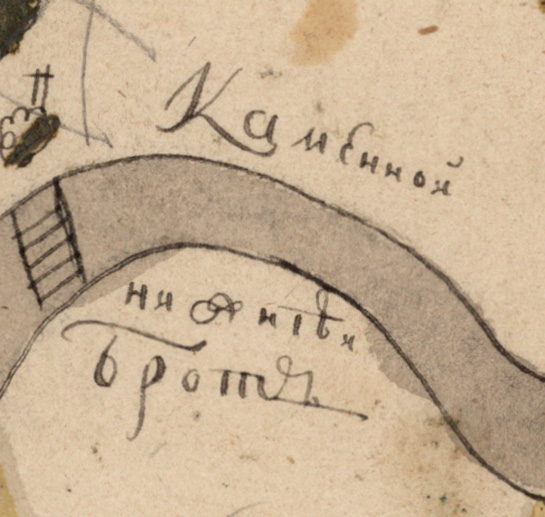
Stone lower ford.
Stone lower ford.