
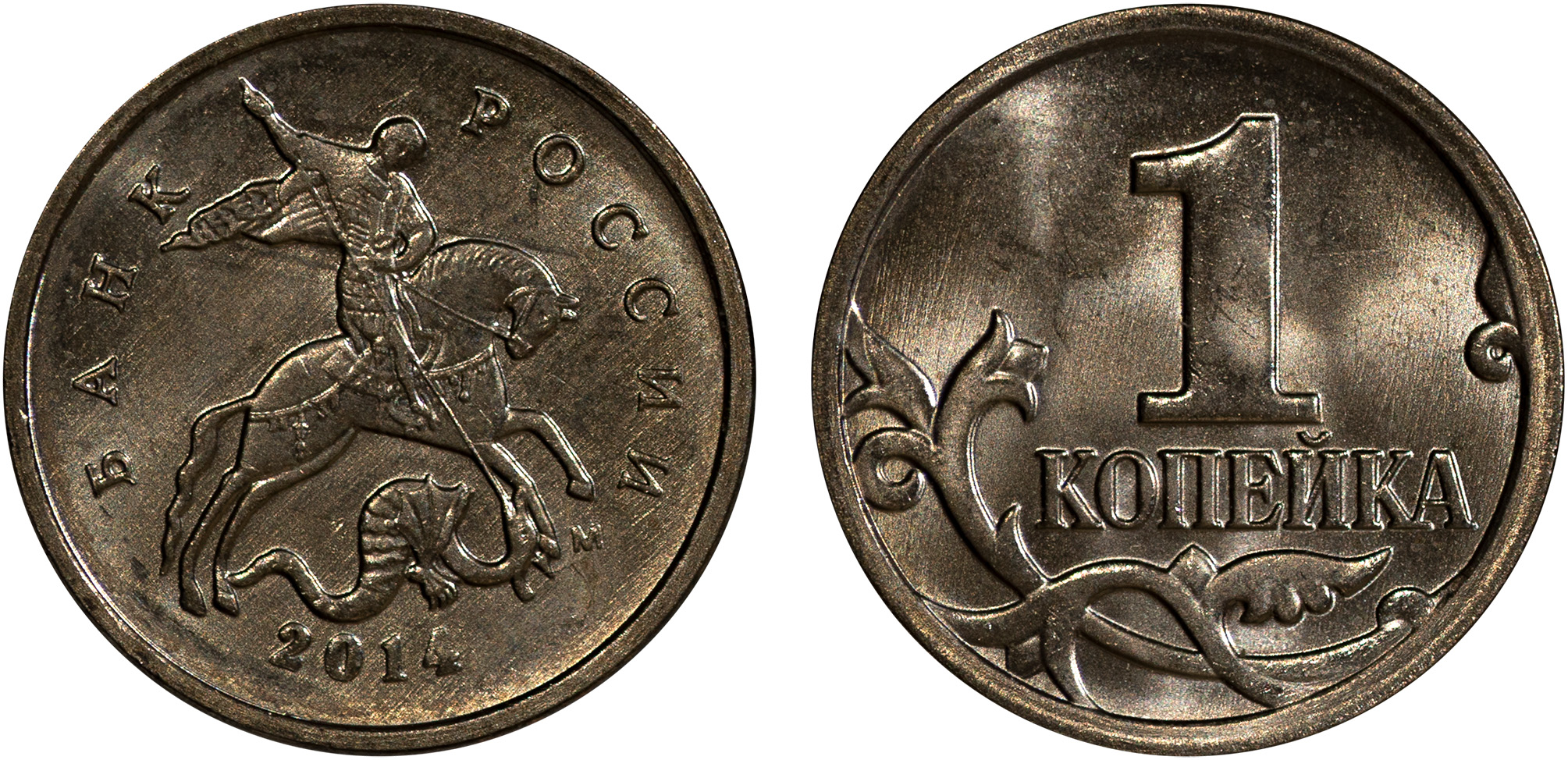
In 2009, the last minting of 1-kopeck coins was supposed to take place. Even by that time, it had become clear that inflation had made the production of such tiny coins extremely unprofitable—and simply meaningless. Previously minted kopecks fell out of use, finding their way into piggy banks, and there was no need to produce new ones, since prices in shops were rounded. Therefore, numismatists were shocked to learn that the Bank of Russia had ordered the Moscow Mint to strike 1-kopeck coins in 2014. Even more surprising is the mintage, which specialists estimate at between 0.5 and 1 million pieces.
There is an opinion that this coin was issued specifically for residents of Crimea after the peninsula became part of Russia. Crimeans needed to be supplied with change. Although not all collectors agree with this view, since there is simply no need for this smallest coin. True, in pharmacies, when buying medicines, you can still receive change in the form of both a 5-kopeck coin and a 1-kopeck coin. This theory is also supported by the fact that the first kopecks were found precisely in Crimea.
18–28 February — in Kyiv, demonstrations by supporters of European integration resumed, protesting the government’s decision to suspend preparations for signing an association agreement with the EU. By mid-February, the confrontation had reached its peak: several thousand demonstrators attempted to storm the Verkhovna Rada building. As a result of clashes with law enforcement, 25 people were killed.
20 February — on Instytutska Street and Independence Square in Kyiv, snipers killed more than 100 people. The opposition blamed President V. Yanukovych for this, but he rejected the accusations.
21 February — the president and opposition leaders, with mediation by representatives of the European Union, signed an agreement to resolve the political crisis in Ukraine. It provided for the creation of a government of national unity, constitutional reform, early elections, the withdrawal of law enforcement from central Kyiv, an end to violence, and the surrender of weapons. The same day, the Verkhovna Rada adopted laws to release all those detained during the protests. However, protesters on the Maidan demanded the president’s immediate resignation, threatening to move to armed action.
Yanukovych left Kyiv.
22 February — in Kharkiv, he stated that he was not going to resign and would not sign decisions of the Verkhovna Rada that he considered unlawful. He called what was happening in the country “vandalism, banditry, and a coup d’état.”
On the night of 22–23 February — by the personal decision of V. Putin, Russian special services evacuated Yanukovych from Donetsk Oblast to Crimea, after which they secretly transported him to Russia.
22 February — the Verkhovna Rada adopted a resolution stating that the head of state had removed himself from fulfilling his constitutional powers.
23 February — the duties of head of state were temporarily assigned to A. Turchynov (Batkivshchyna faction).
27 February — a new cabinet of ministers headed by A. Yatsenyuk was approved.
28 February — at a press conference in Rostov-on-Don, Russia, Yanukovych said that he still considered himself the legitimate head of the Ukrainian state.
16–31 March — in Crimea and Sevastopol, a referendum on the status of these territories was held on 16 March. According to official data, 96.8% of those voting in Crimea and 95.6% in Sevastopol supported accession to Russia.
17 March — the Crimean Supreme Council and the Sevastopol City Council approved these results. Crimea was proclaimed a sovereign state, and the Russian ruble was declared a currency alongside the Ukrainian hryvnia. Taking into account the expression of will of the peoples of Crimea, on 17 March Russian President V. Putin signed a decree recognizing the Republic of Crimea as a sovereign and independent state.
18 March — an interstate treaty was signed on the admission of the Republic of Crimea and the city of Sevastopol into the Russian Federation.
19 March — the Constitutional Court of the Russian Federation found the treaty on Crimea’s accession to be in compliance with the Constitution of the Russian Federation. The State Duma ratified the treaty on 20 March, and the Federation Council on 21 March.
21 March — V. Putin signed the law “On the Admission to the Russian Federation of the Republic of Crimea and the Formation within the Russian Federation of New Subjects.” On the same day, a presidential decree appeared establishing the Crimean Federal District—the ninth in the Russian Federation.
31 March — a new ministry appeared in the Russian government—the Ministry for Crimean Affairs.
14 September — as a result of the single voting day, the parliaments of Crimea and Sevastopol were formed. An absolute majority of seats in them went to United Russia. This is how, by the standards of history, the reunification of Crimea with Russia occurred lightning-fast, in the view of some—or the annexation of Crimea by Russia, in the view of others. These opinions are supported by numerous arguments.
March–May — in Donetsk, Luhansk, Kharkiv, and other cities of southeastern Ukraine, rallies by supporters of federalization began. Participants opposed the change of power in Kyiv and the policies of the new leadership, demanded a referendum on the status of the eastern regions, and sought to grant the Russian language state status.
7 April — in Donetsk, a Republican People’s Council was created, which declared the sovereignty of the Donetsk People’s Republic.
13 April — the National Security and Defense Council of Ukraine decided to conduct a force operation against supporters of federalization. Fighting began between militia detachments on the one hand and units of the Ukrainian army and the National Guard on the other. The intensity of hostilities in eastern Ukraine kept increasing. Settlements changed hands. Destruction and human casualties mounted. According to the Office of the UN High Commissioner for Human Rights as of 15 December 2014, since mid-April 2014, 4.7 thousand people were killed and 10.3 thousand were wounded.
27 April — at a rally in Luhansk, the Luhansk People’s Republic was proclaimed.
11 May — a referendum was held, and according to the announced results, 89.7% of residents in Donetsk Oblast and 96.2% in Luhansk Oblast voted “for” self-determination. Due to the difficult humanitarian situation in the conflict zone, the Russian authorities regularly sent convoys of trucks with humanitarian aid (food, building materials, medicines) to eastern Ukraine.