
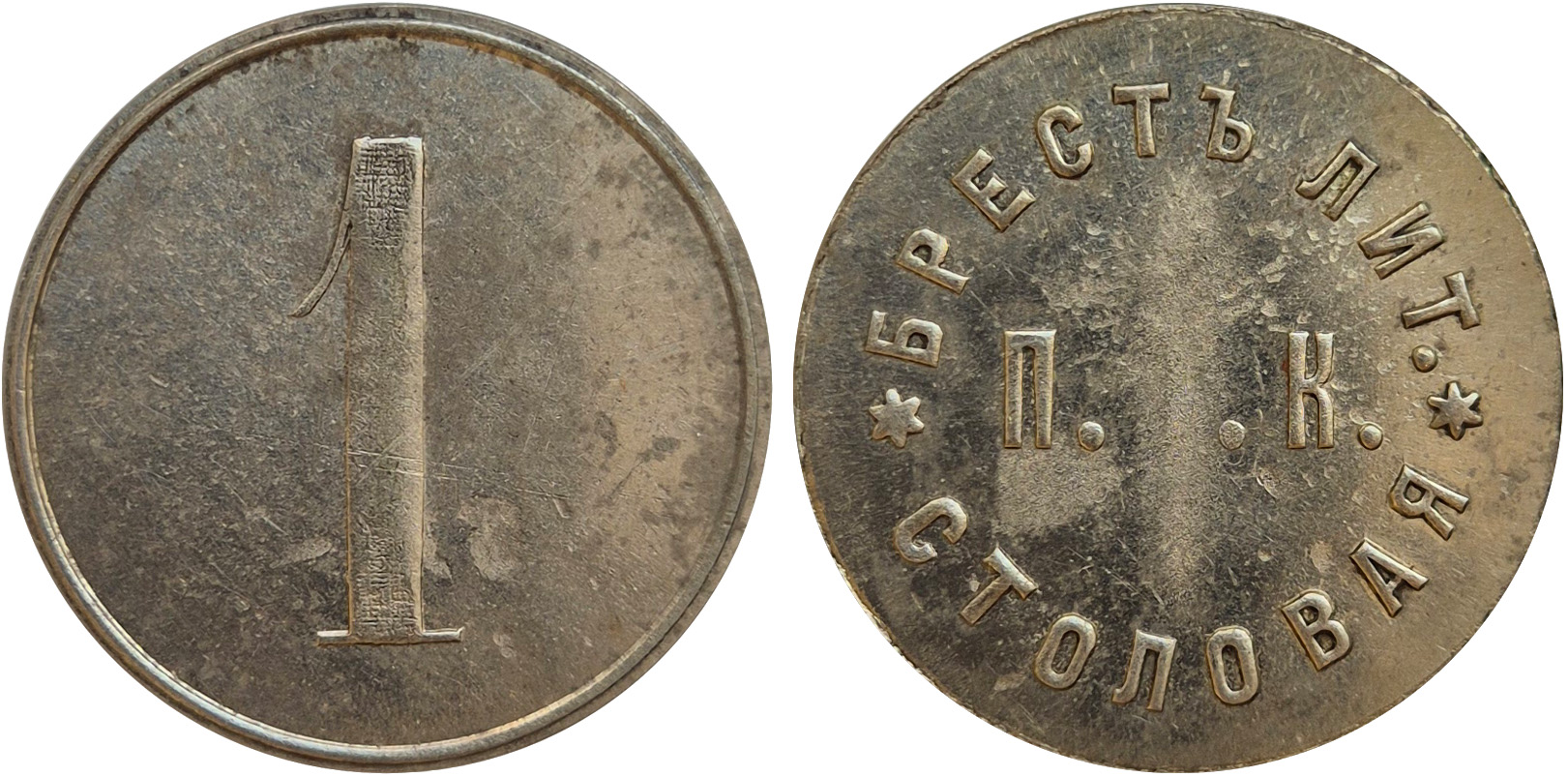
The canteen of the postal and telegraph office in the city of Brest-Litovsk.
In 1848, at Shosseynaya Street and the main square of New Brest—Postovaya Square—an ensemble of buildings appeared: the post station, the district treasury, and the station master’s house, united by the grounds of the postal yard. The buildings of the postal department occupied an entire block bounded by Shosseynaya Street (P. M. Masherov Avenue), Belostokskaya Street (Soviet Border Guards Street), Medovaya Street (K. Marx Street), and Postovy Lane (Sverdlov Street).
In the mid-19th century, the postal yard in Brest was a complex establishment with stables, barns, rooms for transit passengers, and an office. Initially, the post office consisted of two wings—the post building and the treasury—which were later combined into one.
The first floor of the post office was allocated to the main service halls, the second to administrative offices. Around the perimeter of the postal yard were rooms for postboxes, for registering travel papers, storerooms for keeping rye, provisions, and bread, stables for the horses used to deliver the mail; facilities for postal carriages, and a station house for passengers traveling through Brest.
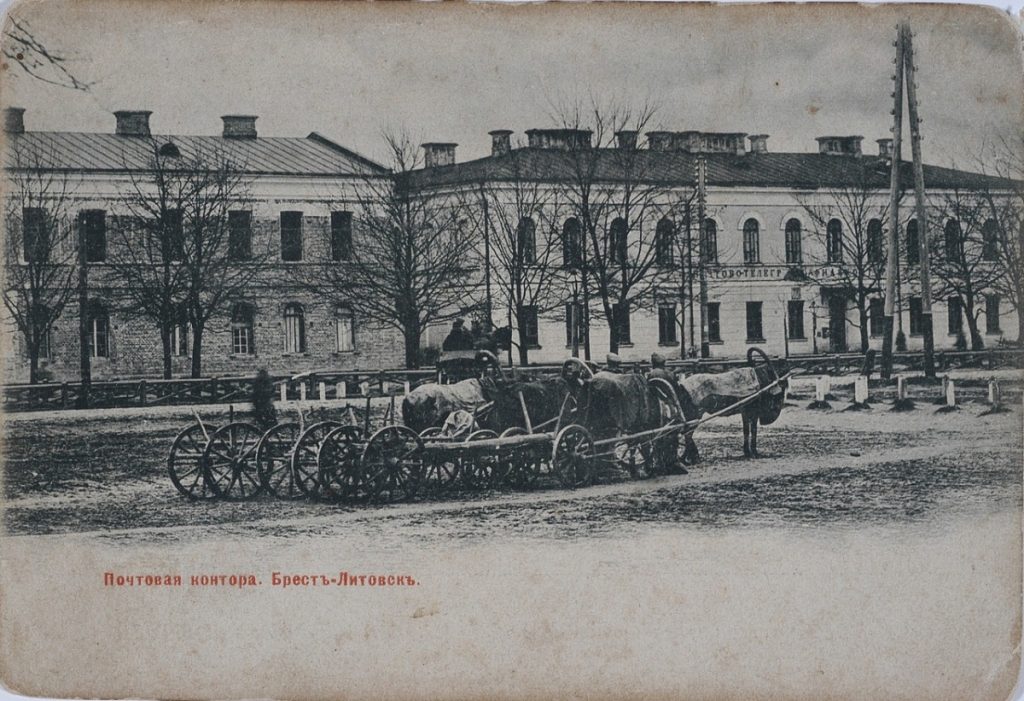
A description of the 19th-century Brest-Litovsk post station can be found in the book “Journey Through Polesie and the Belarusian Region” by the well-known Belarusian writer and ethnographer P. M. Shpilevsky. Here is how the scholar saw Brest in 1858:
“In the Volhynian suburb, and specifically near Postovaya Square, the buildings are more often of stone, in the style of the latest architecture, quite elegant and large, and some even enormous for a provincial town; the streets are regular, wide, and fairly long. Among the best stone buildings one may count the post office and the post station with a… tavern and passenger rooms, the Grobelli cafe-restaurant, and a row of houses containing stalls, shops, and stores with so-called Warsaw goods.
Having examined the sights of New Brest, I hurried to the post station. …Left alone, I breathed freely and for about two hours enjoyed a pleasant idleness. And it should be noted that at the Brest station one can rest with pleasure, especially after the small, unremarkable Polish stations. What cleanliness, what neatness, what comfort and luxury in everything! In this station you will find several large, high rooms papered with beautiful wallpaper, with parquet floors shining like a mirror; in each of these rooms there are elastic sofas and chairs, curtains on the windows, mirrors, and rosewood wall clocks. In the large hall there is a small cast-iron fireplace. More than that: in every room you will at any time find fresh water in clean carafes, silver-plated candlesticks with stearin candles, a washstand, a towel, brushes, and combs… Is that not comfort for weary travelers?” .
In 1862, the staff of the Brest post office numbered 29 people: 5 officials, 6 sorters, 13 postmen, a watchman, and four station masters.
In 1884, a postal reform was carried out in the country: the postal and telegraph departments were merged and a unified Main Directorate of Posts and Telegraphs of the Ministry of Internal Affairs was established, and new staffing tables were approved. Its emblem became a single postal-telegraph sign of two crossed post horns and two bundles of arrows.
At the head of the postal-telegraph office stood a chief (the senior postal official). After telegraph communication was established in Brest, the post office was renamed a postal and telegraph office, and assigned Class II.