
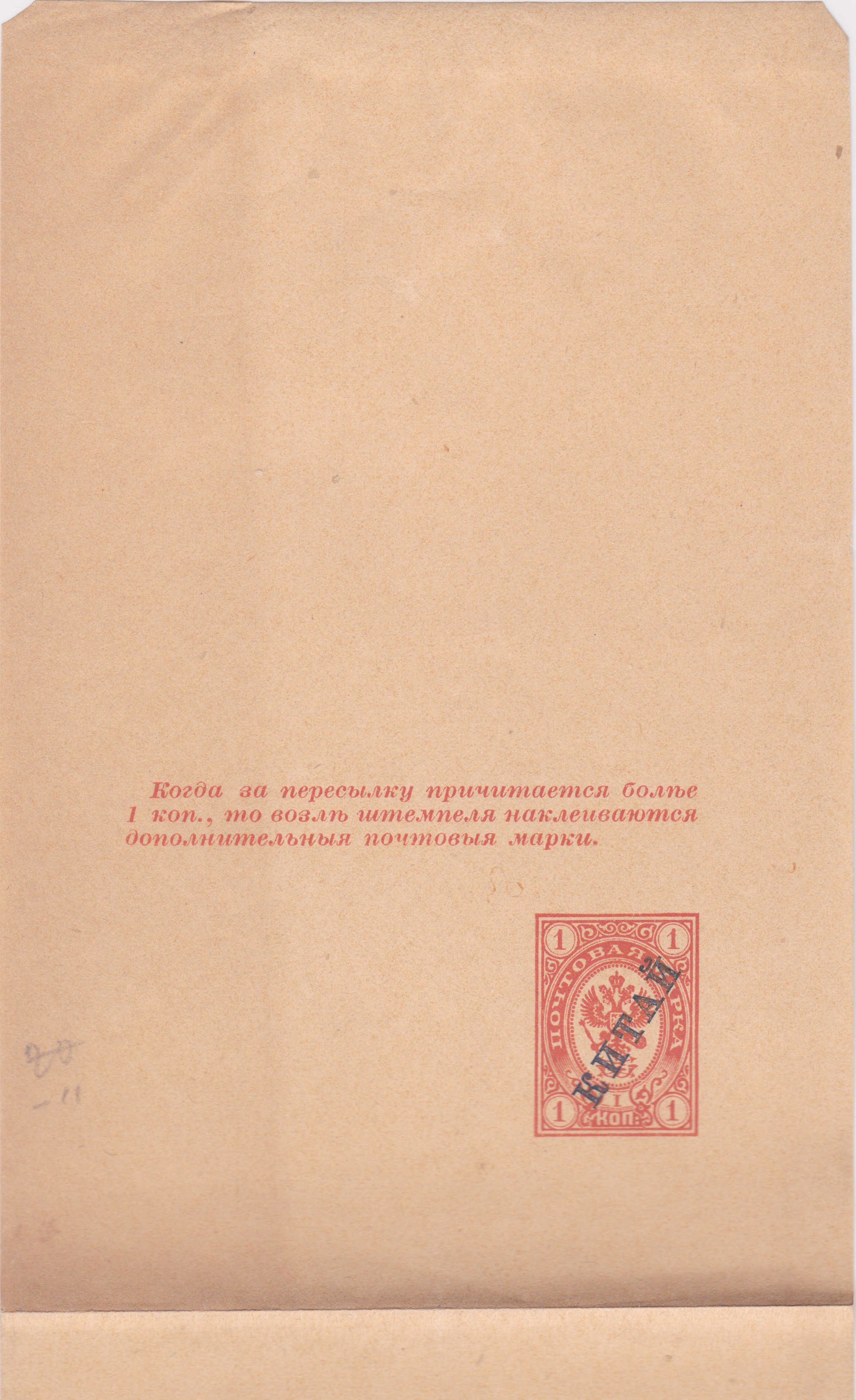
In Russia, imprinted parcel-wrapper bands were issued twice: in 1890–1891 and in 1913.
A type of postal stationery—parcel wrappers. These are paper bands of various widths and lengths with a printed sign of postage payment. Parcel-wrapper bands were intended for wrapping newspapers, books, and other printed matter. Unlike envelopes, parcel wrappers did not fully protect the contents from damage, since the edges usually remained open.
Originally, “banderoles” were paper bands for wrapping postal items which, in some countries, were issued with printed postage payment signs. Such imprinted banderoles are considered postal stationery and are objects of collecting (philately).
In the Russian Empire, the maximum weight for banderole mailings was significantly lower, not exceeding 4 pounds for printed matter and business papers (therefore lower than the maximum weight for sealed letters) and 20 lots for samples of goods. Banderole mailings were paid, although at a substantially reduced rate (the minimum postage for non-local mailings was 2 kopecks (equivalent to 5 centimes) for printed matter, 7 kopecks for business papers, 3 kopecks for samples of goods), but each weight unit—set at 4 lots—was paid in full.
Russian Post in China was a postal service organized by the government of the Russian Empire on the territory of China and operating from 1870 to 1920.
In order to improve postal exchange with China, to support the work of Russian consulates, trade missions, private firms, and later to ensure normal communications in the concession territories, Russian post offices began to be opened from the end of the 19th century.
According to the opinion of the State Council, highest-approved on 23 March (4 April) 1870, the Russian Post in China was established as a private enterprise under the patronage of the Russian government and receiving from it a subsidy of 17,600 rubles per year. The Russian post was maintained between Kyakhta and Tianjin, and along this route four Russian post offices were established—in Urga, Kalgan, Beijing, and Tianjin. In these offices, all kinds of correspondence were accepted and dispatched to all places in Russia and beyond its borders.
At the beginning of the 20th century, such offices existed in Xinjiang (Chinese Turkestan), Mongolia, Manchuria, along the Chinese Eastern Railway, and in a number of Chinese ports (Tianjin, Chefoo, Shanghai, and others).
For the payment of correspondence, both stamps of the Russian Empire and special issues for postal items in China were used. Such stamps bore the overprint “China” and until 1917 were used at the exchange rate of 1 ruble = 1 Chinese dollar (yuan). Due to the onset of inflation, from 1917 the stamps were used only in Chinese currency.
By agreement with the Soviet Government of Russia, the Russian post offices in China were closed in December 1920–January 1921.