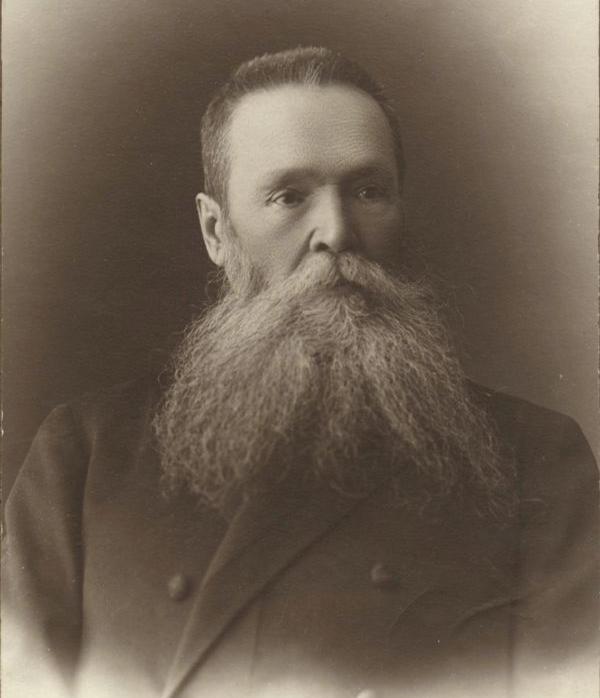
Pyotr Ivanovich Makushin was the son of a rural church clerk. He graduated from a theological school and studied at the Perm Theological Seminary. After passing his exams as an external student, he entered the St. Petersburg Theological Academy, and from his third year he went as a missionary to the Altai Spiritual Mission, where he spent two years. In 1868, P. I. Makushin moved to Tomsk, obtained a vacant post as superintendent at a theological school, and over 4.5 years brought the school into exemplary order for educating 150 children.
In 1870, Makushin opened the first private public library right in his apartment. Books were issued by Pyotr Ivanovich’s wife, while he himself gladly issued books to children, studying their tastes and guiding their choices. Seeing the public’s enormous interest in books, in November 1872 Makushin submitted a petition to the Tomsk governor for permission to open a Siberian bookshop. Until then, there had never been a bookshop in Siberia—the nearest city where such a purchase could be made was Moscow, and at the travel speeds of the time the journey took months. The bookshop opened on a memorable day—February 19.
Makushin had no capital of his own to open the shop, so merchant V. V. Mikhailov provided 5,000 rubles for the first purchase of books. The “Mikhailov and Makushin Trading House” was formed; profits were split equally between the partners, but from 1892 Pyotr Ivanovich began running the business independently, having fully settled accounts with his partner. Twenty years after the first bookshop opened, on February 19, 1893, Pyotr Ivanovich opened a second shop—in Irkutsk.
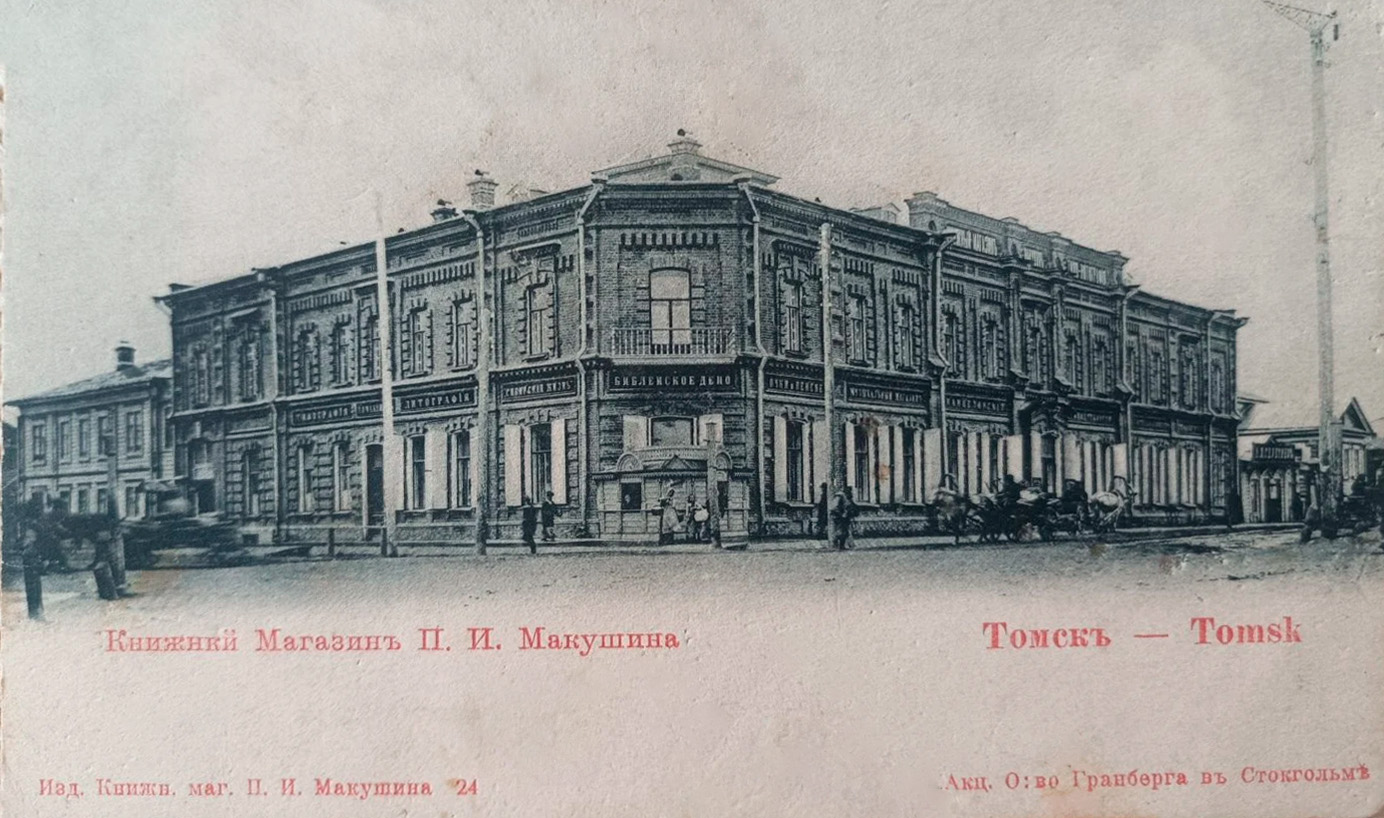
At first, the shop’s assortment was modest—due to a lack of funds, book purchases had to be limited to only the most necessary items. But the success of the venture was so obvious that already with the second purchase, the capital provided by Mikhailov amounted to 10,000 rubles, and Moscow merchants released part of the goods to Makushin on six-month credit. By the end of the first trading year, all credits were fully repaid. The two-story shop came to stand out for an assortment unseen at the time, along with a unique marketing and pricing policy.
Thanks to large purchase volumes and a strong reputation among publishers, Makushin received substantial discounts, and in Siberia a book could be bought for the same price, and sometimes even less, than in Moscow and St. Petersburg.
In 1876, Makushin opened his own modern printing house, a bookbinding and ruling workshop, and later also mastered newspaper publishing. In 1881, he began publishing the “Siberian Gazette,” the first private periodical in Tomsk, and in 1897 “Siberian Life” began to appear—the most popular newspaper in Siberia.
Over 50 years of work in education and enlightenment, Pyotr Ivanovich Makushin founded a public library that reached 40,000 volumes, a pedagogical museum, a museum of applied knowledge, and opened the first free public library in Russia. During the 15 years he chaired the school commission in Tomsk, the number of city primary schools grew from 3 to 20. Thanks to P. I. Makushin’s efforts, from 1901 to 1919, 600 rural free libraries were opened in Tomsk Governorate.
He founded the Society for Promoting the Organization of Sensible Recreation in the villages and hamlets of Tomsk Governorate, as well as summer regent courses for teachers of rural schools. Makushin took an active part in the society providing assistance to Siberians studying in higher educational institutions, in the Tomsk charitable society, and others.
On April 20, 1882, a decree establishing the society for the care of primary education was approved, in which P. I. Makushin served as chairman for 10 years.
In 1902, Makushin began implementing an idea he had long been nurturing: the establishment of a People’s University. He decided to allocate 3,000 rubles from his own funds each year until the capital, growing with interest, reached 100,000 rubles. In 1905, he applied to the Tomsk City Duma and transferred the first accumulated 10,000 rubles to the city. The Duma also resolved to allocate 3,000 rubles annually, and a donation drive was opened to increase the capital. Donations were collected slowly, and in 1909 P. I. Makushin transferred additional capital to the city in the amount of 100,000 rubles.
By October 1912, the building had been constructed and was named the House of Science. It hosted general-education classes; agricultural and photographic societies operated there; and there was a kindergarten (or, as it was called, a “children’s hearth”) for children whose parents had gone off to war. Unfortunately, Makushin’s dream of a free People’s University was not destined to come true—the charter was approved only in 1916, and it was no longer possible to develop activities in wartime conditions.
In 1917, he joined the leadership committee of the Constitutional Democratic (Kadet) Party; in 1920, after Soviet power was restored in Siberia, he was arrested twice.
Makushin’s services to society were recognized by the authorities: in 1919 he was awarded the title of Honorary Citizen of Siberia.
Under Soviet rule, all Makushin’s enterprises and property were nationalized; he worked as a consultant and later as a member of the board of Sibkray-izdat, heading its trade department.
His confiscated house was returned in 1923.
In 1924, P. I. Makushin was approved by the Council of People’s Commissars as deputy chairman of the Siberian branch of the All-Russian Society “Down with Illiteracy.”
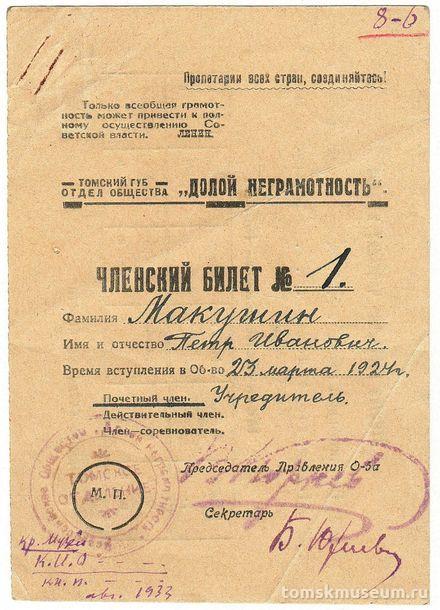
Membership card No. 1 of P. I. Makushin, founder of the Tomsk Governorate branch of the “Down with Illiteracy” society.
He died on June 4, 1926. The newspaper "Pravda" wrote in a note dedicated to his memory:
"In Tomsk, P. I. Makushin, the oldest worker in the enlightenment of Siberia, has died. In his last note, P. I. Makushin asks to 'commit the body to the earth, and instead of a monument place a rail with an electric lantern.'"
The will was carried out. He was buried within the fence of the House of Science, and the tombstone was a steel rail with an electric bulb shining at night.
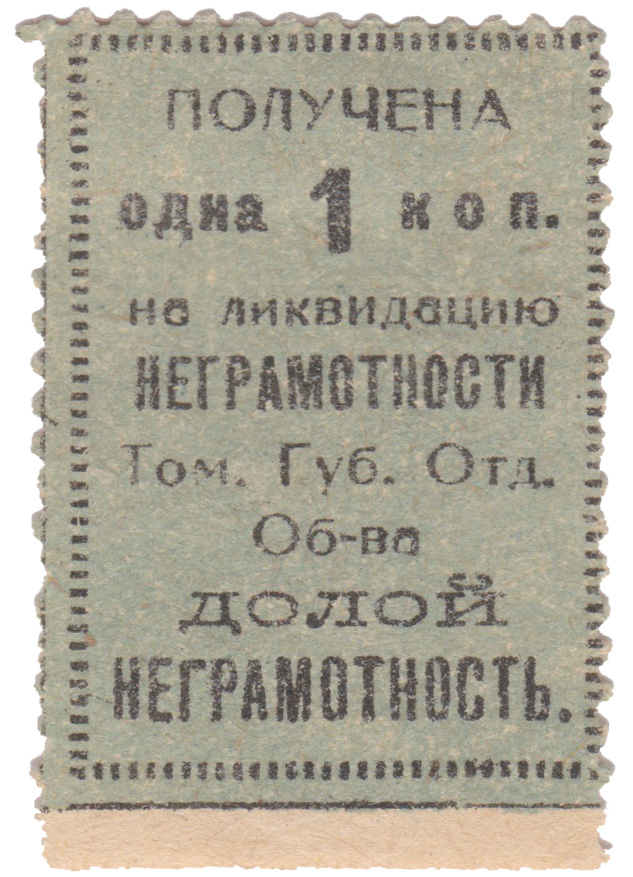
For the elimination of illiteracy 1 Kopeck 1925.
Tomsk Provincial Department of the “Down with Illiteracy” Society.