On July 28, 1914, one of the largest armed conflicts in human history began, later called the First World War.
The war—with its losses, suffering, and millions of deaths—sparked a patriotic surge in Russian society and an unprecedented rise in charitable and selfless activity for the good of the Fatherland.
One of the first public organizations to respond to the need for medical assistance was the Russian Red Cross Society, whose main task was to organize medical facilities and provide medical care. By mid-August 1914, 45 hospitals, 35 transit infirmaries, and 33 mobile field hospitals had been established across the country, yet despite these numbers there was a shortage of medical institutions and nurses.
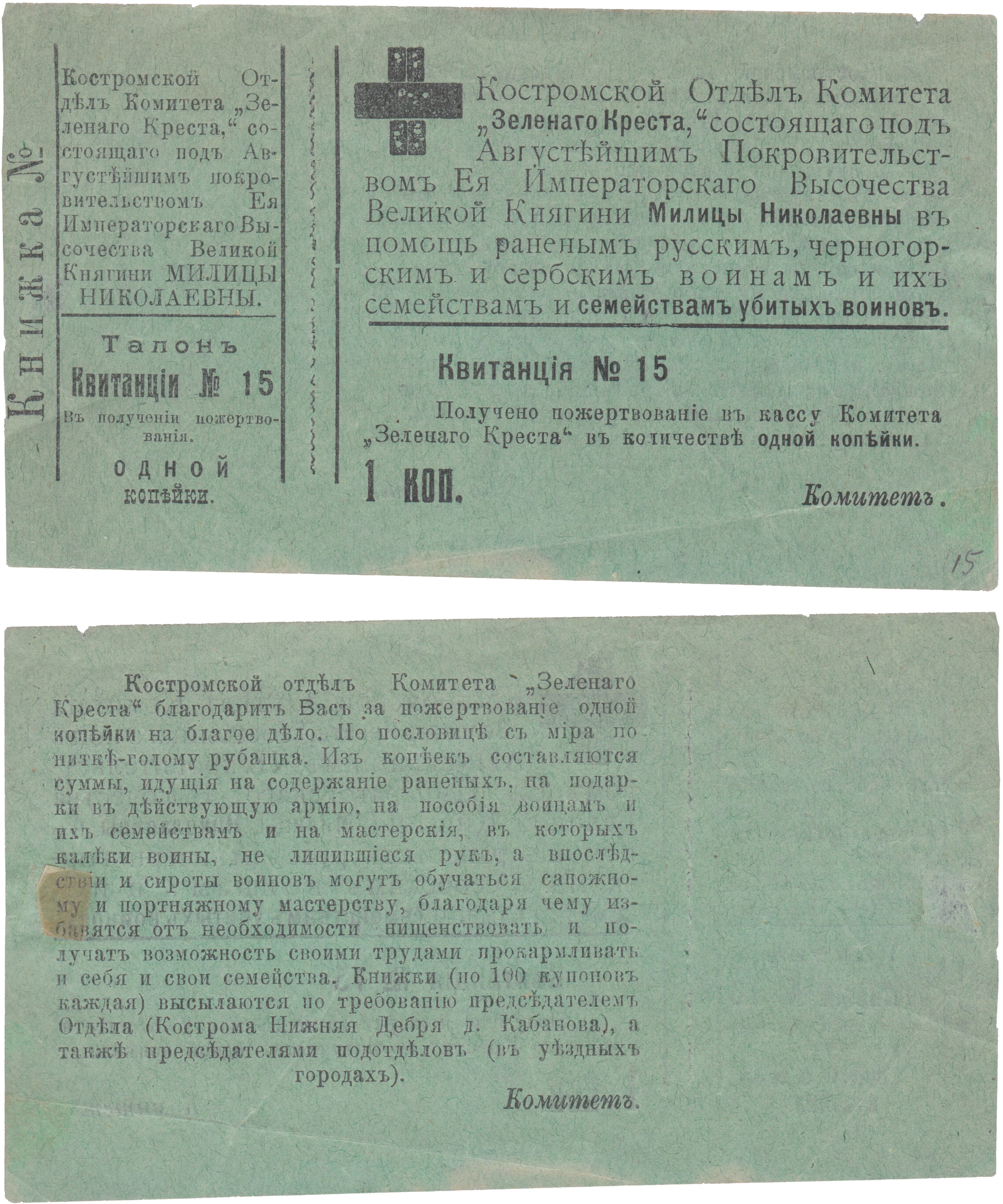
In addition to the Red Cross, other public organizations also established hospitals and infirmaries. For example, the Kostroma charitable society of the “Department of the Committee of Grand Duchess Militsa Nikolaevna for Assistance to Wounded Russian, Montenegrin, and Serbian Soldiers,” also known as the “Green Cross.” It is also known that, besides treating wounded and sick soldiers, the “Green Cross” provided financial assistance to soldiers discharged from infirmaries and hospitals. Those fighting at the front, as well as their wives and children, were not forgotten either: on holidays they were given gifts. While restoring the health of wounded and sick soldiers, the Society systematically organized the work of libraries, readings, musical performances, and literacy instruction for soldiers.
Militsa Nikolaevna was a Montenegrin princess, but most of her life was spent in Russia. First, she studied at the Smolny Institute together with her sisters, and then married a grand duke. Militsa and her husband tragically did not match in temperament: she was passionate, ardent, impulsive, while he was reserved and quiet.
Militsa was born on July 26, 1866, in the small Montenegrin town of Cetinje. The town still exists today, tourists are actively brought there, and it is very beautiful. The medieval stone fortress is striking; it feels as if you are transported to the age of knights and castle sieges.
Militsa was the daughter of the Montenegrin king Nikola I Petrovic and Milena Vukotic. The family was large—noisy and cheerful. Militsa’s childhood passed in her native Montenegro; Nikola pursued a foreign policy loyal to the Russian Empire, and therefore the youth of three of his daughters was spent in Russia.
Nikola I Petrovic decided to strengthen ties with Russia through dynastic marriages; he decided to marry Militsa and Stana to Russian grooms.
While grooms were being sought, Militsa graduated from the institute with the Empress Maria Feodorovna’s gold name medal.
Soon a groom was found as well—Grand Duke Peter Nikolaevich, a grandson of Emperor Nicholas I.
The wedding took place in Peterhof on August 7, 1889. At the time of the wedding, the bride was 23 years old and the groom was 25.
Militsa once introduced the imperial couple to Grigory Rasputin. He was one in an endless procession of “healers” and “predictors” known to the Montenegrin princesses.
Nicholas II wrote in his diary (November 1, 1905): “Had breakfast: Prince Orlov and Resin (on duty). Went for a walk. At 4 o’clock we went to Sergievka. Had tea with Militsa and Stana. Met a man of God—Grigory from Tobolsk Province.”
In 1917, Militsa, Peter, and their children got out of Petrograd and, together with other Romanovs, lived in Crimea. Dulber Palace saved all the Romanovs who found themselves in Crimea in 1917, when the Yalta Soviet threatened to execute them.
Militsa and her family left Russia in 1919 on the British warship “Marlborough.”
Received a donation to the cashier of the Committee "Green Cross" in the amount of 1 Kopeck 1915.
Kostroma Branch of the “Green Cross” Committee.