
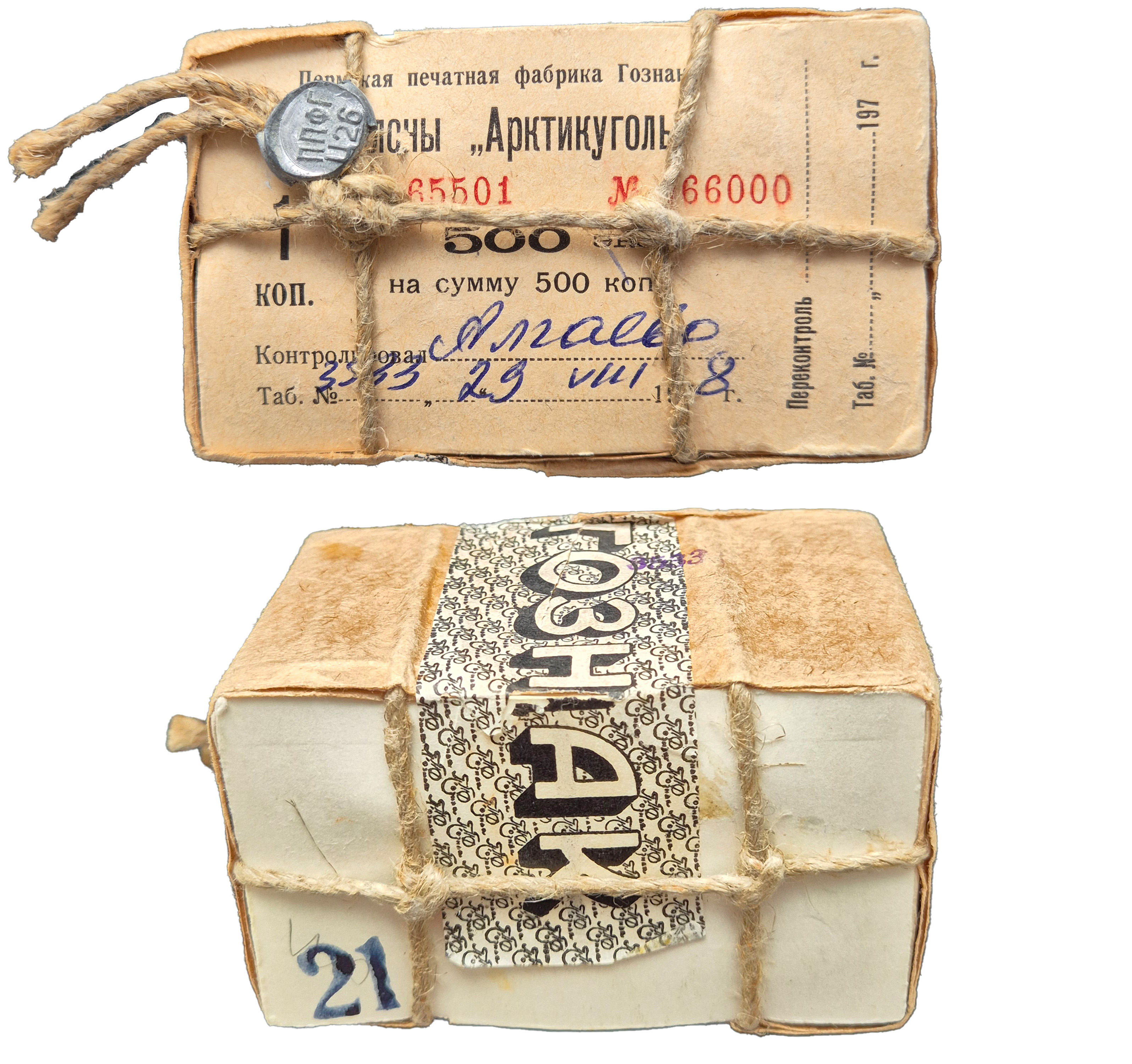
Block of 500 1-kopeck coupons totaling 500 kopecks, in packaging. Perm Printing Factory of Goznak.
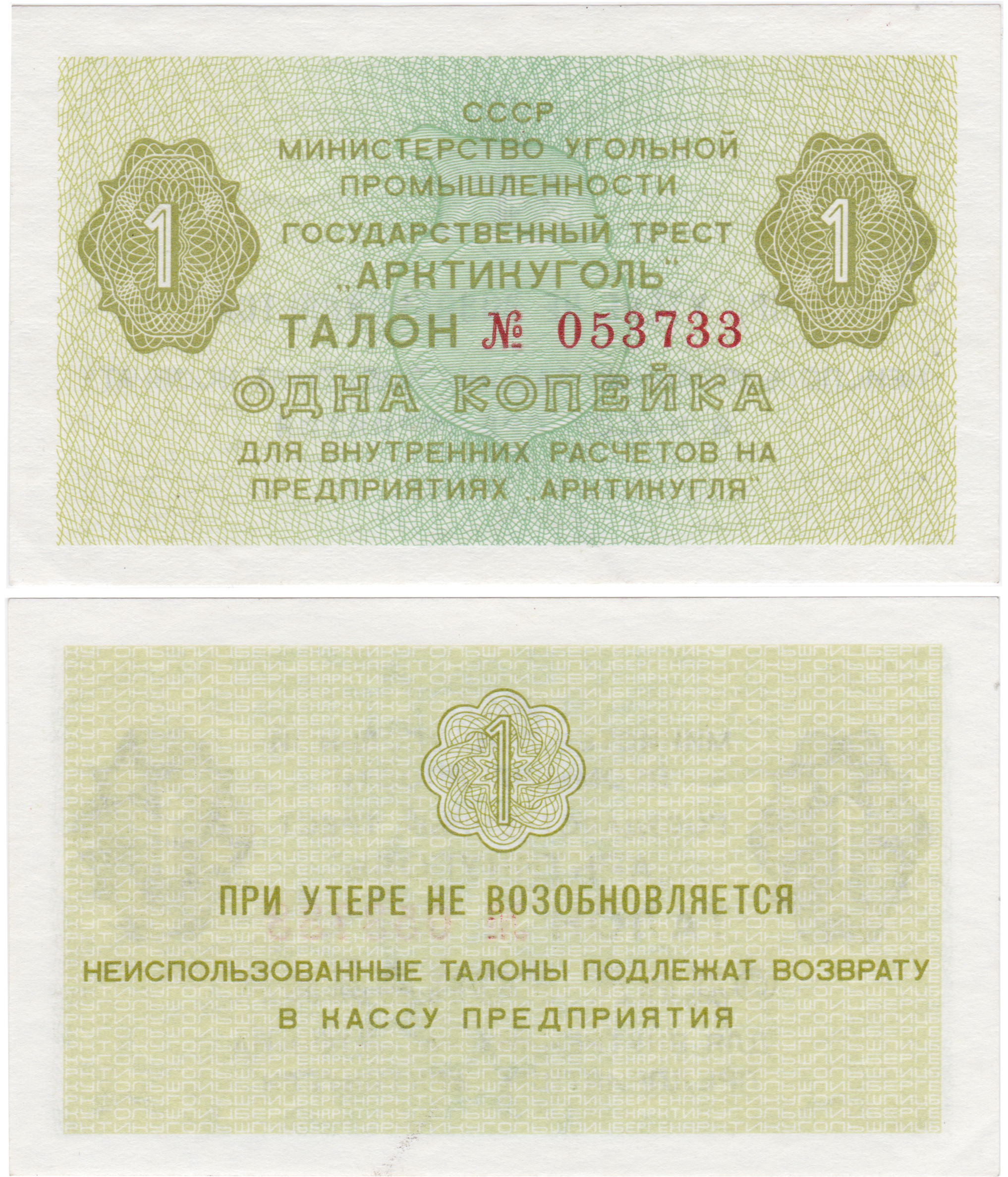
Spitsbergen is an архipelago belonging to Norway, but under the 1920 Paris Treaty the Soviet state, and later modern Russia as its legal successor, has carried out coal mining on the islands. The Arktikugol trust owns 250 sq. km of the islands’ area, where people live and work, providing energy security for the Murmansk and Arkhangelsk regions, as well as for the Northern Fleet.
The first paper money (bon) on Spitsbergen was issued in 1916. These small-change notes were used by miners from the southern regions of the USSR who came to Spitsbergen under contract.
The Arktikugol trust began issuing not metal tokens, as other companies did, but paper notes. The issue of currency substitutes began in 1931.
No year was indicated on them; they were printed so that workers could make purchases only in Soviet trading enterprises based on the island of Spitsbergen.
In 1961, when the Arktikugol trust was transferred from the Ministry of the Coal Industry to the Ministry of the Maritime Fleet, and when in 1979 the company was transferred back, new notes of the 8th issue of the Arktikugol trust were released with a new design.
Despite Norway’s sovereignty, Soviet influence on Spitsbergen was very substantial; for example, in the 1980s more than 2,000 Soviet citizens lived on Spitsbergen, and only about 1,000 Norwegians (now 1,800 Norwegians and 500 Russian citizens). In our settlements of Barentsburg, Grumant, and Pyramiden (the last two are now abandoned), large-scale coal development was carried out, and unique mines and underground railways operated. By the end of the 1980s, coal reserves on Spitsbergen had been significantly depleted, and the Norwegian government reoriented the archipelago toward tourism and an expedition-and-research base: at present Spitsbergen’s economy is profitable and self-sustaining. Arktikugol, however, was unable to cope with a similar task.