

In the Russian Empire there were tobacco excise stamps, or excise banderoles, issued from the mid and late 19th century. They were printed on a thin, long strip used to seal a packet or package of makhorka, tobacco, papirosy, or cigarettes; it was impossible to open the package by breaking the banderole without tearing it.
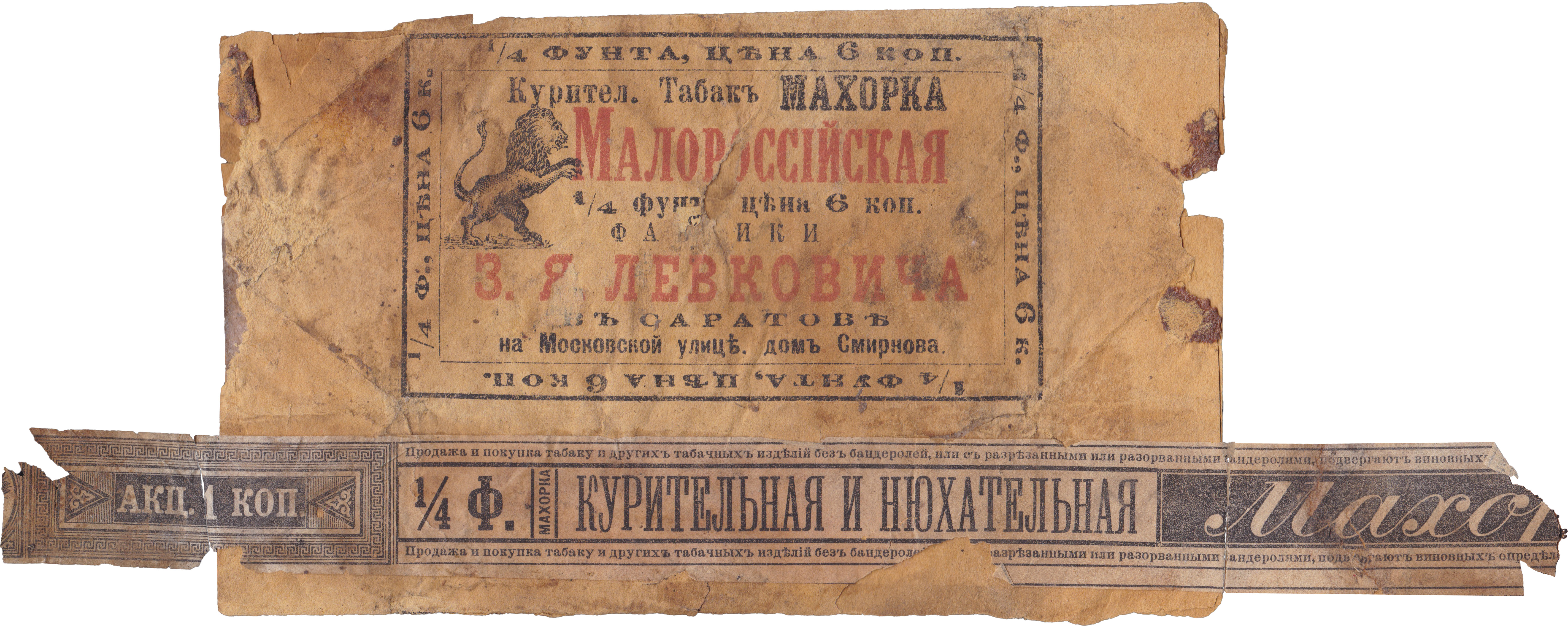
The banderole guaranteed the authenticity of the tobacco factory’s product being sold and indicated that the excise had been paid to the government; excise duties already existed in many countries at that time.
In 1727, free sale of tobacco was permitted, with a duty of 1 kopek per pound.
In 1749, the tobacco monopoly was reinstated.
In 1762, a system of free sale of tobacco was established and it was exempted from tax until the end of the 1830s of the next century.
In 1838, under the “Monetary Reform” (1839–1843) of E. F. Kankrin, Minister of Finance of the Russian Empire, tobacco again became subject to a mandatory excise: “The preparation of tobacco, as an item belonging to the demands of luxury, may, without any restriction for the people, be subject to a moderate excise.” The key words in this phrase, taken in context, are “luxury” and “moderate.”
In 1887 (on the basis of the Tobacco Statute), smoking tobacco was subject to excise charges per 1 pound (0.453592 kg):
1st grade — 90 kopeks.
2nd grade — 48 kopeks.
3rd grade — 18 kopeks.
Snuff — 48 kopeks.
Makhorka — 8 kopeks.
For each 100 pieces:
1st grade cigars — 100 kopeks.
2nd grade — 30 kopeks.
1st grade papirosy — 20 kopeks.
2nd grade — 9 kopeks.
On November 24, 1917, No. 169. Decree of the Council of People’s Commissars “On the new excise tariff and maximum retail prices for tobacco products.”
Papirosy produced from banderolled tobacco in papirosy workshops (Digest of Laws, vol. V, Excise Collection Statute, art. 897; as amended in 1912) are subject to banderoles costing four rubles per thousand pieces.
Signed: Chairman of the Council of People’s Commissars V. Ulyanov (Lenin).
Excise duties in Russia (after their abolition by the Soviet government in 1930) were reintroduced with the start of market reforms in 1992.