
From the early 1960s, the USSR began to develop active cooperation with socialist and developing countries. Thousands of Soviet specialists were sent abroad to work. The government faced the question of how to "protect" them from foreign currency.
A practical need arose to create a system in which citizens would not receive foreign currency in their hands and would spend earnings made in foreign currency at home.
The most important parts of the new system were the Bank for Foreign Trade of the USSR (Vneshtorgbank of the USSR) and the All-Union Association Vnesposyltorg. In the former, citizens were required to hold foreign currency in the form of "invalyutny" rubles, and through the network of Vnesposyltorg shops and firms to spend it.
It is important to note that, unlike other socialist countries, currency "substitutes" in the USSR were issued not for foreigners, but for its own citizens.
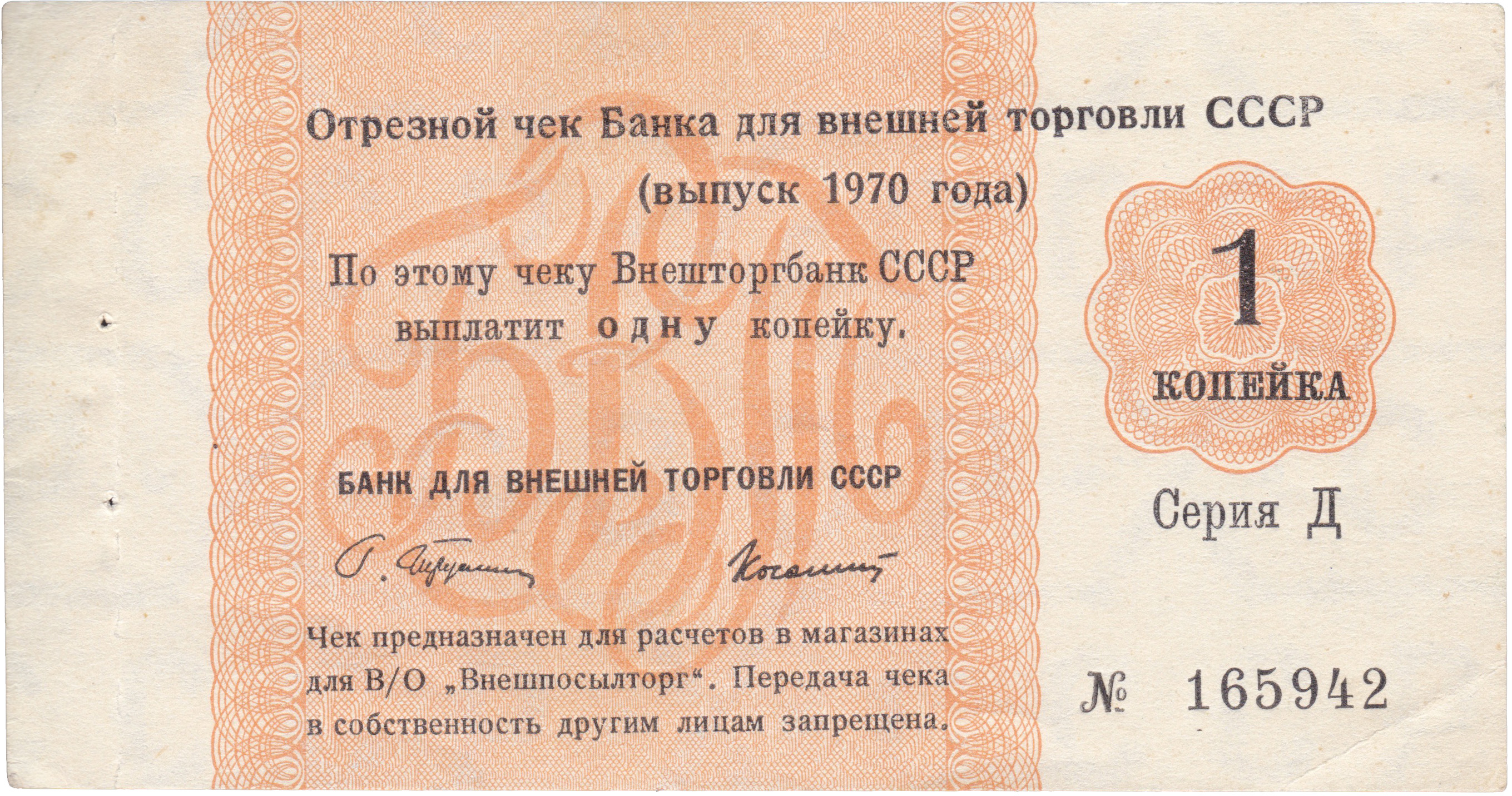
A detachable cheque of Series D of Vnesheconombank (Vneshtorgbank) of the USSR was a monetary obligation of Vnesheconombank (Vneshtorgbank) of the USSR to pay the amount indicated on the cheque. The cheques were bound into cheque books of the corresponding denomination. Detachable cheques were intended for payments by diplomatic personnel for goods and services in specialized shops. All cheques were printed by Goznak.
The Bank for Foreign Trade of the USSR (Vneshtorgbank of the USSR) was established in 1924. The conditions for maintaining accounts were constantly changing. The Bank's clients included both legal entities and private individuals.
For senior diplomatic personnel (from the rank of counselor and above), there were separate Series "D" cheques, accepted for payment on a par with cash foreign currency from foreigners in the parallel system of hard-currency shops, the "Beryozkas."
Thus, in the USSR there were two completely separate (cheque-based and hard-currency) retail systems. In hard-currency shops, only foreigners, diplomats, and the highest party nomenklatura could legally make purchases. Ordinary employees working abroad were required to use only the cheque-based "Beryozkas," which in turn were closed to other Soviet citizens who had only Soviet rubles.