
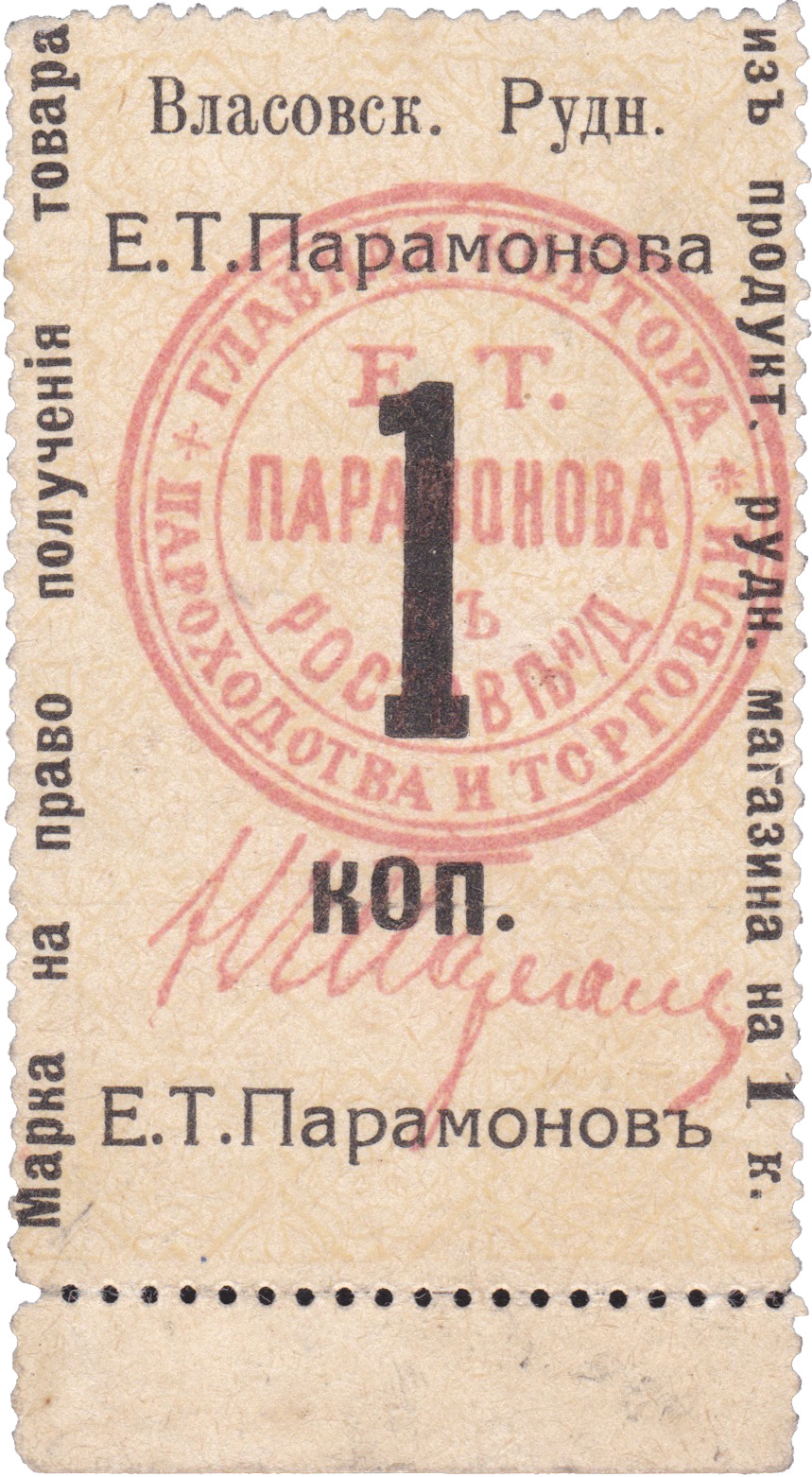
One of the most modern mines in terms of equipment in Russia was laid in the Vlasovsky district in 1907 and opened in 1911 by the company “E.T. Paramonov’s Sons in Rostov-on-Don.” The mine was named “Elpidifor” in honor of Elpidifor Trofimovich Paramonov, the founder of the coal business in Grushevka and Nesvetay, as well as the grain business and steamship enterprise. The main shareholders were Paramonov’s heirs.
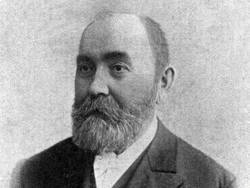
Elpidifor Trofimovich Paramonov was one of the largest figures in Don-region entrepreneurship: a grain merchant, shipowner, and a merchant of the 1st guild.
He was born in the Don Host Oblast, in the stanitsa of Nizhne-Chirskaya, into an Old Believer family of a Don trading Cossack, a member of the Society of Don Trading Cossacks since 1829. He had a “home education” (one class of a parish school) and from an early age helped his father, a small stanitsa trader. After inheriting from his father a small shop selling “red goods” (manufactured textiles), he also began trading timber; in 1860 he took the merchant’s oath, and in 1863 joined the Society of Trading Cossacks with a declared capital of 2,000 rubles.
In 1865, after marrying a local woman, Raisa Mefodievna, he seriously took up buying grain from Cossacks throughout the Don Host Oblast and selling it. In the first years of this new work he personally worked in the granaries, shoveling and transferring grain; later he opened collection points at 15 piers, including in Rostov, where he moved in 1881.
Having accumulated significant capital from the grain trade, he bought for 150,000 rubles a steamship and six wooden barges “to carry his own grain on his own steamships,” including for foreign customers. To supply the flotilla with coal and reduce transportation costs, he bought several small mines from the widow of I.S. Panchenko in the eastern part of the Donets coal basin. By that time he also became the owner of a flour-milling business, having purchased in 1890 from the Greek Margalaki a small roller mill on Beregovaya Street; he sold flour to the cities of Central Russia, to Moscow, the Baltics, Georgia, and abroad. The quality of the flour was awarded a gold medal at an exhibition in Paris. After the success in Paris, E.T. Paramonov began to be called the “bread king of Russia,” and Rostov-on-Don the “granary of the empire.”
By the end of the 19th century, E.T. Paramonov became the largest shipowner in Rostov: he owned up to 30 steamships and up to a hundred large-capacity barges, including the largest passenger steamship on the Don, “Pyotr,” the most powerful tug, “Amur,” and the steamship “Paramonov,” built in Austria in 1884—150 horsepower, with steam boilers and a crew of 24. Cargo steamships carried Russian grain to Italy, Germany, Greece, Turkey, and the Balkans. On passenger and mixed passenger-and-cargo vessels, Paramonov ordered that passengers be given free of charge a sandwich with red caviar and a glass of hot tea.
When the mill burned down, Paramonov decided to build a new one, six stories high, using the most advanced European technologies; it became the largest in Rostov and second in Russia by production volume (it milled 8,000 poods of flour per day). To store raw materials, he equipped warehouses—grain storage facilities (the famous “Paramonov warehouses” on the embankment with an original water-cooling system from underground springs; since 1985 they have been federally protected monuments).
In 1894 he acquired a mansion on Malo-Sadovaya Street (preserved to this day, an architectural monument of local significance), where the office was located on the first floor and private apartments on the second, where the Paramonov couple lived, along with their sons Pyotr and Nikolai and daughters Lyubov and Agniya until they started their own families.
One of the richest people of the Don, he chaired the Committee of the Don Mouths, headed the Exchange Committee, was elected deputy chairman of the Rostov Committee of Trade and Manufactures, served as a member of the accounting-and-loan committee of the Rostov branch of the State Bank, was a member of the district trusteeship for children’s shelters, and a permanent deputy of the Rostov City Duma. In 1908 Paramonov was awarded the gold medal “For Zeal.”
He became famous as a philanthropist: in Rostov he built a building for the mentally ill at the Nikolayevskaya Hospital. The schools, hospitals, barracks for single workers and cottages for families, canteens, and baths at his enterprises were exemplary and free of charge.
He died in Rostov-on-Don at a meeting of the exchange committee on December 12, 1909. Telegrams flew across Russia from Saint Petersburg: “Rostov-on-Don. The trading Cossack E.T. Paramonov has died, chairman of the local exchange committee, member of many public institutions, owner of a significant steamship enterprise, the leading grain-trading business on the Don by turnover, a millionaire and major benefactor.”
By his will he left his sons property that he himself valued at 4.5 million rubles, stipulating that it was necessary to “distribute 20,000 rubles to clerks, trusted agents, and generally all employees. Pay the society of the stanitsa of Nizhne-Chirskaya of the Don Host Oblast 5,000 rubles to establish there some kind of shelter or hospital. Pay Rostov-on-Don 50,000 rubles for schools and hospitals, in amounts for each of them at the discretion of my sons; establish two scholarships at the Rostov Commercial School, another at the Rostov Women’s Gymnasium, for which purpose deposit 4,000 rubles for each scholarship.”
The brothers did not divide the property and in 1911 founded the partnership by shares “Elpidifor Trofimovich Paramonov’s Sons,” in which Pyotr, a graduate of a commercial school, became head of the board.
Nikolai, while still studying at Moscow University, became interested in politics, was expelled from the university, and in 1902 returned to Rostov under informal police surveillance; in time he obtained a legal education at Kyiv University. He went into publishing, financing with his own funds the democratic journal “Byloe,” and in 1903 organized in Rostov-on-Don the publishing house “Donskaya Rech,” which published works by Marx, Liebknecht, Kautsky, Lassalle, and writers Korolenko, Franko, Bunin, Kuprin, and others, and through a network of bookstores began distributing very cheap booklets (2–3 kopecks each) throughout the country. During the 1905–1907 revolution it began issuing leaflets such as “Rights of Man and Citizen,” “What Is Freedom of Speech and the Press,” and others. At the Northern Region Exhibition in 1903, the publishing house received a gold medal.
During E.T. Paramonov’s lifetime, he bought land for his son in Aleksandrovsk-Grushevsky (the town of Shakhty) to set up a coal mine, to distract him from politics. Nikolai became absorbed in the new enterprise: in four years the “Elpidifor” mine was built and equipped with the latest technology—the deepest in the Donets coal basin. The mine had its own power station, a very powerful electric hoist for lowering and raising workers, and electric pumps for pumping out water. In 1912 English coal-cutting machines were lowered into the workings. Next to the mine a horseshoe plant was built, supplying all Grushevsky mines with horseshoes and horseshoe nails, where horses were still used as draft power. The plant also had a contract from the Don Host for supplying its products.
A brickworks, a briquette factory, and a chemical plant that he built in addition to the horseshoe plant worked for the needs of the army in World War I. On the eve of the war, in the settlement of Nesvetay (now Novoshakhtinsk), he began construction of five large mines, which later made this area a center of anthracite extraction.
Like his father, Nikolai cared about the workers: the mine paid high wages, provided a reliable level of workplace safety, and in the settlement by the mine there was a school, a cinema was organized, a temperance society, a shop, and a free canteen for 400 seats; there was a mutual-aid fund, and over time a water supply, a bathhouse, and a library appeared. Back in 1899, N.E. Paramonov built a people’s house in the stanitsa of Nizhne-Chirskaya. In 1913 the Paramonov brothers built in Rostov the E.T. Paramonov School—“the best school building in the city.”
By 1917 the Paramonov brothers owned a steamship company (three sea-going steamships, 23 river steamships, and 105 tug barges), a mill producing about 600 tons of daily milling output, and the Paramonov mines shipped tens of thousands of railcars of anthracite. Their main capital reached 20 million rubles.
As a member of the Cadet Party, N.E. Paramonov found no supporters either among the new власти or among the leadership of the Great Don Host; during the German occupation of Rostov in 1918 he was imprisoned for refusing to supply the Germans with grain. In late autumn 1919 the sons and daughters of E.T. Paramonov left on one of the last trains to Novorossiysk, from where, on the only remaining steamship from their former fortune, the “Printsip,” they sailed to Turkey, leaving to the new Russia a mill that successfully operated for another 30 years, a fleet that became the basis for the Rostov steamship company, and a developed coal industry in the eastern Donbass.