
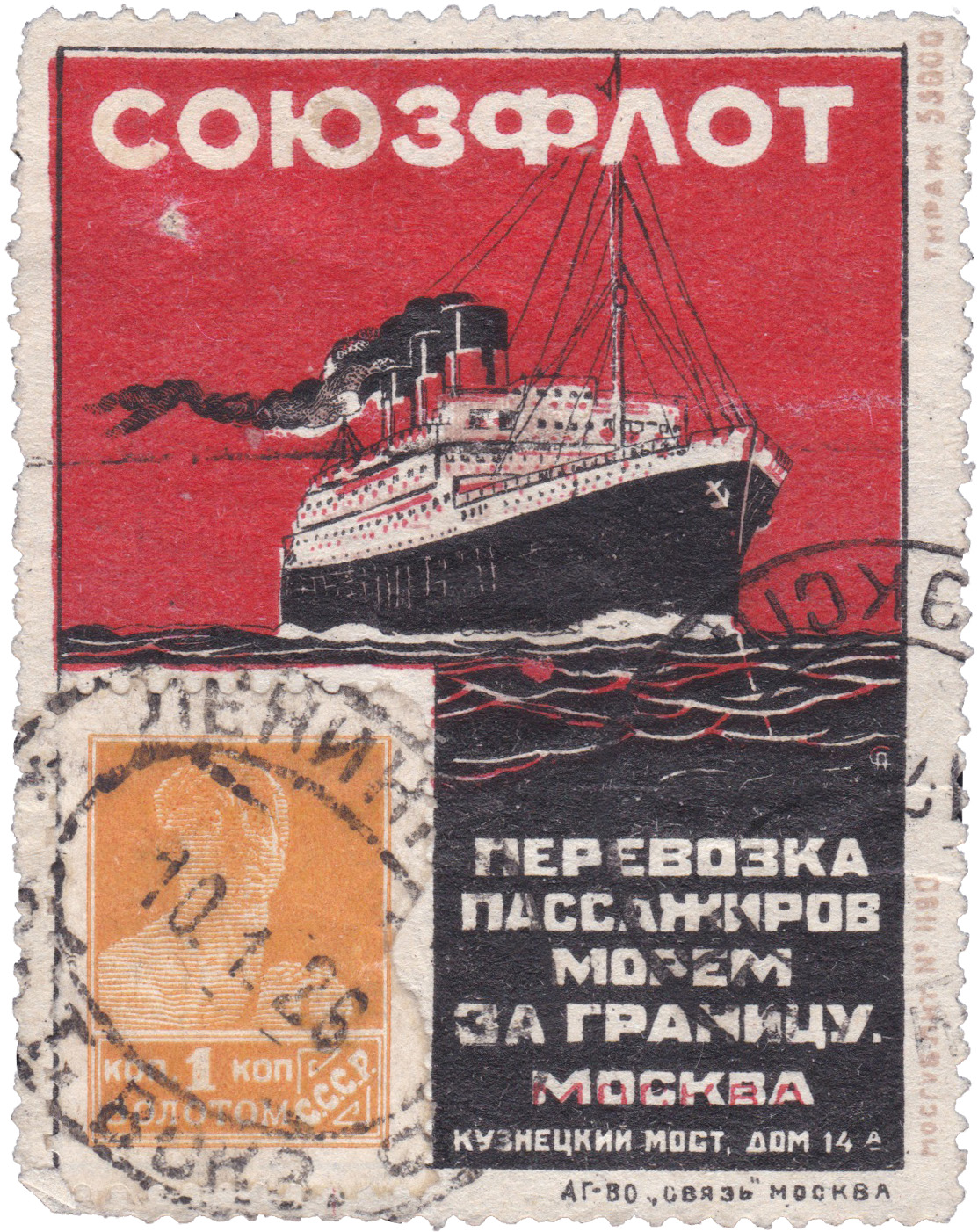
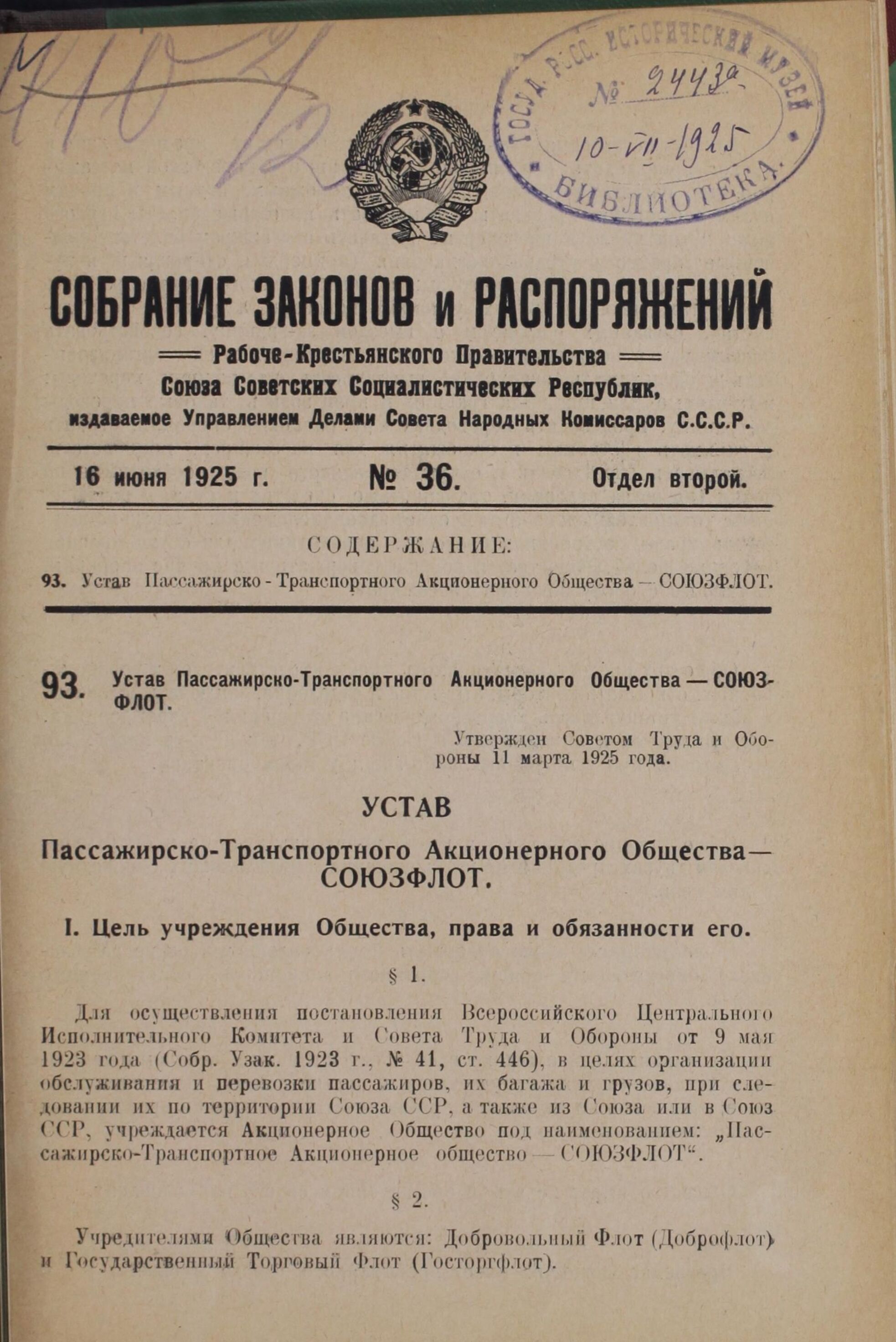
Passenger Transport Joint-Stock Company — Soyuzflot.
A postal-advertising stamp is a type of postage stamp that, alongside paying for postal items, is used for advertising purposes. Regular stamps from standard issues affixed to a label with advertising.
During the period of the so-called New Economic Policy (NEP), a course was proclaimed toward broad use of commodity-money relations and the development of entrepreneurship while keeping management of the national economy in the hands of the state. In the course of that restructuring, trusts and syndicates were created. Advertising was enlisted to serve their needs.
To act as an intermediary between state trade and industrial enterprises and the public, and to unify all advertising and publishing activity of the postal and telegraph administration, on August 27, 1923 the “Advertising, Publishing, and Commercial Agency under the People’s Commissariat of Posts and Telegraphs” was established, abbreviated as the “Svyaz Agency” under the Commissariat.
Postal-advertising stamps were issued in Moscow, Leningrad, Kyiv, Kharkiv, Odesa, Rostov-on-Don, Simferopol, and Samara during 1923–1926 and remained in circulation until the end of the 1920s. The advertising label was printed separately from the stamp and gummed on the reverse side. As a rule, the label size was 40 × 55 mm. It provided a dedicated space for affixing the stamp, and contained advertising text and an illustration. They were printed by lithography in several colors, with a blank space for attaching a postage stamp. They had line perforation. The sheet edges were usually not perforated, so edge examples lack perforation on one side, and corner examples on two sides. In the margins, publication data were typically printed: the publisher’s name (Svyaz Agency), the printing house, the “litho” or order number, the print run, and some other details. All postal-advertising stamps had adhesive on the reverse side.
Postal-advertising stamps were sold at post offices with postage stamps already affixed in accordance with the current rates. The list of post offices where such stamps were sold was set by the advertiser. Sixty-three issues of postal-advertising stamps are known.
Many issues intended for major advertising campaigns—tobacco trusts and factories, Sovtorgflot, Soyuzflot, the State Supply Administration of the Supreme Council of the National Economy of the USSR, Farfortrest, Avtopromtorg, the Moscow Machine Trust, the concession firm “Ball Bearing,” the Leather Syndicate, and others—were produced in print runs from 50,000 to 800,000 copies.
On May 18, 1927, by a resolution of the Council of Labor and Defense, the Svyaz commercial agency under the Commissariat was liquidated. This was connected with the winding down of the NEP. However, advertising regulations remained in force until October 27, 1928, up to the issuance of a new advertising instruction, and the remaining stamps continued to enter postal circulation until they were fully used up.