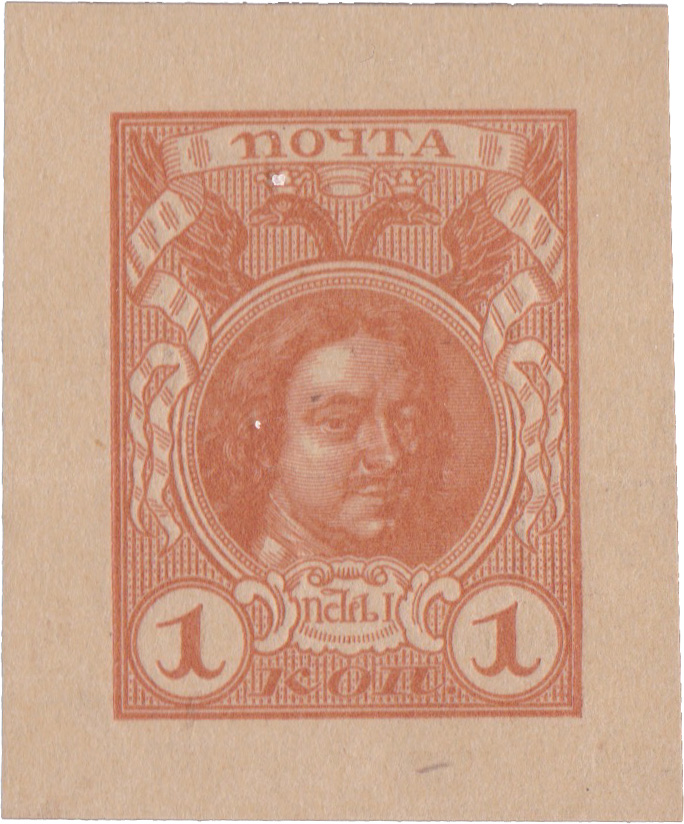
Stamp design project
The first commemorative issue, "300th Anniversary of the House of Romanov". Artist I. Bilibin. Peter I is depicted (after a portrait by Carl Moor, 1717).
The first and only series of commemorative stamps of the Russian Empire was issued on January 1, 1913 and was dedicated to the 300th anniversary of the Romanov dynasty. The series consists of 17 stamps with face values from 1 kopeck to 5 rubles. A number of the stamps are known imperforate. The 7-kopeck stamp exists in blue instead of brown. The post offices of St. Petersburg, Moscow, and Riga prepared and put on sale booklets made up of blocks of commemorative stamps in various denominations.
The official date of release into circulation was January 1, 1913, but isolated cases are known of stamps entering circulation in late 1912.
Preparation of the design for a large series of jubilee stamps began long before the celebrations. In February 1912, the Expedition for the Procurement of State Papers (EZGB) submitted for approval to the Main Directorate of Posts and Telegraphs a proposal for the color scheme of stamps with denominations from 1 to 70 kopecks, along with portrait images of the tsars that had already been previously agreed with this directorate.
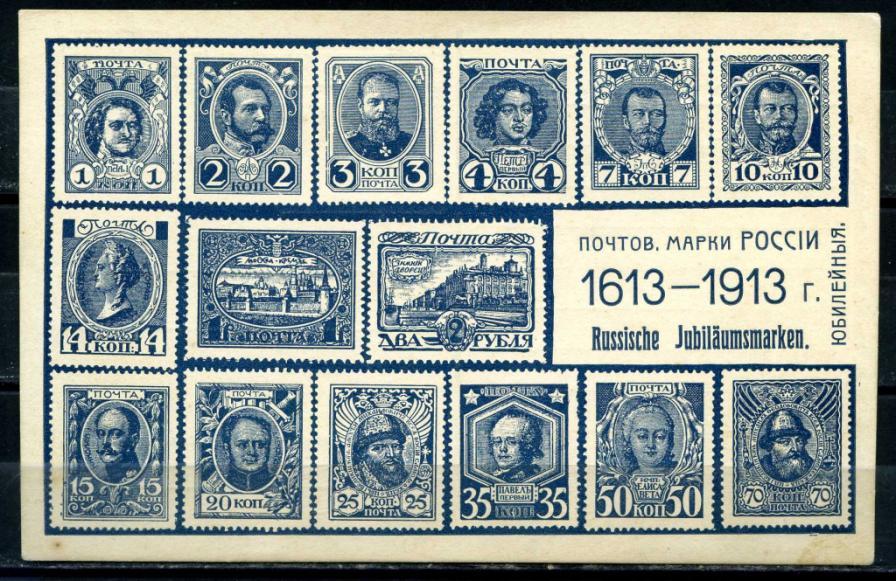
In January 1912, the press published official notices that the EZGB was producing "300 Years of the House of Romanov" stamps, and at the end of that year newspapers reported that these stamps would be introduced into circulation on January 1, 1913, replacing all postage stamps that had existed up to that time.
However, no sooner had the new stamps entered circulation than the newspaper "Peterburgskii Listok" of February 7, as well as other newspapers, carried reports that it was planned to withdraw from sale, in the near future, stamps bearing portraits of reigning persons "due to certain inconveniences in cancelling the stamps".
More specifically, the issue was explained in other publications. In the official journal of the Holy Synod, Bishop Nikon (secular name N. M. Rozhdestvenskii) condemned the printing of the stamp's face value next to the images of the tsars, which, in his view, demeaned the pious tsars revered by the people. The stamps were subject to cancellation, and devout Orthodox believers and loyal supporters of the monarchy condemned what they regarded as the desecration of the sacred image of the tsar. "Worse still," he wrote, "these Tsarist portraits are smeared with the postal postmark, as if for the sake of even greater mockery of us." And the newspaper "Zemshchina", the mouthpiece of the far-right "Union of the Russian People", pointed out that by law, desecration of the image of the emperor was punishable by penal servitude. "Many postmasters refused to defile the tsar's face with postal markings and left the stamps uncancelled."
The Main Post Office and its branches ceased selling the jubilee stamps. The stamps were immediately sold at speculative prices, but after just five days the situation with stamp sales took an entirely new turn. At the Main Post Office, the 35- and 50-kopeck stamps, as well as sets (booklets) of 1-, 2-, and 3-kopeck stamps, and also the 2-ruble stamp, began to be sold without hindrance. However, most of the low-denomination kopeck stamps still were not sold.
1 Kopeck 1913.
Russian Empire.