
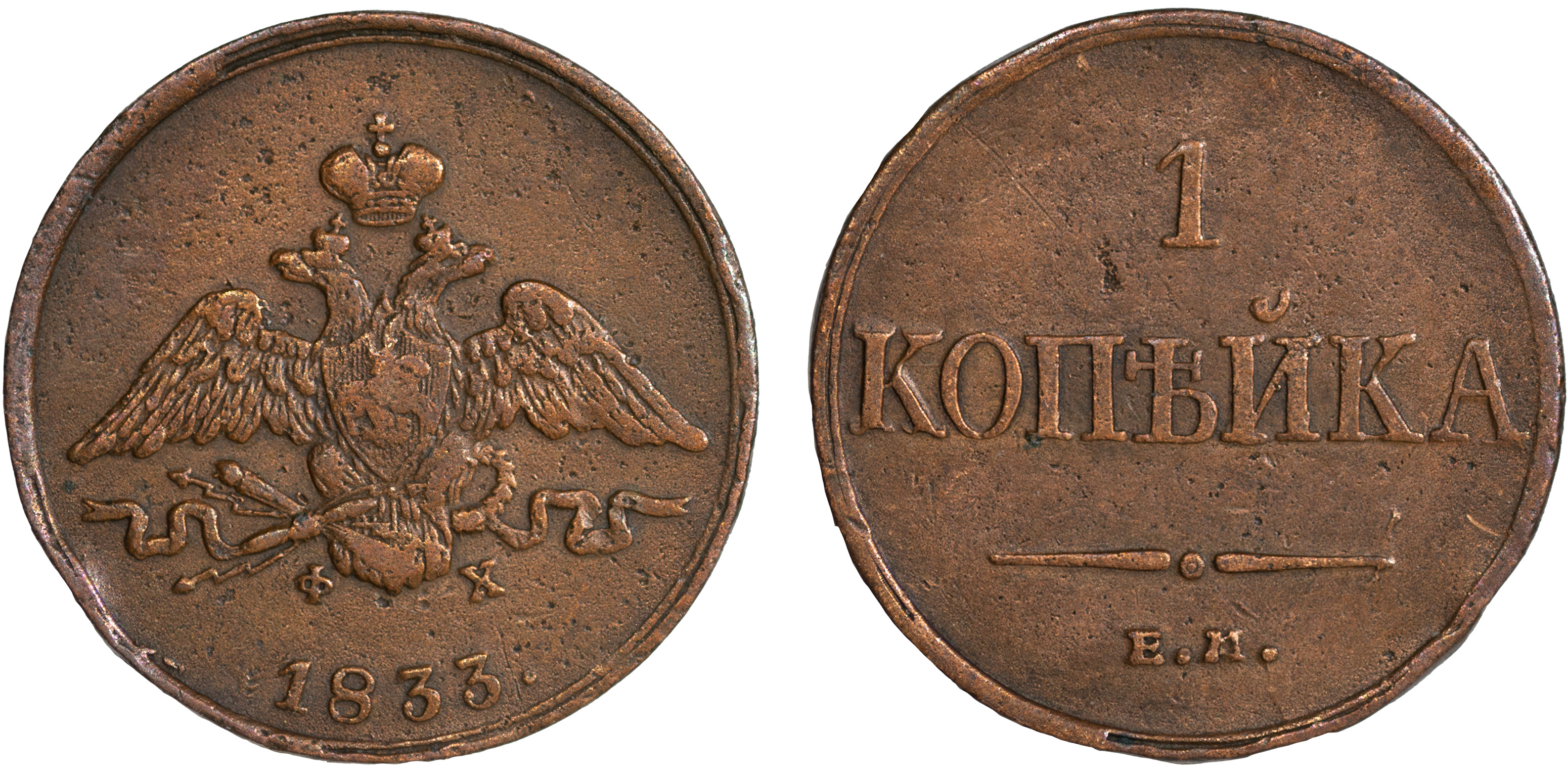
Nicholas I demanded intensified missionary work in Eastern Siberia, that is, the conversion of pagans to Orthodoxy.
A new anthem. Until that year, the Russian national anthem had been the polonaise “Let the Thunder of Victory Resound,” composed by bandmaster O. A. Kozlovsky to lyrics by G. R. Derzhavin специально for a celebration held in the Tauride Palace by Prince G. A. Potemkin in honor of Catherine II.
In December, on the Emperor’s name day at the Bolshoi Theatre in Moscow, the first public hearing of the anthem “The Prayer of the Russian People” took place. At Nicholas I’s order it was written by Prince A. Lvov. Glinka also tried to create an anthem, but the Emperor preferred Lvov’s composition. By Decree No. 188, the anthem “God Save the Tsar” (by its first line) was declared official.
Decree banning the sale of serfs at public auction. Their sale at auctions without land to pay off debts was prohibited, as was the sale of members of the same family to different owners.
In summer, slavery was abolished in the British colonies. In August, the East India Company was dissolved as a trading organization. A law limiting child labor was adopted.
After the Munich meeting with the Austrian Emperor Franz, a new course in international relations took shape with full clarity. Fully good relations between Russia and Austria were restored, in particular with Metternich.
In September, Russia and Austria concluded in Munchengratz a convention confirming their rights to the respective parts of Poland.
In October, the Berlin secret agreement on mutual assistance between Prussia, Austria, and Russia was concluded.
In Turkey, unrest reached extreme limits and the Sultan’s affairs took a critical turn as a result of the successful revolt of the Egyptian pasha Mehmed Ali, whose son Ibrahim crushed the Sultan’s army. The fall of the Turkish Empire was averted by Russian intervention. Nicholas offered the Sultan armed assistance and sent him General Muravyov’s corps. The Sultan allowed Russian ships to enter the Bosporus, and in April 10,000 Russian soldiers landed on its Asian shore. In June, the Treaty of Unkiar Skelessi was concluded, giving Russia the role of Turkey’s protector. The treaty was concluded for eight years and contained a secret article obliging the Sultan to close passage through the Dardanelles to the warships of all foreign powers if Russia so requested.
In the tragic year 1833, when famine broke out in the Caucasus, peasants and Cossacks ate “acorn bread.” Cattle were fed weeds and reeds. Thousands of head perished.
A. Bazhanov discovered coal deposits.
Georges Charles d’Anthes arrived in St. Petersburg after the Vendean uprising.
On January 7, Katenin and Pushkin were admitted as members of the then-existing Russian Academy, which they visited together for the first time. At first Pushkin attended its Saturday meetings quite diligently, but soon he began to appear only on special days, when they proceeded to elect new members to replace those who had departed. In spring Pushkin began a historical study devoted to the Pugachev uprising. By the end of May the draft manuscript was finished. In July Pushkin became a father for the second time; this time a son was born. On September 18–20 Pushkin was in Orenburg, collecting materials for “The History of Pugachev.” Dal helped him, accompanied him on trips around the area (for example, to the famous Berdy settlement—Pugachev’s headquarters), and also supplied him with various ethnographic information. In October, V. A. Perovsky received a communication from the Nizhny Novgorod governor Buturlin dated October 9 establishing secret police surveillance over Pushkin. This year Pushkin will write the poem “The Bronze Horseman,” which will be published in 1837.
August 26 — 200,000 people died in the eruption of the Krakatoa volcano (Indonesia) from fire, molten lava, falling debris, ash, and tsunamis caused by the explosion and reaching a height of 36 m. The explosions were heard at a distance of 4,000 km, and the effect on the atmosphere made itself felt worldwide.
October 21 — Alfred Bernhard Nobel was born, inventor of dynamite and founder of the famous prizes.