
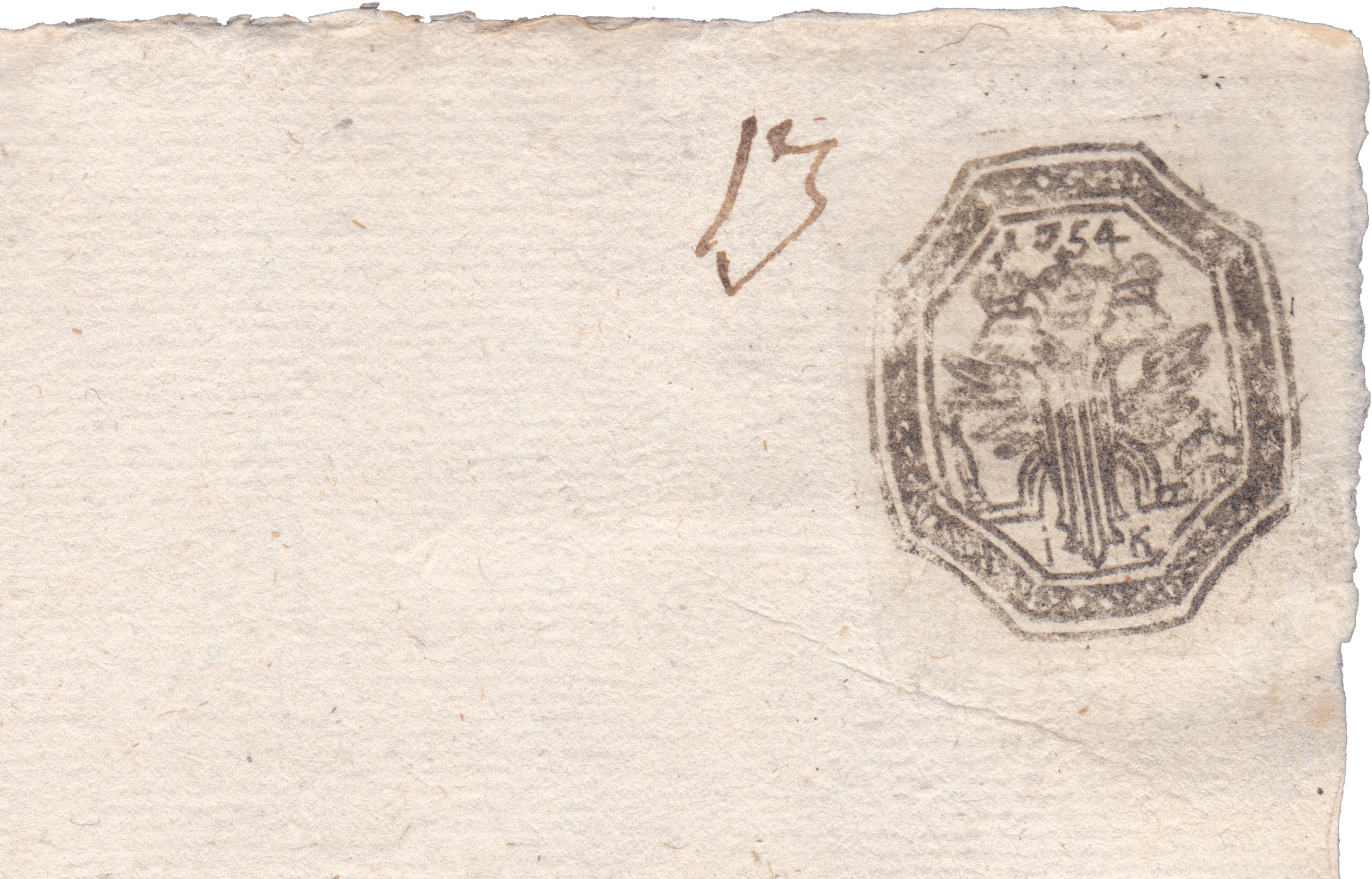
Stamped paper “for drafting deeds of conveyance” (for notarized acts) was introduced in Russia under the decree of January 23, 1699.
Russia owed the idea of the state issuing stamped paper to Alexey Alexandrovich Kurbatov (steward to Count B.P. Sheremetev), who, after traveling abroad with the Count, submitted to Tsar Peter Alexeyevich a proposal for “eagled” (stamped) paper “for the profit of the treasury.” For his services, A.A. Kurbatov was appointed “Chief Inspector of Town-Hall Law,” and in 1711—Vice Governor of the Arkhangelsk Governorate.
In 1719, a calendar year began to appear on the stamp. In 1720–1723, only the year was placed on the stamps, without the price of the stamped paper.
A decree of February 13, 1720 reaffirmed the mandatory execution of notarized acts (property instruments, deeds of sale, mortgage deeds, and certain other written obligations and contracts) on stamped paper: “all such instruments, with payment of the prescribed duties, are to be written on stamped paper.”
Starting in 1724, pursuant to the decree of October 17, 1723, stamped paper began to be produced with watermarks. The actual manufacture and supply of the paper were handled by private mill owners (virtually throughout the 18th century). The procurement of paper “for stamping” from various manufacturers explains the great variety of eagle images in the watermarks. In practice, the state was engaged only in stamping and selling stamped paper. The sale of stamped (impressed) paper was permitted only through state institutions.
In 1726, new stamp designs for different grades of stamped paper were developed, and they remained in use until 1798. On the stamps, only the year, the price of the stamped paper, and the image of the eagle were changed.