
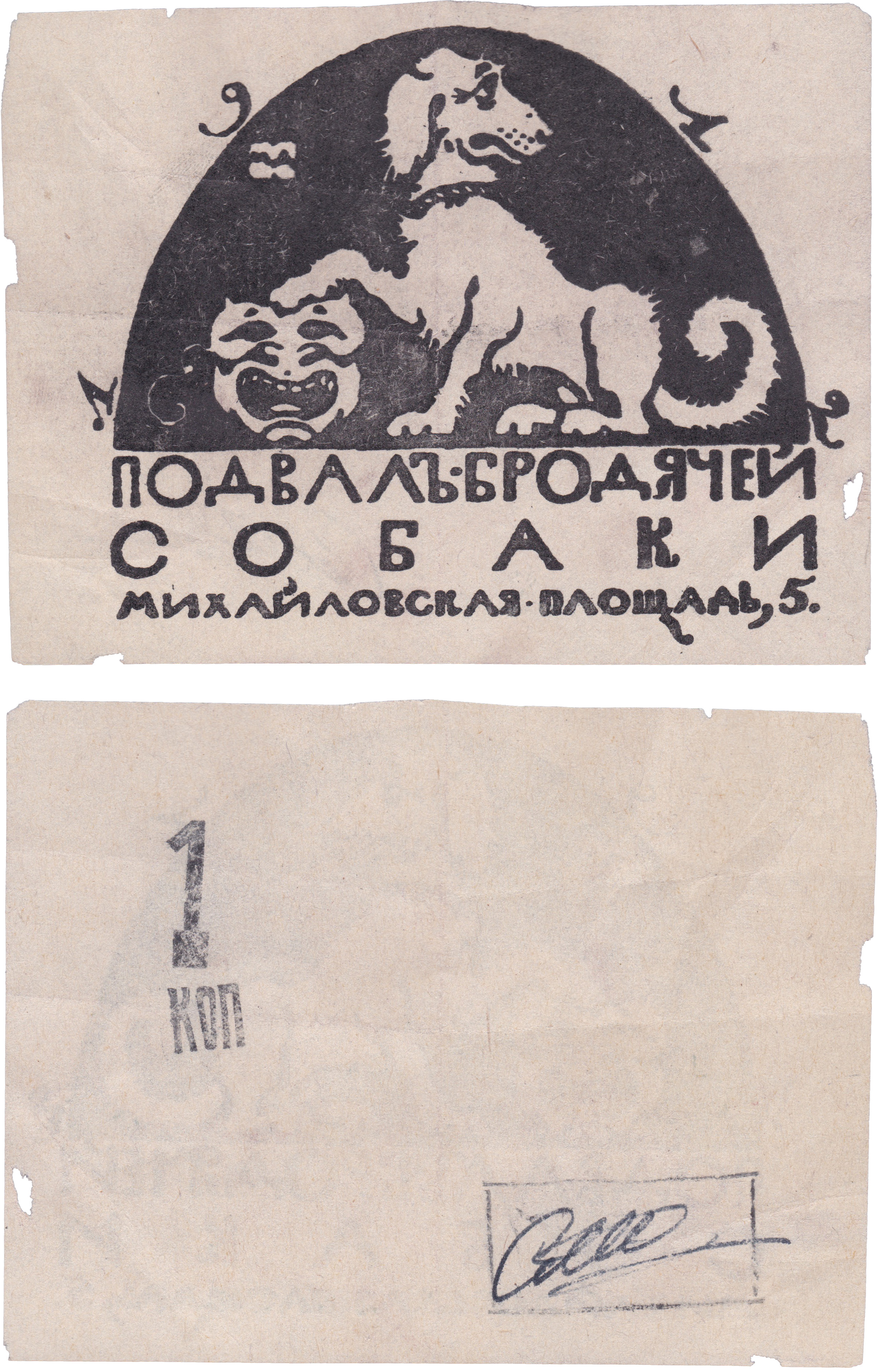
The basement’s name was coined almost offhand by Aleksey Nikolayevich Tolstoy, who was walking near the future cafe together with the artist Sergei Sudeikin and the idea generator, impresario Boris Pronin, who became the art director of the “Stray Dog”.
In a nearby lane they met a ragged beggar trying to foist a puppy on passersby. For two silver rubles they took the shaggy mongrel, sensing a kindred soul in it. They named her Mushka.
And the cafe became the “Basement of the Stray Dog”, a refuge for restless, half-impoverished poetic lost causes—the bohemia of the Silver Age.
Mushka went on living in the cafe, becoming its official symbol.
Artists S. Sudeikin, the husband of the famous actress O. Glebova-Sudeikina, and N. Kulbin were brought in to design the interiors of the future “Basement”. They painted the vaulted ceiling and walls with huge outlandish flowers, multicolored birds, Pierrots, Columbines, and Harlequins, turning the basement into a mysterious dwelling of otherworldly beings. The fireplace was made by Ivan Fomin; Sudeikin decorated it with a wreath. In the center of the hall they set a round table for thirteen people; above it hung a chandelier with thirteen candle-lamps on four chains. The entrance was lit by a red lantern.
The “Basement of the Stray Dog” was ceremonially opened on New Year’s night, from December 31, 1911 to January 1, 1912.
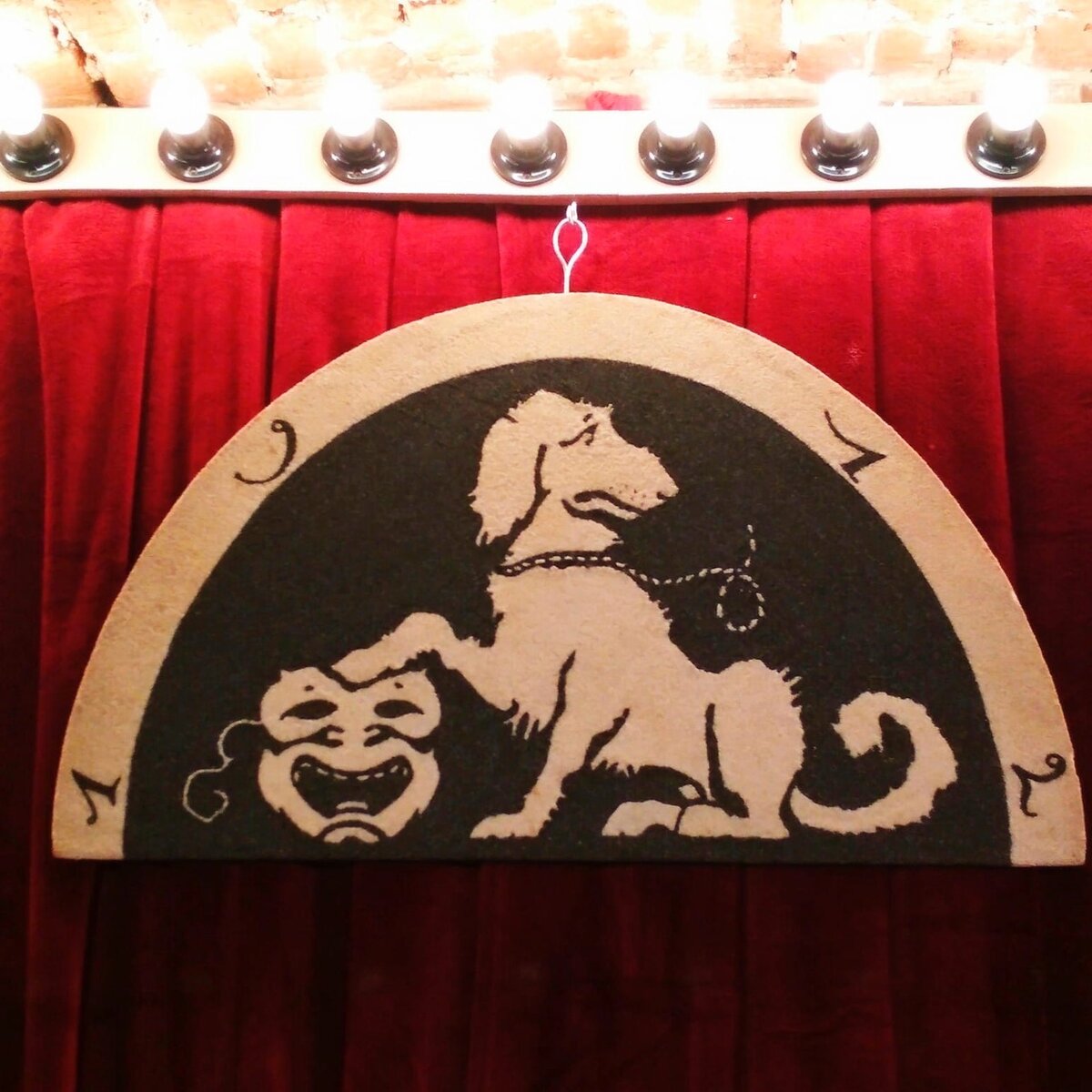
Later Mstislav Dobuzhinsky created an emblem, painted by the artist on a heraldic shield: a seated stray dog with its paw resting on an antique mask. The coat of arms was hung above the entrance to the “Basement”.
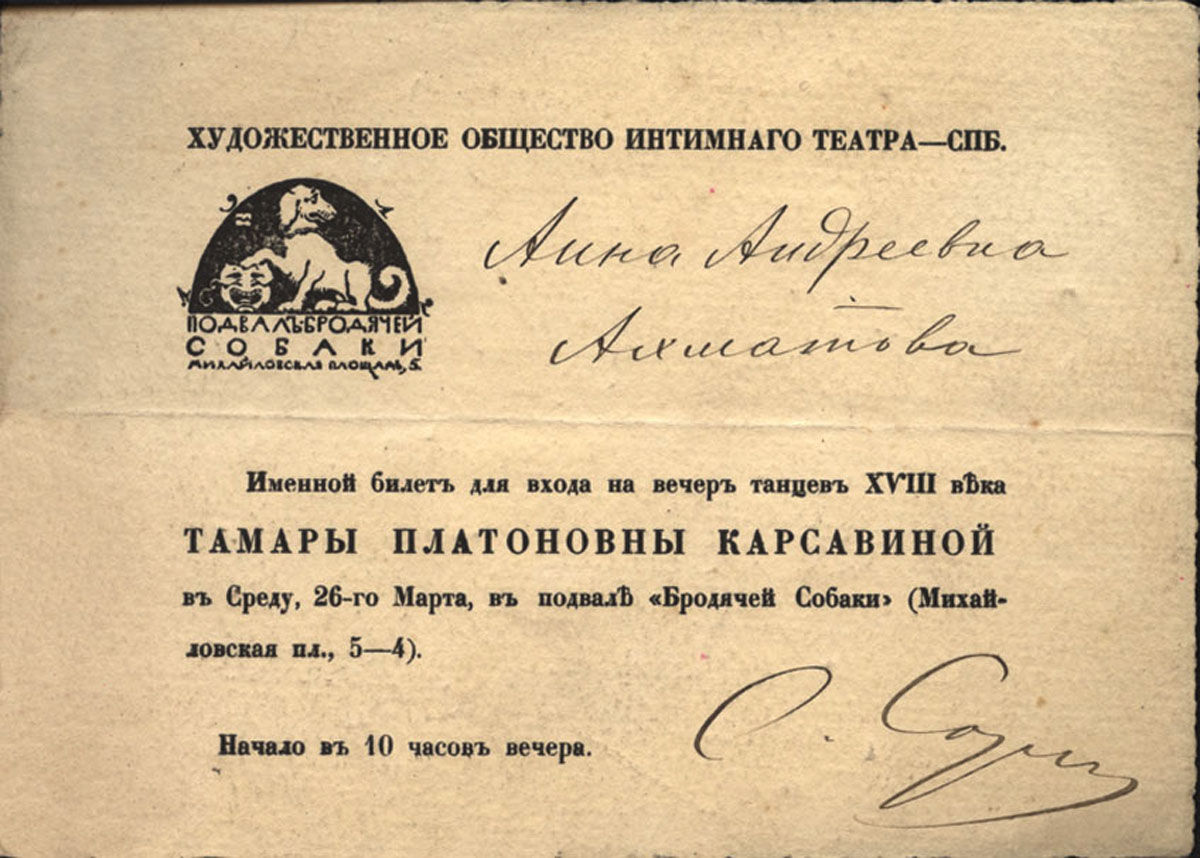
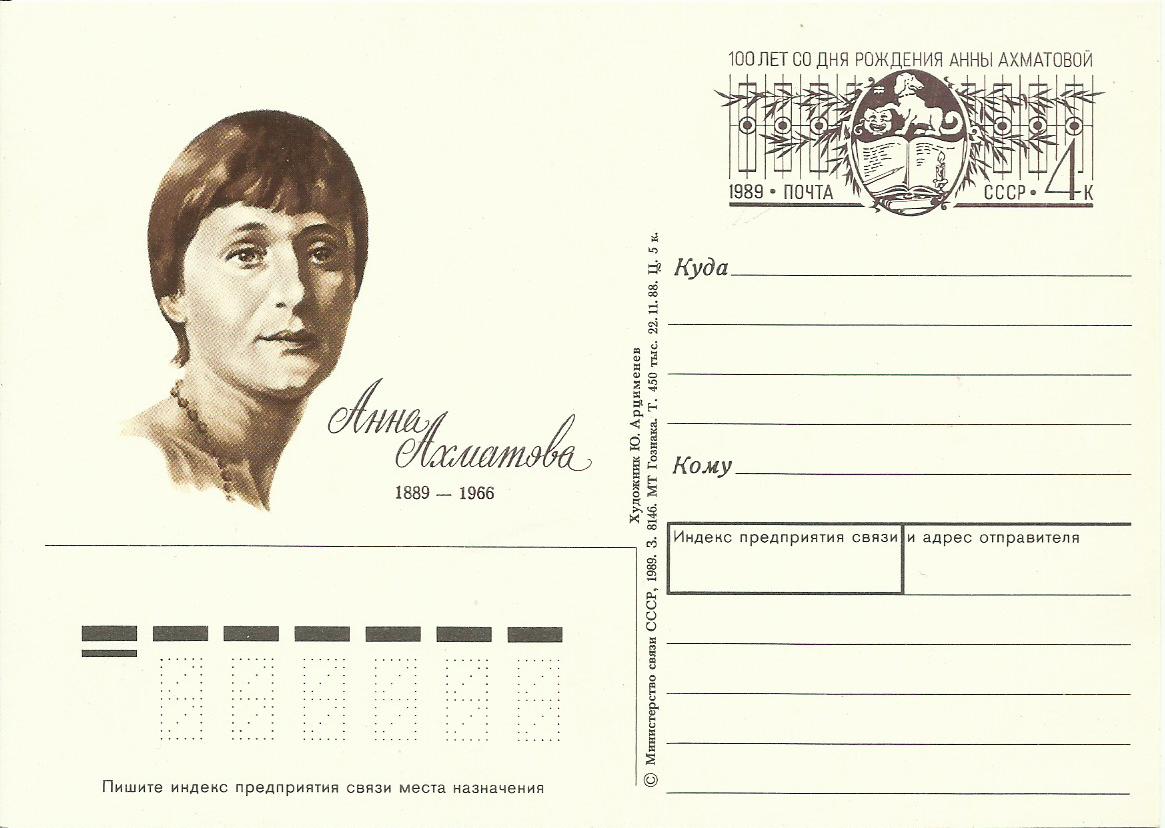
Aleksey Tolstoy took a very active part in organizing the “Stray Dog”. He helped gather many Petersburg celebrities for the New Year’s evening that opened the basement’s life. At the entrance he placed a huge leather-bound book, the “Pig-Dog Book”. Every visitor signed it and, if they wished, left their impromptu verses. That evening, the visitors of the “Stray Dog” were the quintessence of poetic and artistic Petersburg: T. P. Karsavina, M. M. Fokine, Yu. M. Yuryev, Anna Akhmatova, Nikolai Gumilyov, K. D. Balmont, Igor Severyanin, M. A. Kuzmin, P. P. Potyomkin, Sasha Chyorny, Osip Mandelstam, Georgy Ivanov, Sergei Makovsky, Ilya Sats.
The opening of the “Stray Dog” became a notable event in Petersburg’s life. At first the meetings were held on Wednesdays and Fridays; later—four or five times a week, or even every night.
Masquerades, harlequinades, tributes to poets, writers, and actors, skits, poetry readings, art exhibitions, evenings of the Futurists, the “Poets’ Guild”, festive banquets and feasts—everything went on in an unbroken succession, pausing only from May through August.
This turbulent artistic life was only one side of the basement’s existence. The other, no less—and perhaps more—important, was spiritual freedom, the liberation of the individual, which could not but remain in the memory of those who visited the “Stray Dog”. Many remarkable lines by Anna Akhmatova, N. Gumilyov, V. Khlebnikov, and Igor Severyanin were written and read here.
On November 17, 1912, nineteen-year-old Vladimir Mayakovsky gave his first public poetry reading here.
In “Theater Review” they wrote:
“... after Mr. Burlyuk, another Moscow poet—Mr. Mayakovsky—appeared, reading several of his poems, in which the listeners immediately sensed a true, great poetic gift. Mr. Mayakovsky’s poems were met with applause.”
Admission for people in creative professions was much cheaper than for ordinary visitors. For example, for a ticket to an evening of poets the “guests” had to pay 3 rubles, while actors, poets, artists, musicians, and “friends of the Dog” paid only 1 ruble. However, the “Stray Dog” was conceived from the start as a refuge for “its own”, where authors and performers could rest from the hardships of everyday life.
The world war that broke out in 1914, as B. Livshits wrote, blew the “rouge from the cheeks of the Stray Dog’s regulars”. On March 3, 1915, soon after Vladimir Mayakovsky’s sharp anti-war speech, by order of the city governor the “Stray Dog” basement was closed. The official version stated that the reason for the closure was the “illegal sale of wine”. Despite the fact that Boris Pronin made several attempts to revive the “Stray Dog” in new locations, the atmosphere of the original seemed to have been lost forever along with the representatives of the Silver Age, many of whom perished or emigrated after the revolution.