
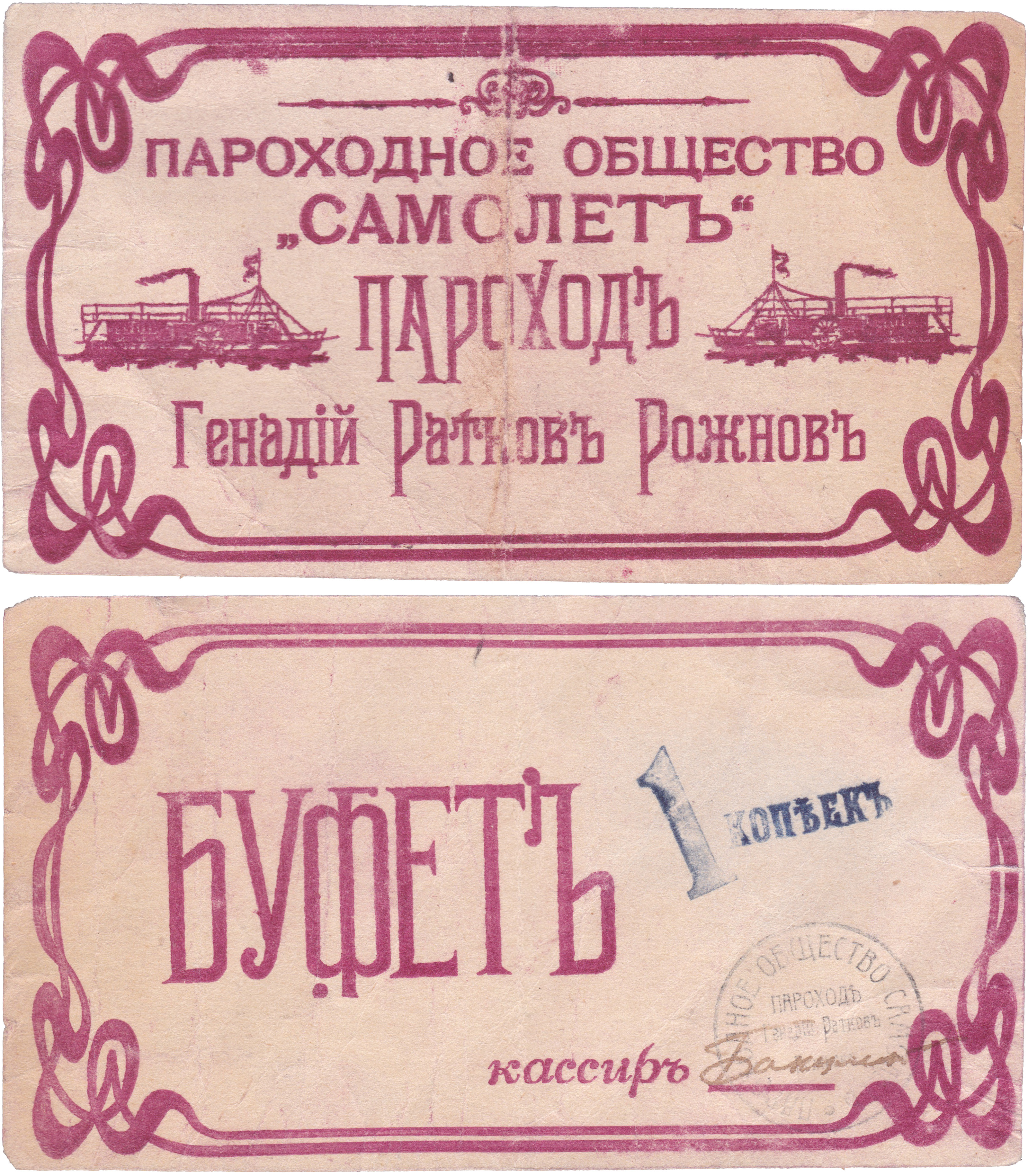
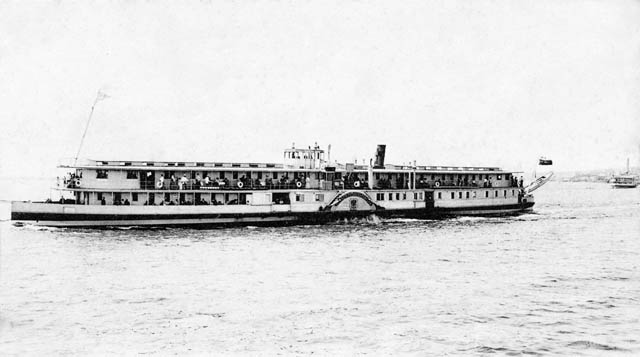
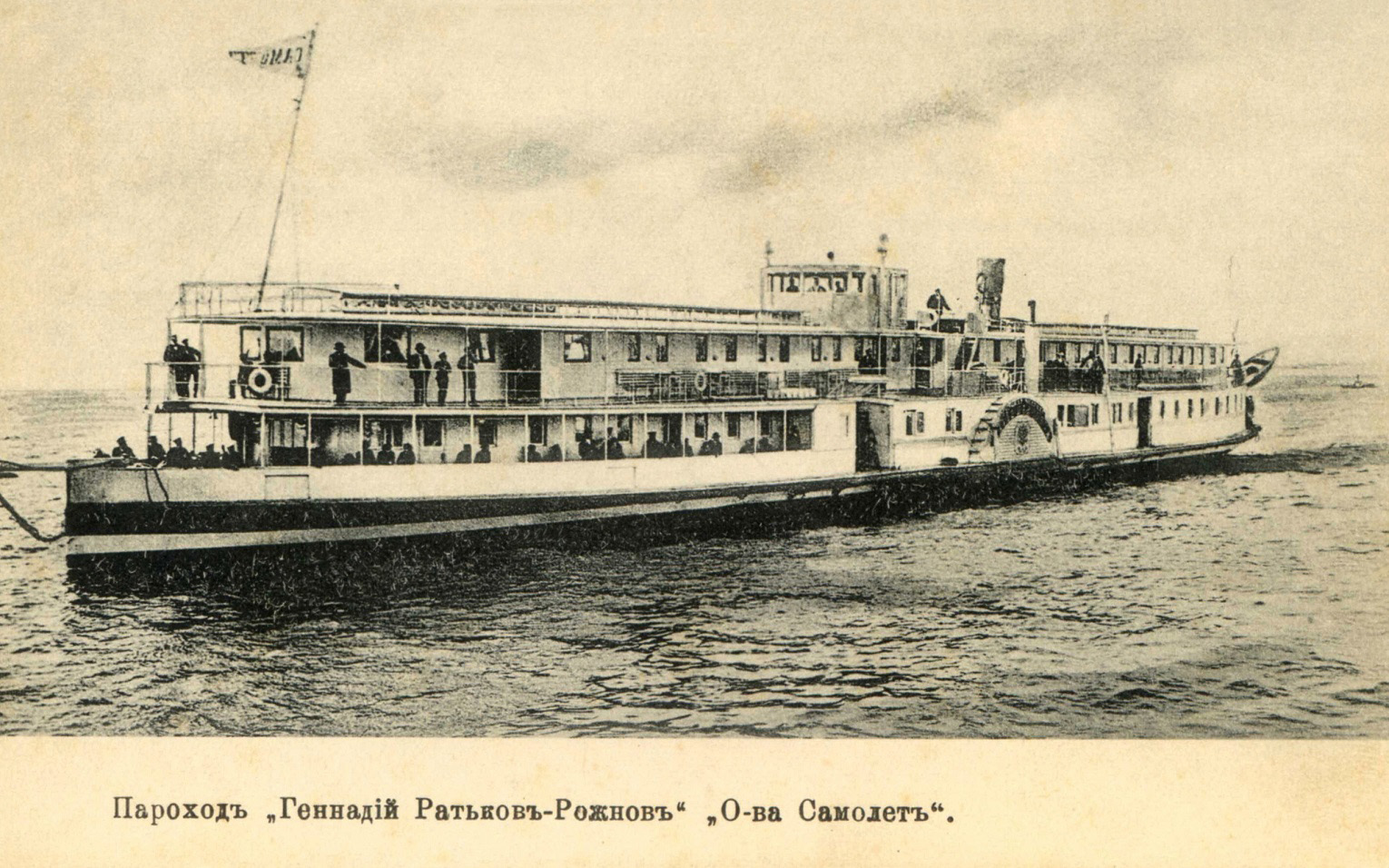
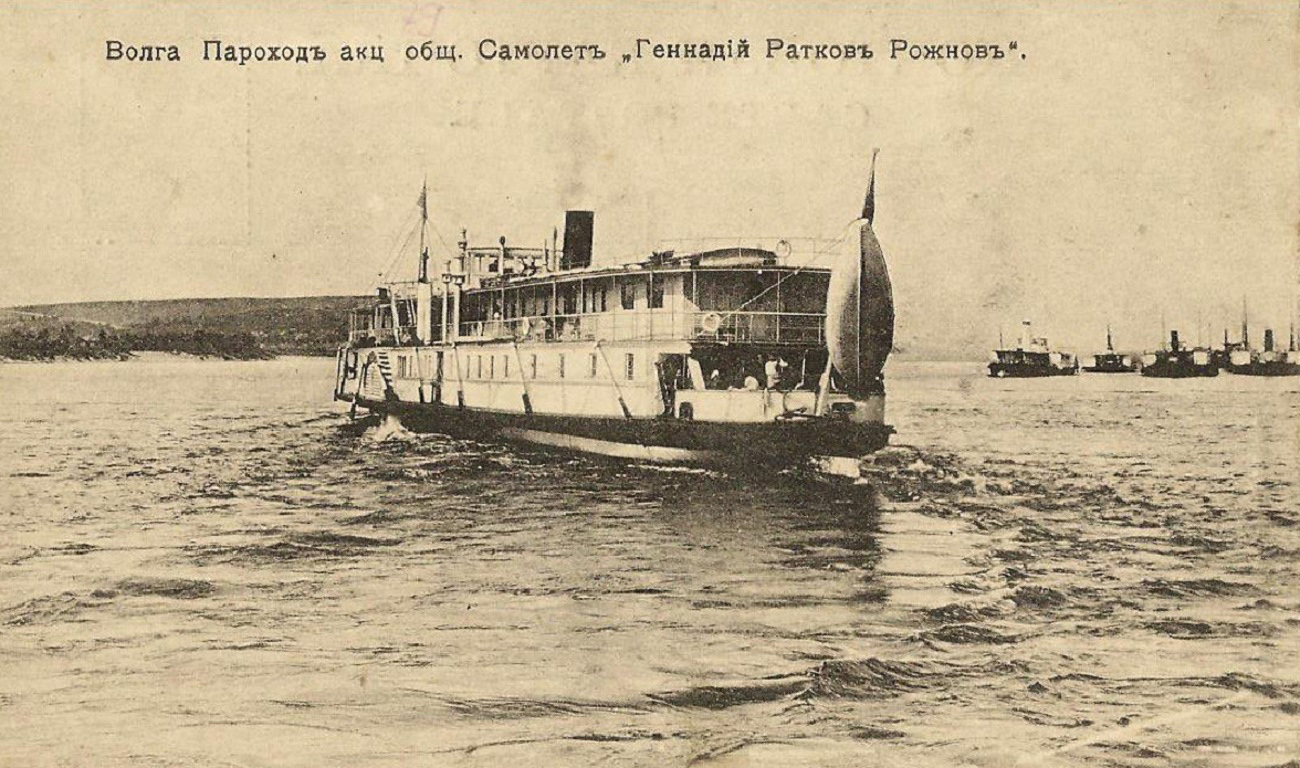
The steamship “Gennady Ratkov-Rozhnov” was built abroad to the order of the “Samolet” Company at the Cockerill works in Belgium in 1897, based on the design of the steamship “Pushkin.” It was named after the company’s managing director, G. A. Ratkov-Rozhnov, who led “Samolet” out of difficulties in the 1880s.
In 1904 it underwent a major overhaul. The steamship operated mainly on the Nizhny Novgorod–Astrakhan line. After the Revolution it was renamed “Professor Mechnikov.” In 1939 it underwent a major overhaul. It served in the “Moscow–Volga Canal” shipping company and was considered one of the best vessels. Before the war it ran on the Moscow–Uglich line. In 1941, “Professor Mechnikov” carried out evacuation transports of the population arriving from the northwestern regions, from Kalinin to the Uglich dam. In 1948 it opened a new passenger route Moscow–Kuibyshev–Moscow. It also operated on the Moscow–Molotov (Perm) line. From 1961 it was a branch of the “Arkhangelskoye” clinical sanatorium.
Dimensions: overall length — 81.0 m, beam — 8.6 (16.0) m, side height — 3.1 m, overall height — 11.8 m, draft — 1.3–1.8 m. Compound engine power — 840 ihp. Passenger capacity — 400 persons, including 1st class — 38, 2nd class — 51, 3rd class — 105. Cargo capacity — 30 t.
Decommissioned in 1963; used in Saratov as a base for the “Trud” sports society.
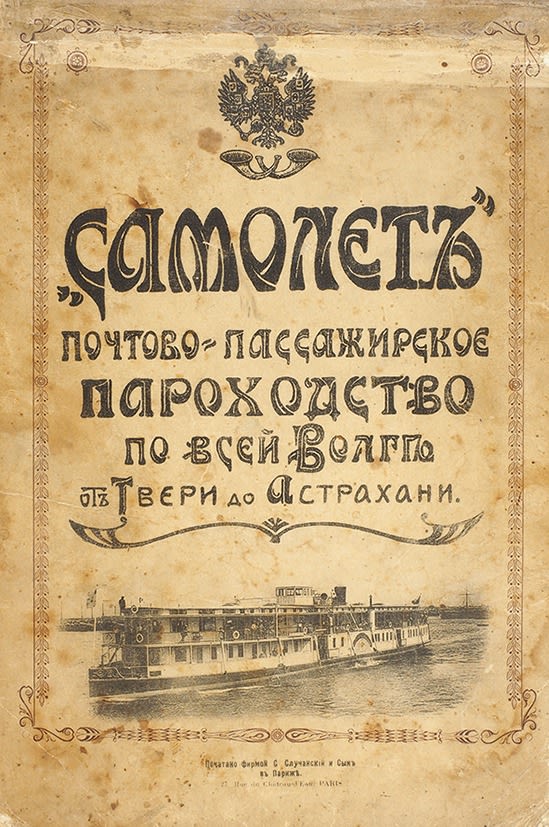
The shipping enterprise of the “Samolet” partnership (company) was one of the three largest shipping companies on the Volga and in the Volga basin.
In July 1852, retired naval captain Vladimir Aleksandrovich von Glazenap submitted a petition to the head administrator of communications routes and public buildings for permission to open a dedicated passenger steamship service on the upper reach of the Volga—between the cities of Tver, Rybinsk, and Yaroslavl. In a separate memorandum on this matter, von Glazenap indicated that he intended to provide the “public and working people” with fast and inexpensive travel between those cities, connecting them at the same time with the newly opened Nikolayev Railway. On February 5, 1853, permission was granted, after which Glazenap, together with Titular Councillor Maximilian Gustavovich Behagel von Adlerskron, petitioned for authorization to establish a share partnership under the name “Samolet,” with a charter capital of 250,000 rubles divided into 1,000 shares. Along with the petition, a draft charter of the partnership was submitted and approved on October 30, 1853. The name was taken from a type of Volga barge with underwater “wings” that moved along the Volga in the mid-19th century at fairly high speeds.
Even before the charter was approved, the initiators had ordered in Belgium, at the Cockerill works, three steamers, each with a power of 50 nominal horsepower, and in Tver they leased a backwater and set up workshops there to assemble the ordered vessels. In January of the following year, 1854, the steamers were delivered to Tver in disassembled form, and in April they were already put into service. They were long (about 22 sazhen) steam boats with iron hulls, huge paddle wheels on the sides, and very tall twin funnels.
Of the above-deck structures, at first there were only the captain’s bridge and several small sponson cabins (so-called cabins arranged along the sides of the paddle-wheel housings—iron semicircular casings that cover the paddle wheels).
First- and second-class passenger quarters, furnished with soft sofas (arranged along the sides in two tiers), were located in the holds of the steamers—the first class forward, the second aft; and in each class there were only two common cabins—one for men and one for women. The cabins were heated by iron and cast-iron stoves and lit (like all other rooms on the steamers) by kerosene lamps. It goes without saying that, under such conditions, in bad and cold weather, when it was necessary to stoke the stoves and light up early, there could be no talk of clean air or special neatness in the cabins.
Third-class passengers were accommodated on deck, under the open sky, protected neither from rain nor from summer heat. In addition, sparks and small coals flying out of the funnel badly damaged both passengers’ clothing and their luggage. Cargo was also loaded on deck, in quantities of no more than 2,000–4,000 poods per steamer, covered with tarpaulins and waterproof canvas. The entire middle of the vessel’s holds was occupied by boilers and machinery; in addition, a small space was set aside here for passenger baggage, and a hatch was arranged for a store of firewood used to heat the boilers. Steamship employees lived in the sponson cabins, while sailors and stokers lived in the forward and aft hatches, where communal bunks were arranged for them in 2–3 tiers.
The steamship administration’s attitude toward passengers was rather patriarchal. “Captains (of the first passenger steamers),” says an old guidebook to the Volga (Monastyrsky: “A Companion on the Volga,” 1880), “posed as very important persons and did not stand on ceremony with passengers. There was no such thing as a sailing schedule. It would happen that a steamer would moor somewhere and stand for an hour or two, and sometimes for a whole day: the captain had gone hunting or gone to visit a familiar landowner.”
However, if one compares all the conditions of passenger travel on the first steamers with the transport of “living cargo” on barges and boats, as it was before the emergence of the “Samolet” company, one cannot but acknowledge that it represented a huge step forward in this respect, especially given the unprecedented speed of steamers on the Volga before it. The company’s merit is all the greater because organizing a dedicated passenger steamship service, as an entirely new undertaking, involved a certain risk and nevertheless required considerable additional expenses both for fitting out the steamers and, especially, for establishing permanent piers and firewood depots—not to mention that, with higher speeds and at the same time the lack of proper navigational arrangements, passenger steamers ran a much greater risk than tugboats of accidents and even loss.
Reality, however, justified the founders of the partnership, and it began to develop rapidly, increasing its fleet and improving it qualitatively, especially in terms of passenger comfort. Thus, soon awnings were installed on the decks in the bow section of the steamers, and then large plank deckhouses appeared with stairways down, furnished with comfortable upholstered furniture and serving as drawing rooms and dining rooms for class passengers; at the stern and over the middle of the vessel, where deck passengers were located, iron сетки began to be stretched overhead, protecting from coals and large sparks; later, an awning was also stretched under the mesh, protecting, if not from bad weather, then at least from the scorching sun and from rain that drenched passengers due to soot settling on the mesh and washing down in whole streams of грязь.
The first steamers of the partnership, which, despite their shallow draft, proved too deep for the upper Volga reach where, due to fairway conditions, the draft was not supposed to exceed 14 vershoks, were replaced by others, even shallower, by the third navigation season and moved to the Rybinsk–Nizhny reach. At the same time, the partnership received from the government the carriage of mail during navigation periods between Tver and Kostroma. Then, as stated in a special decree, “in consideration of the benefit brought to the Volga residents by the frequent and rapid carriage of their correspondence on the partnership’s steamers,” the latter were granted the right “to fly the flag of postal steamers, to have the double-headed eagle on the paddle-wheel housings with a postal horn beneath it, and to assign the steamship crew a special uniform according to the model approved by the Highest authority.”
In 1857 the partnership extended its operations as far as Kazan; in 1858 it opened service on the Kama as far as Perm; in 1859 it established sailings to Saratov; in 1861 it announced a route on the Oka River as far as Yelatma.
In 1863 the “Samolet” partnership was reorganized into a company.
Throughout the 1870s the “Samolet” company continued to expand its fleet, but stubbornly adhered to the old type—single-deck vessels—only regularly renewing and improving their arrangement. The establishment by the company of a special position of shipping manager, based in Tver (and later in Nizhny Novgorod), helped significantly in putting operations in order. As a result of all these measures, the company’s financial position finally stabilized: as early as 1869 it had paid off all its private debts, and in 1878 it also redeemed the bond loan issued during the difficult period of the mid-1860s.
At the same time, the company ceased operations on the Mologa, selling its entire Mologa enterprise to the Vesyegonsk merchant Yefremov, who for the first time on the Mologa organized regular daily service between Rybinsk and Vesyegonsk.
On the main Volga, in the 1870s “Samolet” had daily departures on the Tver–Nizhny Novgorod reach and six departures a week from Nizhny to the lower reaches: two to Saratov, two to Tsaritsyn, and two to Astrakhan.
In the late 1870s a passenger steamship service appeared on the upper Volga between Tver and Rzhev, where, during the high spring water, the “Samolet” company sent its small steamers.
By the beginning of the 1880s the “Samolet” company had fallen rather behind its competitors: it continued to operate old, single-deck steamers, of which it had 39 units with a total power of 2,955 nominal horsepower. True, these steamers were distinguished by the traditional Samolet qualities—speed and punctuality—but they were far from offering the comforts of American-type steamers, and, most importantly, with the development of Volga freight turnover they were becoming unprofitable due to their low carrying capacity.
The company’s revenues began to decline gradually, and in 1882 it was forced to issue a bond loan. Old and the least economical vessels were sold, and some were replaced with new ones; in general, however, the company’s fleet was reduced quite significantly. Yet these measures proved insufficient, and the company decided to experiment by building its first American-type steamer, which it ordered in Belgium at the Cockerill works. The steamer, named “Vera,” fully satisfied the company, and it ordered at the same works another American-type steamer—“Grand Duchess Maria Pavlovna”—and also one steamer—“Nadezhda”—at the Kolomna works. The last two steamers entered service in the spring of 1886, but while the first of them proved successful in every respect, the second was unsuccessful, so much so that the company even refused to accept it.
With the newly built vessels, “Samolet” formed a fleet of 30 steamers. With the measures taken and some reduction in expenses, the company began to improve its position somewhat, when it was suddenly struck by a great misfortune. In August 1886, the new steamer “Vera” burned near Rovnoye, in the Kamyshin reach, with many human victims. This fire had a strong impact on the company’s affairs, reducing the flow of class passengers to it, who began to avoid Samolet steamers. There was a moment when the company’s affairs became so shaky that people spoke of its liquidation, but the situation was saved by the energy and confidence in the undertaking of the company’s managing director, G. A. Ratkov-Rozhnov.
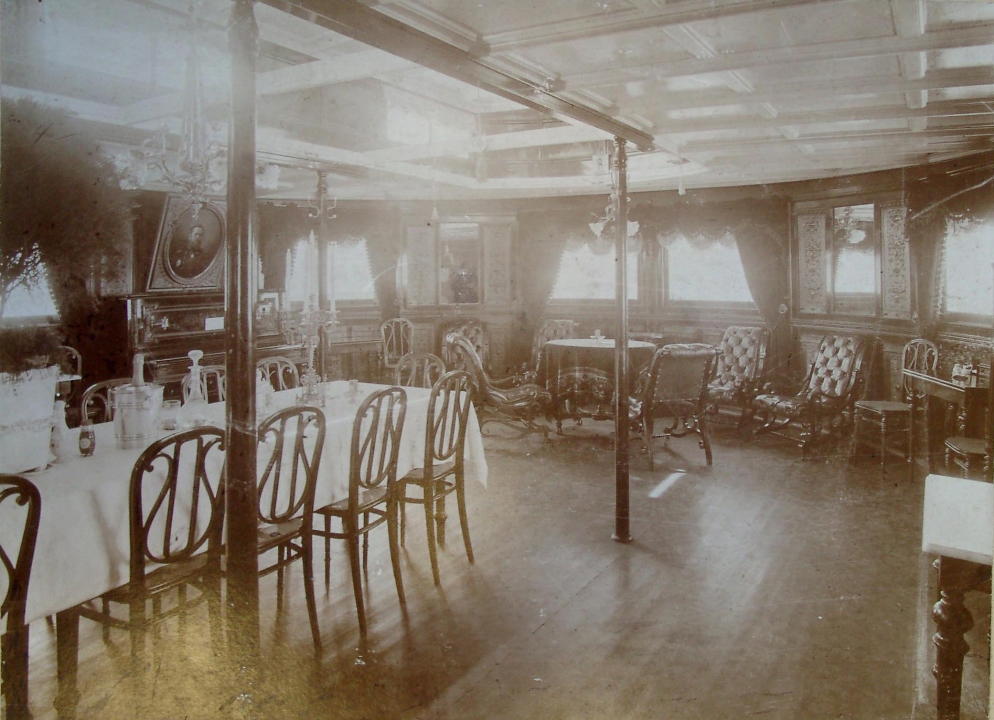
Supported by the meeting of shareholders, he decided to renew the company’s entire fleet from the ground up, and the Cockerill works very successfully designed (based on the “Grand Duchess Maria Pavlovna”) a type of new vessels, sized for the lower reach, with double-expansion engines, combining speed and great elegance of finish (with all amenities for passengers) with substantial carrying capacity—20,000 to 24,000 poods. Spacious and bright passenger accommodations, with electric lighting and running water in each cabin, were heated by steam and were excellently ventilated. Huge dining-salons, comfortably furnished, with a piano, elegant mirrors, and furniture, were illuminated by a whole row of electric bulbs. Finally, special attention was given to fire-prevention measures, and the steamers were well protected against the possibility of fire and accidental ignition of oil.
With the introduction of new vessels, the old ones were sold off or (in most cases) converted into tugboats.
The total fleet of the enterprise reached 45 steam vessels.
In 1913 the company opened a passenger and freight line along the Caspian Sea coast, establishing for this purpose, jointly with the “Merchant Shipping Company,” a special “Caspian Shipping Partnership.”
Unlike most other shipping companies, “Samolet” also carried passengers on the Oka River, and on the Volga—up to the city of Rybinsk, i.e., through the shallow upper reaches. In 1862 the company had 25 passenger steamers, and by the mid-1870s already 38, with regular routes on the Volga from Tver to Astrakhan, on the Oka from Nizhny Novgorod to Ryazan, on the Kama to Perm, and on the Sheksna.
The superstructures of all company vessels were painted pink, and three stripes were painted on the hull sides: red-white-red. On the upper reach from Tver to Rybinsk, steamers with the names of composers (“Serov,” “Dargomyzhsky,” “Tchaikovsky,” “Glinka”) and “Saltykov-Shchedrin” sailed predominantly—the latter apparently among the “composers” because he was a native of Tver Province. Steamers of the middle reach (from Rybinsk to Nizhny Novgorod) bore the names of Russian princes: “Prince Yuri of Suzdal,” “Prince Mikhail of Tver,” and others. On the lower reach (from Nizhny Novgorod to Astrakhan) vessels carried the surnames of writers: “Pushkin,” “Lermontov,” “Gogol,” “Nekrasov,” “Goncharov,” “Turgenev,” “Krylov.”
By the nationalization of the river fleet in 1918, “Samolet” had 42 steamers.