
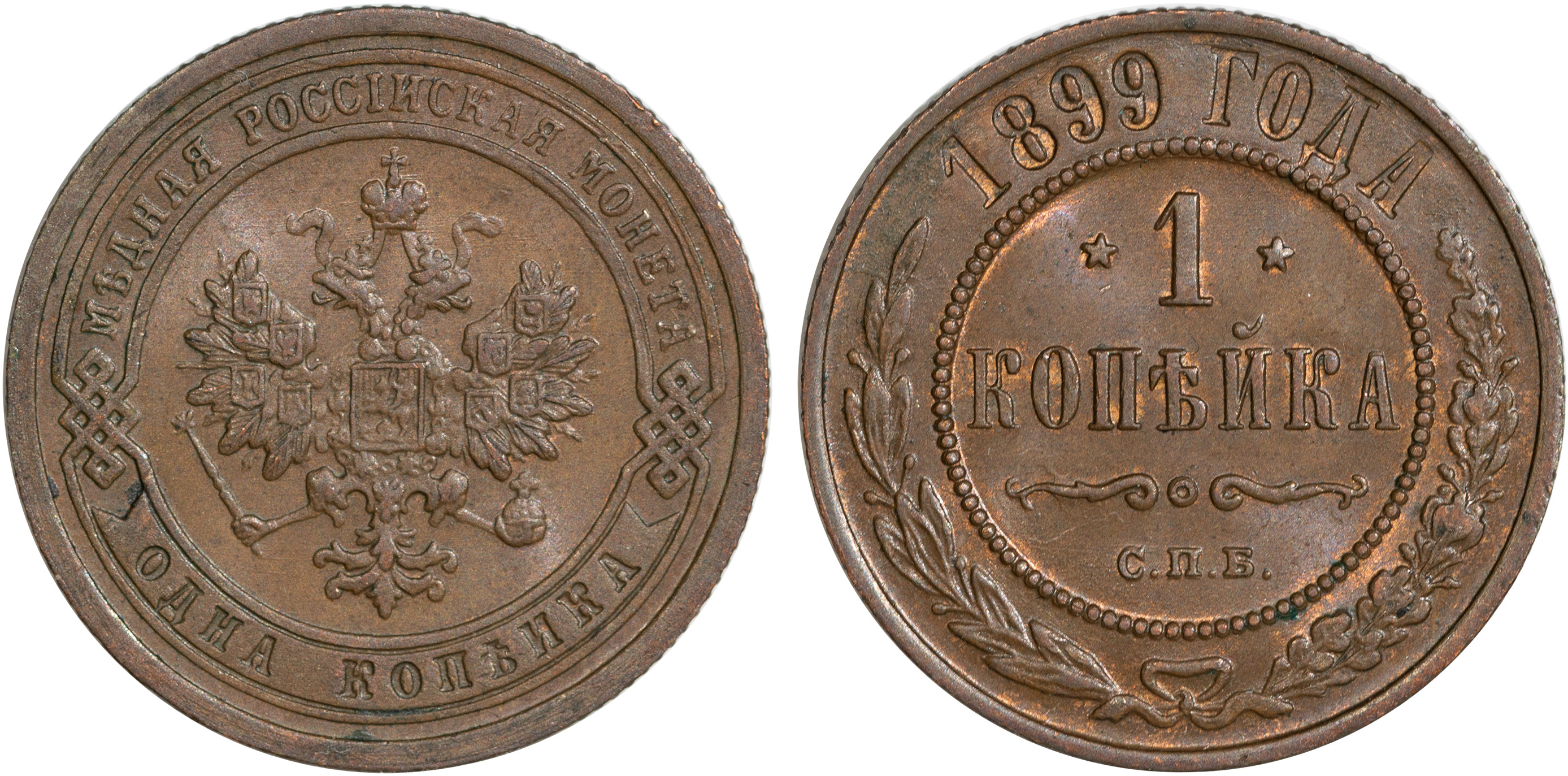
19 June — Emperor Nicholas II approved the Coinage Statute, which completed the monetary reform of Finance Minister Sergei Yulyevich Witte, as a result of which the Russian ruble became fully convertible into gold.
The Coinage Statute consolidated all legal provisions of the 1895–1897 monetary reform, which led to the elimination of the silver ruble as the main monetary unit of the Russian Empire. From 29 August 1897 until 1915, under the decree on the State Bank’s issue operations—which granted it the right to issue banknotes backed by gold—the silver ruble became a physical means of payment tied to the new monetary unit: the gold ruble.
Under the Coinage Statute, the ruble came to contain 17.424 dolyas of pure gold. A regularly minted ten‑ruble coin, for example, contained 1 zolotnik and 74.24 dolyas of gold, i.e., 7.74 g.
Silver and copper coins became subsidiary means of payment; therefore, silver money was mandatory for acceptance in payments only up to 25 rubles, and copper small change only up to 3 rubles. The amount of silver coins in circulation was not to exceed 3 rubles per capita of the Russian Empire. At the same time, high‑fineness (full‑value) coins were denominations of 1 ruble, 50 kopecks, and 25 kopecks, containing 900 parts pure silver and 100 parts copper. Silver coins of 20, 15, 10, and 5 kopecks contained 500 parts silver and 500 parts copper. All silver coins were produced under so‑called “closed coinage,” unlike gold coins, which enjoyed the right of “free coinage.”
As a result of Count S. Y. Witte’s monetary reform, the structure of the country’s money circulation changed, and Russia, for the period up to 1914, obtained a stable currency backed by gold. If in 1895 credit notes accounted for 91.7% of the total money supply, then by January 1914 gold made up 21.2% of the total money supply, silver 5.4%, and credit notes 73.4%.
The 1895–1897 monetary reform strengthened the ruble’s external and internal exchange rate, improved the country’s investment climate, and helped attract domestic and foreign capital into the economy.
With the outbreak of World War I in 1914, the exchange of money for gold was discontinued.
L. N. Tolstoy, who was publishing his novel “Resurrection” in the magazine “Niva,” issued by A. F. Marx, recommended to the publisher during a personal meeting that he publish a collected edition of Chekhov’s works. Through Sergeyenko, Chekhov entered into negotiations with Marx, which ended with the sale of these works into the publisher’s full ownership.
16 January — Sergeyenko sent Chekhov a telegram: “They offer ownership rights for fifty, I’m holding out for 80,000; a third of the money can be now, the rest in installments. Do you authorize me to conduct negotiations and conclude contracts? I hope persistence will pull it up to 10,000. Will you come, send a power of attorney, or a trustee?”
21 January — Sergeyenko telegraphed: “My role is exhausted. I’m in a hurry. The preliminary agreement has been signed. Make the power of attorney for concluding the contract in the name of Sergey Arkadyevich Andreyevsky — Znamenskaya, 35 — he has agreed to be your representative.”
The contract was signed as follows: “St. Petersburg. On the twenty-sixth day of January of the year one thousand eight hundred and ninety-nine. We, the undersigned: hereditary nobleman Adolf Fyodorovich Marx and the authorized representative of Doctor Anton Pavlovich Chekhov, the Slavo-Serb petty townsman Pyotr Alexeyevich Sergeyenko, have concluded this contract as follows:
1. Anton Pavlovich Chekhov sells to Adolf Fyodorovich Marx, into full literary ownership, all his works, both those already printed under his, Chekhov’s, surname or under his numerous pseudonyms up to this time..., as well as those that will be published during the first twenty years after the signing of this contract..., to be transferred into the full literary ownership of Adolf Fyodorovich Marx.
2. For the right of literary ownership of all works... printed up to this... year, Adolf Fyodorovich Marx shall pay... seventy-five thousand rubles on the following dates: upon the transfer to him of the penalty bond referred to in Clause Eight of this contract, twenty thousand rubles; in December of this... year ten thousand rubles; in January of the coming year one thousand nine hundred, twenty thousand rubles; in December of that same... year ten thousand rubles; and in January of the next year one thousand nine hundred and one the remaining fifteen thousand rubles.
3. For the right of literary ownership of future works...: (a) during the first five years from the date of signing this contract... at two hundred and fifty rubles per printed sheet of thirty-five thousand characters; (b) ...up to 26 January 1909 at four hundred and fifty rubles; (c) ...up to 26 January 1914 at six hundred and fifty rubles; and finally (d) ...up to 26 January 1919 at eight hundred and fifty rubles per printed sheet...”
Altogether there are 10 clauses in this contract.
18 February — in a letter, Sergeyenko wrote: “Your phrase in the telegram that you give your word not to live past 80 was taken by Marx at face value and nearly spoiled the deal.”
That summer, Chekhov purchased a small plot near the Udelnaya station outside St. Petersburg, where he built a dacha and lives there permanently with his family.
4 June — the regulation on measures and weights permitted, in all kinds of transactions and contracts, by mutual agreement of the parties, the use of metric measures. A rule was introduced that trade measures and scales must, every three years, be inspected and re-stamped; for this purpose, verifiers and other officials of the financial department were sent to populated localities assigned to the district verification tent.
19 March — in St. Petersburg, on the initiative of the renowned surgeon Nikolai Velyaminov, the first emergency medical station was opened. Each station had one carriage equipped with medicines, instruments, and dressings. When called, a doctor, a feldsher, and an orderly would go out in them. These teams very quickly gained recognition and became in demand.
15 February — Imperial manifesto on the supremacy of the laws of the Russian Empire over Finnish legislation. The beginning of the policy of Russification of Finland.
In Russia they await the end of the world. At Sytin’s printing house a book was published: “There will be no end of the world on either 1 or 13 November 1899.”
Publication of the book “The Development of Capitalism in Russia,” written by Lenin in Siberian exile and containing a critique of populist views.
S. I. Mamontov was accused of spending 750,000 rubles belonging to the Moscow–Yaroslavl–Arkhangelsk Railway Joint-Stock Company and, on 11 September, was placed in debtors’ prison. Mamontov was chairman of the board of this company and builder of the railway.
Construction, begun in 1895, was completed for A. A. Morozov to a design by architect V. A. Mazyrin of an extraordinary house in Moscow: in a pseudo-Moorish style with a lacy attic and balcony grille, a mighty entrance portal, and walls studded with shells.
6 March — a patent was issued for aspirin. The name is composed of two parts: “a” from acetyl and “spir” from Spiraea, the Latin name of meadowsweet—the plant from which salicylic acid was first chemically isolated. By tradition, our ancestors reduced fever and relieved pain with a water infusion of willow or pussy willow bark. In 1763, the clergyman Edward Stone presented a report to the Royal Society of London on curing feverish chills with an infusion of willow bark. And in 1838 it was shown that the active component of willow bark is salicylic acid. Somewhat later, the Italian chemist Raffaele Piria isolated salicylic acid from willow bark, determined the chemical composition of this substance, and successfully synthesized it. It was called salicylic “spiraea” acid. But at that time salicylic acid did not find practical medicinal use. Only 15 years later did the sodium salt of salicylic acid come into use. To obtain other forms of salicylic acid whose therapeutic properties might be even more effective, Bayer employee Felix Hoffmann developed a technology for producing acetylsalicylic acid—aspirin.
8 August — Minnesota inventor Albert Marshall patented a refrigerator.
13 August — American inventor William Gray patented the payphone.
6 April — regular electric tram service began in Moscow.
Ernest Rutherford discovered alpha and beta rays. A year later Paul Villard discovered gamma radiation.
L. N. Tolstoy’s novel “Resurrection.”
20 May — Jacob German became the first driver arrested for speeding. He was driving on Lexington Avenue in New York at a speed above the permitted 12 mph.
13 August — Alfred Hitchcock was born, an Anglo-American film director and maker of many horror films.